ENEnglish
 LTLietuviškai
 DEDeutsch
 FRFrançais
 RUРусский
 ESEspañol
 PLPolski
 ITItaliano
 UKУкраїнська
 CSČeština
 PTPortuguês
 JA日本語
 LVLatviešu valoda
 ETEesti
 HUMagyar
 IDBahasa Indonesia
 TRTürkçe
 HIहिन्दी
 ELΕλληνικά
 ARالعربية
 THไทย
 VITiếng Việt
 RORomână
 MSBahasa Melayu
 BNবাংলা
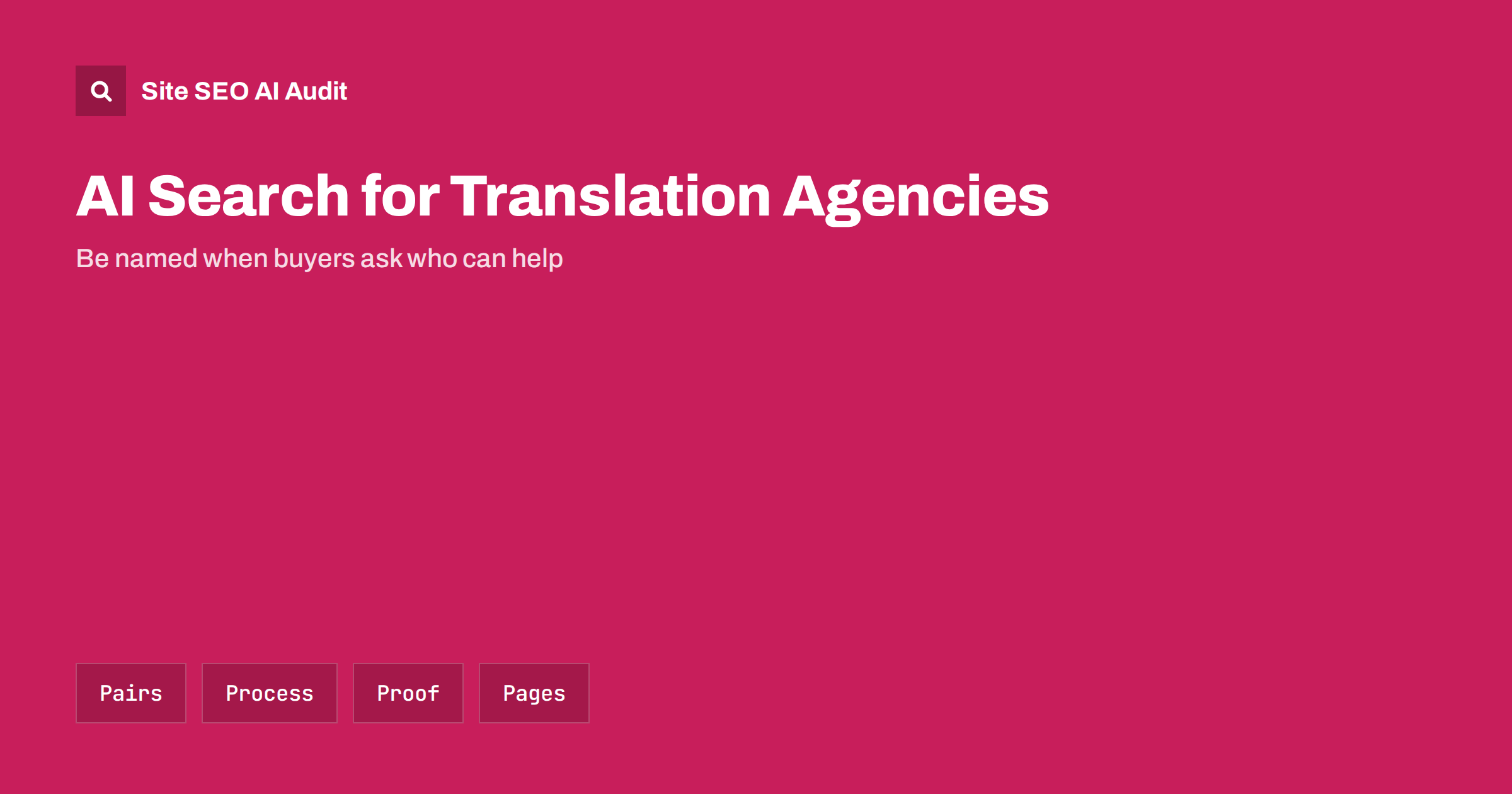
Short answer: Buyers increasingly ask AI assistants which agency can translate a contract, localize an app or handle a website in several languages. To be named, an agency needs pages that state clearly which language pairs, subject fields and services it offers, how quality is checked, who does the work and what turnaround and pricing logic apply. Specific, honest and well-structured pages are easier for AI systems to quote than a general promise of fast, quality translation.
Translation is a trust business. The buyer cannot judge the output in a language they do not read, so they look for signals of competence. AI assistants now sit in front of that search: a procurement manager may ask for an agency that handles medical documents from Finnish to English, and the answer will list a few names with reasons. Agencies that explain their work in precise terms are easier to include. This guide shows what to publish and how to structure it, building on the guide to generative engine optimization.
How buyers ask
Questions to an assistant are longer and more specific than keywords. Typical examples are which agency translates legal documents between German and Spanish, who can localize a mobile app into several Asian languages, how much a certified translation costs, how long a website translation takes and what the difference is between translation, localization and transcreation. Each question mentions a language pair, a subject, a service or a decision criterion. Your pages should contain direct answers to such questions in the same terms.
Agencies often hide behind generic copy: global reach, certified quality, hundreds of languages. Such phrases give an assistant nothing to quote. A sentence such as we translate technical documents for manufacturing companies from English into Polish, Czech and Lithuanian, reviewed by a second linguist, gives it something concrete.
Describe services precisely
Create a separate page for each core service, with a clear name and a consistent description. Useful categories include document translation, certified or sworn translation, website and software localization, subtitling and video, interpreting, transcription, desktop publishing and multilingual SEO. Explain on each page what is included, what the client must supply, which file formats you accept and what the typical process is from request to delivery.
Avoid putting everything on one long page. Separate pages let a search engine and an AI system match a specific question to a specific answer. Link them together so that the relationships are clear, and keep the wording the same everywhere, for instance by always writing certified translation, not alternating with several other names. Entity clarity matters, as explained in the guide to entity SEO.
Publish language pairs and fields
A list of eighty languages in a footer is not useful. A better design is a hub page that lists the languages you actually cover, with a short page for each important pair describing the specialists, the types of text and any local requirements. Mention direction, since translating into a language is a different skill from translating out of it, and many agencies use native speakers of the target language.
Do the same for subject fields: legal, medical, technical, financial, marketing, software and so on. Say who handles each field and what qualifies them, without inventing credentials. If you work with freelancers, say so plainly, and describe how you select and review them. The multilingual side of this topic is covered in the guide to multilingual keyword research.
Explain quality control
Quality is the buyer’s main worry and the agency’s main selling point, so explain it. Describe the steps in your process: translation by a qualified linguist, a review by a second person, checks for terminology and numbers, a final format check and a way to handle client feedback. If you use translation memory, glossaries or machine translation as part of the workflow, state it openly and explain how a human reviews the result. Honest descriptions are more convincing than promises of perfection, and assistants favour specific statements that can be compared.
Add facts that can be verified: membership in professional associations if true, standards you are certified under if true, the number of years in business and the size of the team. Do not claim recognition you do not hold. For certified or sworn work, explain which authorities accept your documents, since this differs by country. Our guide to machine translation and SEO explains how automated translation affects search, which is also relevant to how you describe your own process.
Show proof without exposing clients
Agencies are often bound by confidentiality, so naming clients can be impossible. You can still offer proof: anonymised case descriptions that explain the problem, the languages, the volume and the approach, short testimonials with the client’s permission, sample before-and-after passages on a neutral text and clear statements about turnaround. Reviews on independent platforms help too, and consistent details across those profiles and your own site build trust, which is the subject of the guide to reviews and reputation.
Publish the people behind the work. A page with the project managers and senior linguists, with their languages and fields, makes the agency real. Short author bylines on blog posts connect expertise to topics, a point explored in the guide to author pages and bylines.
Pricing and turnaround
People ask about price and time more than almost anything else. Many agencies avoid publishing figures because each job differs, but you can still explain the logic: pricing per word or per page, minimum charges, extra cost for urgent work, certification fees, how repeated text is treated and what affects the quote. Give typical turnaround ranges for common volumes, labelled as examples. A page that explains how a quote is made is more useful than a page that says contact us. If you do publish prices, keep them current and consistent in every language version of the page.
Structure pages for answers
Use clear headings that match questions, short opening answers and lists for steps. Add a FAQ to service pages, with answers that are accurate and complete in themselves. Mark up the organisation, the services and the FAQ with structured data that matches visible content. Make sure that your own website is multilingual correctly: with proper language versions, hreflang and translated metadata, because an agency whose own site is badly localized loses credibility. The technical side is covered in the hreflang guide.
Check also that AI crawlers can read your pages. If you block them in robots.txt by mistake, or hide key text behind scripts, assistants will not see it. The decision on access is discussed in the guide to AI crawlers and robots.txt.
Think about the questions that appear before a buyer ever contacts an agency. How do I prepare a document for translation? Should I supply a glossary? What is a translation memory and does it lower my cost? Should the website be translated by machine first? Articles that answer these questions attract the right readers and show how you think. They also create content that assistants can cite when explaining the topic, with your name attached.
Here is a short example. A small agency specialises in medical device documentation for Baltic and Nordic manufacturers. Its old site had one page with a long list of languages and a promise of fast service. After a rewrite, it published a page per service, a language hub that listed seventeen pairs it really handles, a description of its two-step review, an example of how a quote is built and a guide to translating instructions for use. Assistant answers about translating device manuals into Baltic languages now mention it, because the pages state exactly what it does and for whom.
Measure the effort honestly. Ask assistants the questions your buyers ask, in several languages, and record which agencies are named and why. Repeat monthly and note changes. Look at your server logs and analytics for visits from assistants, and at enquiries that mention that a recommendation came from one. Measuring is covered in the guide to measuring brand visibility in AI answers.
One more point concerns languages on your own site. A translation agency is judged by its own multilingual presence. If the English page describes a service and the German page is a rough machine translation with missing sections, buyers and assistants both notice the contradiction. Keep every language version complete, review each by a native speaker and keep the facts, such as services and contact details, identical across versions. Name the team members consistently, use the same company name everywhere and keep profiles on business directories and professional networks aligned with your site. Small consistent details help systems decide that the pages describe one real company, which makes a recommendation more likely and more accurate.
Site SEO AI Audit checks the pages of a website for crawl, on-page, link, speed, structured data, language and AI visibility issues, including hreflang return links and AI crawlers in robots.txt, which matters for a multilingual agency site. It does not judge translation quality or write your service pages. The first audit of up to 200 pages is free, and the pricing page lists plans for larger sites.
Related reading
- AI Search for Agencies, Consultants and Freelancers
- Translation vs Localization for SEO
- AI Search for Professional Services
The bottom line
Agencies are named by AI assistants when their pages state language pairs, fields, services, quality steps, pricing logic and proof clearly, and when their own multilingual site is technically sound.
SSS
Should I list every language I offer?
List the languages and pairs you truly cover, and give the important ones their own pages with fields and specialists.
Can I mention that machine translation is part of my workflow?
Yes, if it is true. Explain how a human reviews the output, since buyers value openness.
What if my clients are confidential?
Use anonymised case descriptions, permitted testimonials, independent reviews and clear descriptions of your process.
Do I need to publish prices?
Not necessarily, but explain how quotes are built, what affects cost and typical turnaround, labelled as examples.
How do I check whether assistants mention my agency?
Ask the questions your buyers ask, in several languages, record the names mentioned and repeat monthly.