ENEnglish
 LTLietuviškai
 DEDeutsch
 FRFrançais
 RUРусский
 ESEspañol
 PLPolski
 ITItaliano
 UKУкраїнська
 CSČeština
 PTPortuguês
 JA日本語
 LVLatviešu valoda
 ETEesti
 HUMagyar
 IDBahasa Indonesia
 TRTürkçe
 HIहिन्दी
 ELΕλληνικά
 ARالعربية
 THไทย
 VITiếng Việt
 RORomână
 MSBahasa Melayu
 BNবাংলা
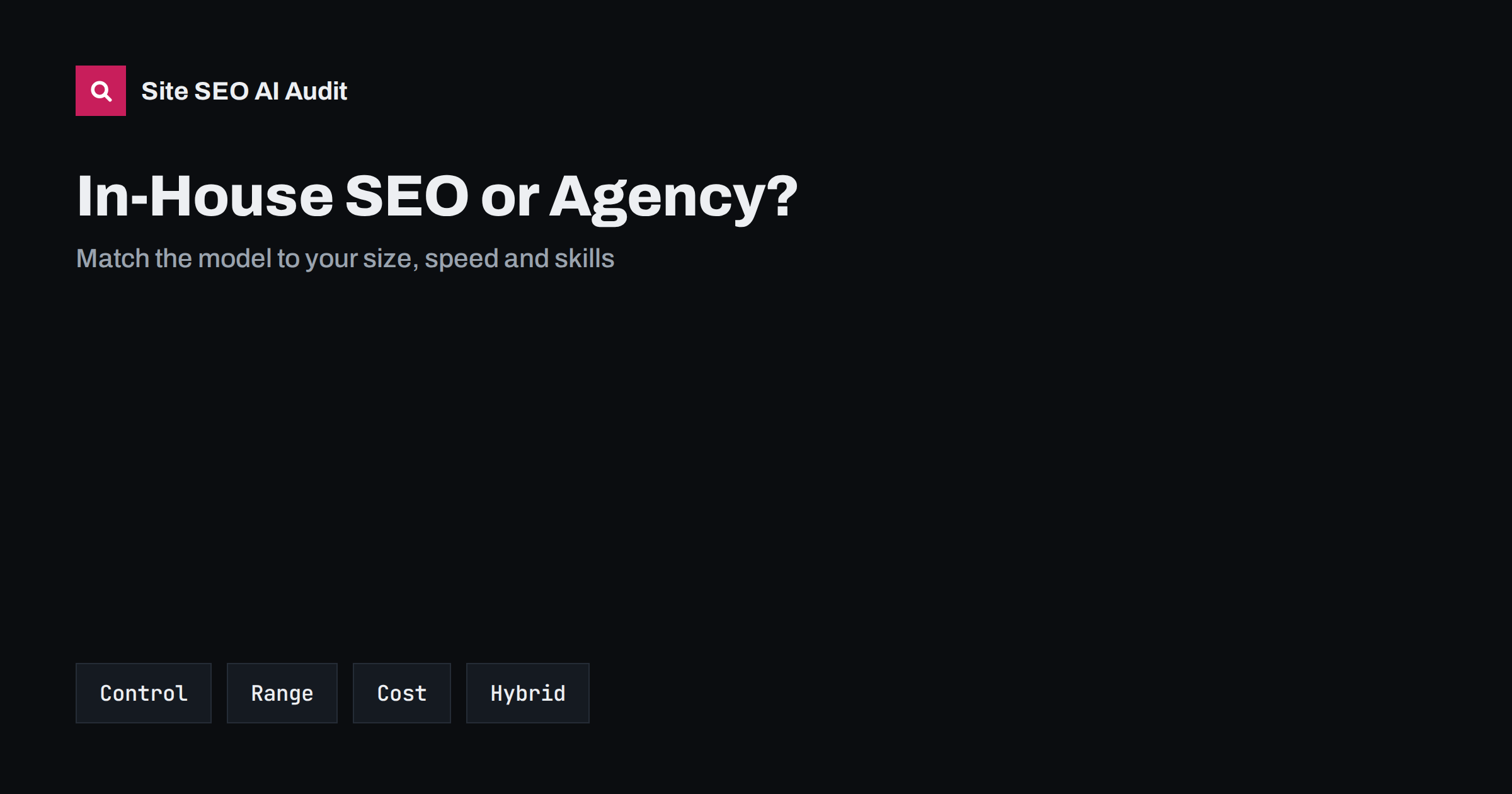
Short answer: Hire in-house when SEO is central to your revenue, your site changes constantly and you can employ someone who works closely with developers and writers. Choose an agency or freelancer when you need a wide range of skills for a limited budget, a project such as an audit or migration, or an independent view. Many businesses combine the two: an internal owner who knows the business and external specialists for technical work or links.
Small and mid-sized businesses often ask this question when SEO becomes too big to handle on the side. There is no universal answer, because the right model depends on how much of your growth comes from organic search, how fast your site changes, who can implement fixes and how much you can spend. This article lays out the strengths and weaknesses of each model, the costs to expect, the questions to ask and a way to decide that does not depend on a sales pitch. If you are still choosing a provider, the red flags in the guide to choosing an SEO provider are worth reading too.
What SEO work actually includes
Before comparing models, list the work you need over the next year. Most plans combine a few recurring tasks with a few projects, and the mix points to the right model.
SEO is not one skill. It covers technical work such as crawling, indexing, speed and structured data, content planning and editing, keyword and intent research, internal linking, links and digital PR, local presence, analytics and reporting. Increasingly it also includes visibility in AI answers. Very few individuals are strong in all of them.
That matters for the decision. An in-house hire is one person, with one set of strengths. An agency can staff a project with a technical specialist, an editor and an analyst. On the other hand, the in-house person lives with your product every day, and that knowledge is hard to buy.
The case for in-house
Companies that treat search as a core channel, such as publishers, marketplaces, software firms and larger shops, usually end up here sooner or later, because the volume of small decisions is too high to outsource comfortably.
An internal SEO knows your products, customers and politics. They can sit in planning meetings, spot a risky release before it ships, talk to developers daily and keep the work going between campaigns. They are accountable to one business, and the knowledge stays when projects end. For companies where organic search drives a large share of revenue, or where the site changes often, this closeness is hard to replace.
The weaknesses are cost, range and risk. A salaried specialist costs more than the salary: add taxes, equipment, training, tools and management time. One person cannot do everything, and may lack a peer to challenge them. If they leave, the knowledge may leave too, unless it is documented. They may also lack the authority to get changes made, which is the most common reason in-house SEO stalls.
The case for an agency or freelancer
Smaller businesses, local companies and teams without developers often get better value from a trusted freelancer than from a full-time hire who would have too little to do.
An external provider offers speed and breadth. You can start in weeks rather than months, call on specialists for the exact problem and stop when the project ends. Providers see many sites, so they recognise patterns, and they bring tools you might not want to license for yourself. For one-off work such as a site migration, a technical audit or a recovery from a drop, a specialist is often the most efficient choice.
The weaknesses are distance, divided attention and variable quality. An agency serves many clients and may assign junior staff to your account. Reports can look impressive without producing changes. Without a person inside your business who owns the work, recommendations end up in a folder. A provider can also make guesses about your brand that someone who works there would not make.
A comparison at a glance
| Question | In-house | Agency or freelancer |
|---|---|---|
| Cost pattern | Fixed salary plus overheads | Retainer or project fee |
| Business knowledge | Deep and continuous | Grows over time, depends on briefing |
| Range of skills | One person’s strengths | Several specialists |
| Speed to start | Slower: hiring takes months | Faster: weeks |
| Access to developers | Daily contact | Through your team |
| Flexibility | Harder to scale down | Easy to pause or end |
No row decides the question alone. Weigh them against your situation, not in the abstract.
The hybrid model
For many growing companies, this is the practical middle path, because it avoids both a heavy fixed cost and the loss of control that comes with handing everything to outsiders.
A hybrid combines an internal owner with outside help. The owner sets priorities, writes briefs, coordinates developers and editors, and checks quality. External specialists handle things that need depth or extra capacity, such as technical audits, large content projects, link outreach or international work.
This works well because it fixes the weakness of each side. The agency gets the context it lacks, and the in-house person gets the range they cannot have alone. The key is that responsibility stays clear: the internal owner is accountable for results, and the external team is accountable for deliverables. Without that, work drifts.
What it costs
Money is only part of the price. Time spent briefing, reviewing and approving work is a cost too, and it falls on your team in every model. An agency that needs ten hours of your staff time each month for approvals has a real price beyond its invoice, just as a new employee needs weeks of onboarding before they are productive.
Costs vary widely by country and experience, so use these as questions rather than figures. For an employee, add all overheads to the salary and include tool licences. For an agency, ask what the retainer includes, how many hours are committed, who does the work and what is billed separately. For a freelancer, ask about availability and how they handle holidays and sickness.
Compare cost with the value of organic traffic, a calculation described in the guide to the ROI of organic traffic. If organic search brings only a small share of revenue, a large team is hard to justify. If it brings most of it, underinvesting is the bigger risk.
Warning signs in each model
In-house arrangements fail when the specialist has responsibility but no authority. Signs include tickets that wait for months, a developer team that treats SEO as optional, reports nobody reads and a hire who spends the day on tasks unrelated to search. If you see these, the problem is organisational, and replacing the person will not help.
Agency arrangements fail when activity replaces results. Signs include monthly reports full of rankings for easy terms, vague promises of guaranteed positions, no named person responsible, work that cannot be explained in plain words and reluctance to share access to accounts. Be cautious of anyone who promises first place, because nobody controls the results pages. Ask to see examples of implemented changes, not only charts.
In both models, watch for the quiet failure: nothing visibly wrong, yet nothing changes. Put a review on the calendar every quarter and ask a simple question, what did we change on the site, and what happened as a result?
How to decide
Ask five questions. How much revenue depends on organic search? How often does your site change? Who can implement fixes, and how quickly? Which skills are missing today? What can you afford for twelve months, including your own management time? If revenue depends heavily on search and the site changes weekly, lean in-house or hybrid. If you need a defined project, lean external. If you cannot implement changes at all, no model will work until that is solved.
Pilot before committing. Start with a three-month project or a freelancer, define clear outcomes and see whether the work produces implemented changes. Use the pilot to learn what you really need.
Whichever you choose, set up the basics
Many problems blamed on the model are really problems of setup, and a few agreed rules prevent most of them.
Write down goals, owners and a way to measure progress. Give the person responsible access to analytics, Search Console and the content system, and make sure developers know SEO tickets are real work. Keep a changelog so results can be explained, as in the article on SEO changelogs.
An independent audit also helps whichever model you use. A report from Site SEO AI Audit gives your team or your provider a ranked fix list, and the first audit of up to 200 pages is free.
Related reading
The bottom line
Choose the model by how central organic search is, how fast your site changes and who can implement fixes, and pilot before you commit.
FAQ
Is an in-house SEO cheaper than an agency?
Not always. Add taxes, tools, training and management time to the salary, and compare with the scope of work you actually need.
Can a small business manage SEO itself?
Yes, for basics such as titles, content, local details and a site audit. Bring in specialists for technical projects.
How long should I give an agency before judging results?
Judge implemented work after the first months and traffic after longer, since SEO takes time. Ask for a plan with milestones.
What is a hybrid model?
An internal owner sets priorities and quality, while external specialists provide capacity or skills for specific tasks.
What should I own if I use an agency?
Your accounts, analytics, Search Console, content and documentation. Never let a provider hold them exclusively.