ENEnglish
 LTLietuviškai
 DEDeutsch
 FRFrançais
 RUРусский
 ESEspañol
 PLPolski
 ITItaliano
 UKУкраїнська
 CSČeština
 PTPortuguês
 JA日本語
JA日本語 LVLatviešu valoda
 ETEesti
 HUMagyar
 IDBahasa Indonesia
 TRTürkçe
 HIहिन्दी
 ELΕλληνικά
 ARالعربية
 THไทย
THไทย VITiếng Việt
 RORomână
 MSBahasa Melayu
 BNবাংলা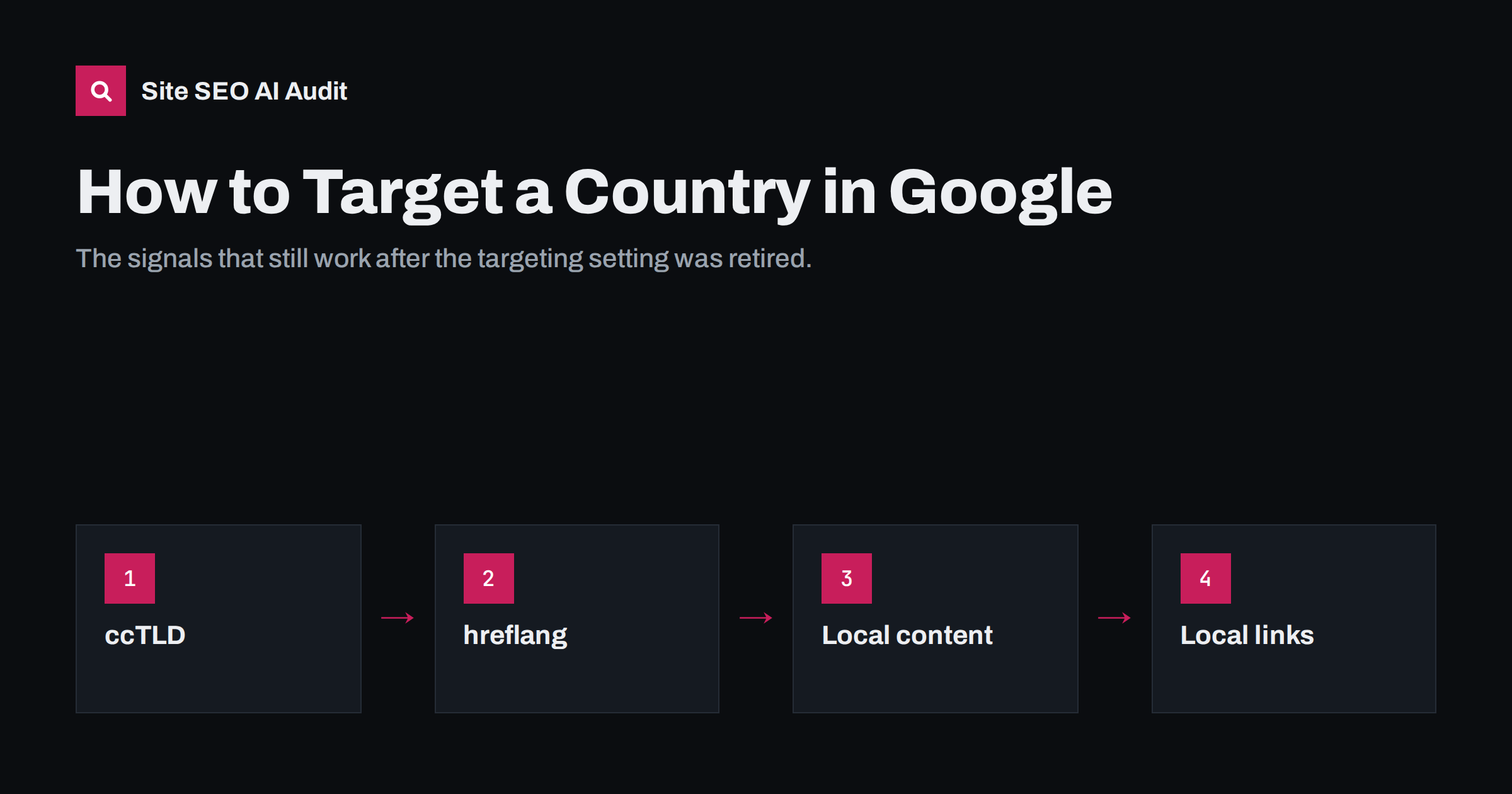
Short answer: Google no longer offers a manual country targeting setting in Search Console; it retired the International Targeting report in 2022. Today, you target a country through the signals Google reads from your site: a country-code domain if you use one, hreflang with a country code such as de-at or en-gb, content written for that country with local currency, addresses and terms, and links and mentions from sites in that country. No single signal guarantees rankings, but together they make your intended market clear.
What changed with country targeting
For many years, Search Console let site owners with a generic domain, such as a .com, choose a target country for the whole property or for a subfolder added as a separate property. This setting was part of the International Targeting report, which also listed hreflang errors.
Google deprecated that report and its country setting in 2022. Google said at the time that the setting had limited impact and that it relies on other signals to understand which country a site is relevant for. Site owners who had relied on the setting for a /de/ or /fr/ folder lost that explicit lever, and hreflang error reporting in Search Console disappeared with it.
In practice, this means country targeting now depends entirely on what your site says about itself, in its URLs, markup and content, and on what other sites say about it. Google’s guide to managing multi-regional and multilingual sites summarises the signals it considers.
Signal 1: country-code top-level domains
A ccTLD such as .de, .fr, .co.uk or .lt is a strong indication that a site is meant for one country. Google uses it as a geotargeting signal automatically; there is nothing to configure.
- Strength: the clearest signal available, and one that users recognise and often trust.
- Limitation: one domain per country means separate authority, separate maintenance and often separate sites.
- Caveat: some country codes, such as .io, .co, .me and .tv, are treated by Google as generic, because they are widely used without any link to their country. They do not signal a target country.
If you already run country domains, keep using them. If you do not, a ccTLD is not required to rank in a country; generic domains with good local signals do well in many markets.
Signal 2: hreflang with country codes
hreflang is the main technical signal for sites with a generic domain. A code such as de-at tells Google that a page is for German speakers in Austria; en-gb marks a page for English speakers in the United Kingdom.
Keep three points in mind:
- hreflang needs alternates. It describes a set of versions. A single page with a country code and no alternates says little.
- It must be correct to count. Return links, valid codes, 200-status targets and matching canonicals are all required. Broken hreflang is common and silently ignored.
- It chooses between your pages; it does not create rankings. hreflang helps Google show the right version of your page in a country where your site already has visibility.
Signal 3: local content and details
Google looks at the content itself to understand who a page is for. Local details are among the most natural and reliable signals:
- Language and vocabulary of the target market, including local spelling.
- Currency and prices in the local currency, with local tax display.
- Addresses and phone numbers in the country, in local format with the country calling code.
- Shipping, returns and legal terms that apply specifically to that country.
- Local references: regulations, holidays, standards, cities and regions.
- Структуровані дані that reflects the same details, such as the offer’s price currency and the organisation’s address.
These signals help people as much as search engines. A visitor from Austria who sees prices in euros, an Austrian support number and delivery times to Vienna is much more likely to stay than one who sees a generic international page.
Signal 4: local links, mentions and business presence
Search engines also learn about a site’s country relevance from the rest of the web:
- Links from sites in the target country, such as local media, industry associations, partners and directories.
- Mentions of your brand in local-language content.
- A business profile for physical locations, which matters mostly for local searches in that area.
- Reviews from customers in that country on platforms people there actually use.
These cannot be switched on; they are earned. But they are often what separates a country version that ranks from one that merely exists.
A realistic way to start is to list the organisations you already work with in the target country: distributors, resellers, suppliers, event organisers, customers who might publish a case story of their own, and industry bodies you belong to. Many of them have websites that could reasonably link to your local version, especially if you give them a page in their own language to link to. That kind of link is both legitimate and a clear signal of local relevance.
Signals that matter less than people think
- Server location. Once considered a hint, it is a weak signal at most. Content delivery networks make it largely irrelevant. Speed matters more than where the server sits.
- The lang attribute. Google has said it relies on the visible text to determine language and does not use the lang attribute for that. It still matters for accessibility and other tools.
- Meta geo tags. Tags such as geo.region are not used by Google for country targeting.
- Content-Language meta tag. Google does not rely on it; Bing has said it considers it.
Countries with several languages
Targeting a country becomes more complex when the country has more than one major language. Switzerland (German, French, Italian), Belgium (Dutch, French, German), Canada (English, French), Finland (Finnish, Swedish) and Luxembourg are common examples. Here, “Switzerland” is not one audience but several.
The usual approach is to create a version per language for that country and annotate each with a combined code:
de-chfor German-speaking Swiss visitors,fr-chfor French-speaking Swiss visitors,it-chfor Italian-speaking Swiss visitors.
All three share the same country details, such as prices in Swiss francs, Swiss shipping and Swiss contact numbers, but differ in language. They belong in the same hreflang cluster as your versions for Germany, France and Italy, so a French speaker in Geneva is shown the Swiss French page and a French speaker in Lyon the French one.
Do not try to guess a visitor’s language from their location in these countries. A visitor in Switzerland may read any of the three languages, or English. Let them choose, remember the choice, and rely on hreflang to put the right version in search results. If you do not have the resources for every official language, start with the one that matches most of your existing customers there and add others as demand appears.
A practical plan for a .com site targeting several countries
- Create country folders only where content differs by country, for example /de-de/ and /de-at/, or language folders where it does not, for example /de/.
- Implement hreflang with language and country codes, return links on every page and a sensible x-default.
- Localize each country version: currency, prices, shipping, legal terms, contact details and vocabulary.
- Reflect the same details in structured data, so the machine-readable information matches the page.
- Build local presence: local partners, press, associations and customer reviews.
- Avoid forced redirects by IP, which can hide country versions from crawlers.
- Measure per country in Search Console, filtering by country and folder, to check that each version appears where intended.
How to check that your targeting works
Without the old report, the evidence comes from performance data and crawls. In the Search Console performance report, filter by country and look at which pages get impressions. If Austrian searches mostly show your German-for-Germany pages, your Austrian version is not being chosen, and hreflang, canonicals or differentiation need attention. Crawls show whether the technical signals are in place.
Site SEO AI Audit crawls the whole site the way a search engine does and checks the Languages area on every page, including hreflang return links, x-default, broken language versions and lang attributes, together with canonicals and structured data. Issues are weighted by how many pages they affect. The first audit is free.
Related reading
- ccTLD vs subdomain vs subfolder for international sites
- Same language, different countries: how to target en-US and en-GB
- What is hreflang? A plain-English guide for site owners
The bottom line
There is no longer a switch in Search Console for country targeting. Google works it out from your domain, your hreflang, your content and your presence in the market. Use a ccTLD if you have one, implement hreflang with country codes correctly, localize the details that matter to people in each country, earn local links and mentions, and measure results per country to confirm the right version is showing.
FAQ
Can I still set a target country in Search Console?
No. Google retired the International Targeting report and its country setting in 2022. Country relevance now comes from signals on and around your site.
Do I need a local domain to rank in another country?
No. A local domain is a strong signal, but many sites rank abroad using a generic domain with country folders, hreflang and well-localized content.
Does hosting my site in the target country help?
Only marginally, if at all. Page speed matters more, and a content delivery network can serve pages quickly in every country regardless of server location.
Does hreflang alone make my page rank in a country?
No. hreflang helps Google show the right version of your page to searchers in a country. The page still has to earn its visibility through relevance and quality.
Are geo meta tags useful for Google?
Google does not use meta geo tags such as geo.region for targeting. Focus on hreflang, local content and local links instead.