ENEnglish
 LTLietuviškai
 DEDeutsch
 FRFrançais
 RUРусский
 ESEspañol
 PLPolski
 ITItaliano
 UKУкраїнська
 CSČeština
 PTPortuguês
 JA日本語
JA日本語 LVLatviešu valoda
 ETEesti
 HUMagyar
 IDBahasa Indonesia
 TRTürkçe
 HIहिन्दी
 ELΕλληνικά
 ARالعربية
 THไทย
THไทย VITiếng Việt
 RORomână
 MSBahasa Melayu
 BNবাংলা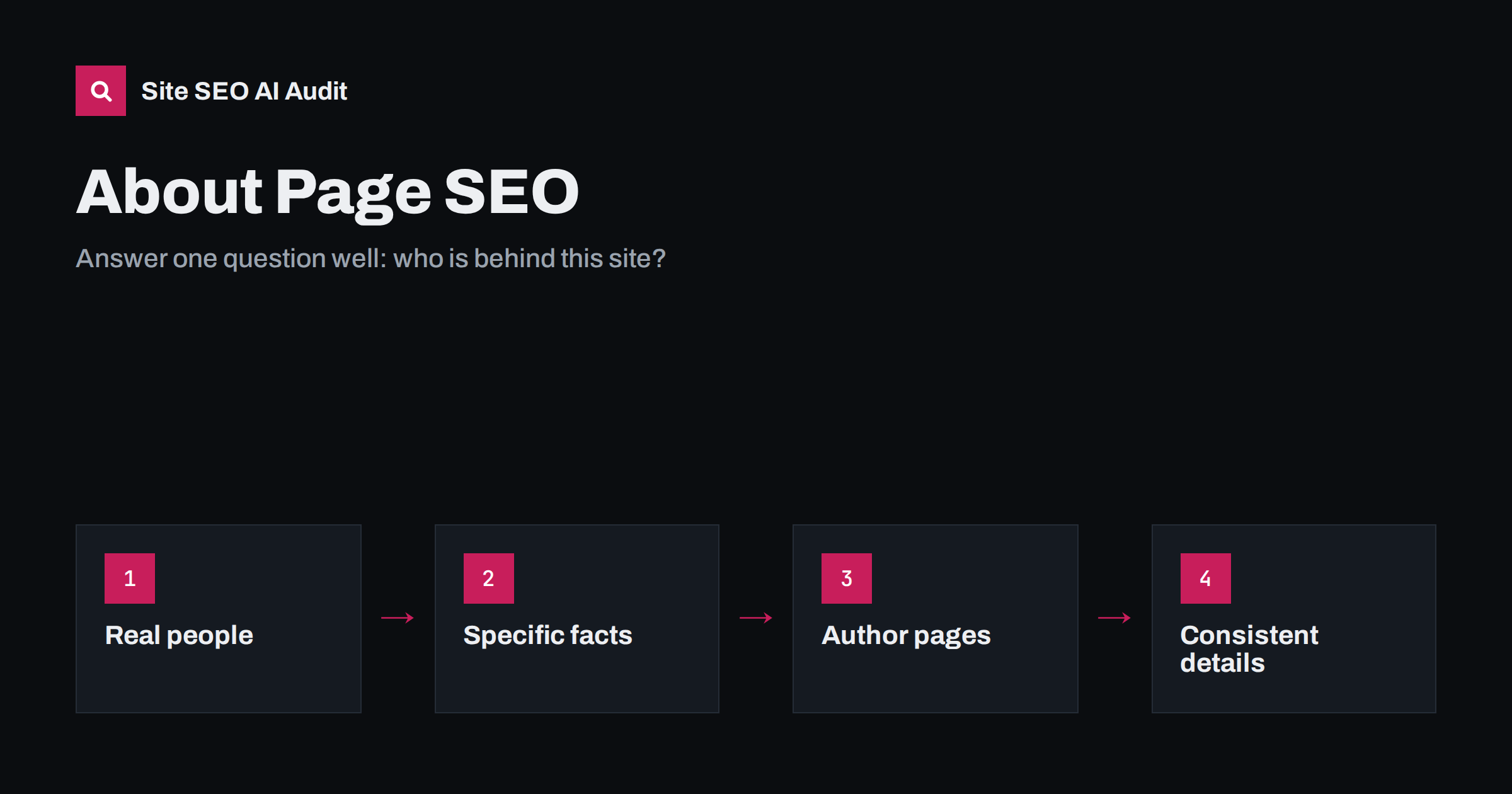
Short answer: An about page helps SEO indirectly by showing visitors and search engines who is behind the site: the real company or person, what they do, their experience, where they are based and how to contact them. It rarely ranks for much beyond your brand name, but it supports trust across the whole site. Write it with specific facts instead of slogans, link it from every page, and keep it consistent with your contact page and business listings.
Why the about page matters
The about page is one of the most visited pages on many small business websites. People go there when they are deciding whether to trust you: before buying, before booking, before handing over personal details, or after reading an article and wondering who wrote it. A vague or missing about page leaves that question unanswered at the moment it matters most.
For search, the about page is not usually a traffic page. It may rank for your brand name, “brand + about” or “brand + founder”, and that is about it. Its value is in what it says about the rest of the site. Search engines try to reward content from sources that are transparent and credible, and their guidelines for evaluating quality ask who is responsible for a website and whether that is clear. The about page is the natural place to make it clear.
AI assistants and answer engines add another reason. When they describe a business or decide whether to cite a site, they rely on what the web says about it, and a clear, factual about page is one of the most direct sources. A page that states plainly what the business is, where it operates and what it offers gives them accurate material to work with.
What a strong about page includes
- Who you are. The legal or trading name of the business, and the people behind it. Real names and, where appropriate, photos.
- What you do and for whom. One or two plain sentences, the same message as your home page but with more room.
- Your experience. How long you have been doing this, relevant qualifications, certifications and memberships, and the kind of work you have done.
- Where you are. Your location and the areas or markets you serve.
- How you work. Your approach, standards or process, described concretely.
- Proof. Examples of work, genuine reviews, notable clients with permission, awards you actually received.
- How to contact you. A link to the contact page, or contact details directly.
- Company details where relevant: registration number, VAT number, registered address. For many businesses these are legally required somewhere on the site anyway.
Specific facts beat slogans
About pages are prone to empty language: “passionate team”, “innovative solutions”, “customer-centric approach”, “we go the extra mile”. Every competitor says the same. Replace each claim with a fact that proves it:
| Vague | Specific |
|---|---|
| “Experienced team” | “Our three engineers have each worked on heating systems for over ten years and are Gas Safe registered.” |
| “Trusted by many clients” | “We have built and maintained websites for local businesses in Vilnius since 2012.” |
| “Passionate about quality” | “Every bag is cut and stitched by hand in our workshop in Kaunas, and we repair anything we sell.” |
| “Innovative approach” | “We test every recipe three times in a home kitchen before publishing it.” |
Only state what is true and what you can stand behind. An about page that overstates is worse than a modest one, because visitors and journalists check.
A simple outline you can follow
If you are starting from a blank page, this structure works for most small businesses:
- Opening: one or two sentences on who you are, what you do, for whom and where. “Brandname is a family-run bakery supply shop in Vilnius. Since 2014 we have sold flour, starters and baking equipment to home bakers across Lithuania.”
- The story, briefly: why the business exists and how it started, in a paragraph, not a chapter.
- The people: names, roles, photos and a line on each person’s relevant experience.
- How you work: what customers can expect, stated as facts: delivery times, quality checks, guarantees, how you choose suppliers.
- Proof: a few genuine reviews, examples of work or facts that support what you have said.
- Company details: legal name, registration details and address, as required in your country.
- Next step: a link to your main products or services and to the contact page.
Most about pages following this outline end up a few hundred words long. That is enough; the aim is clarity and credibility, not length.
Author pages and bylines
If your site publishes articles, advice or reviews, readers also want to know who wrote them. A byline on each article linking to an author page gives that answer. A good author page includes:
- The author’s name and photo.
- Their role and relevant experience or qualifications.
- What they write about.
- Links to their articles, and to professional profiles if they have them.
This matters most for topics where advice can affect people’s money, health, safety or legal position. A tax article written by a named accountant with years of practice is more credible than the same text with no author.
On-page basics for the about page
- Title tag: “About Brandname: Family Dentists in Kaunas Since 2009” says more than “About Us”.
- H1: can be simply “About Brandname” or a short statement about who you are.
- Meta description: a one-sentence summary of who you are and what you do.
- Images: real photos of people, premises or work, with descriptive alt text. Avoid stock photos of strangers presented as your team.
- Internal links: link from the about page to your main services or products and to the contact page; link to the about page from the main navigation or footer on every page.
- Structured data: Organization or LocalBusiness markup, usually on the home or about page, can describe your business name, logo, address and profiles. It must match the visible information.
Consistency across the site and the web
The facts on your about page should match everything else: the contact page, the footer, the legal pages, your business listings on maps and directories, and your social profiles. Common inconsistencies include an old address on the about page, a different company name in the footer, or a founding year that differs between pages. Each one erodes trust a little, and together they make it harder for search engines to connect information about your business.
Whenever something changes, such as a move, a new phone number or a new legal entity, update the about page and contact page first, then work through your listings.
Other trust pages worth having
The about page works together with a few other pages that answer “can I trust this business?”:
- Contact page with real contact options and, for local businesses, the address and opening hours.
- Privacy policy and terms that reflect how you actually operate.
- Delivery, returns and warranty information for stores.
- Editorial policy for publishers: how articles are researched, reviewed and corrected.
- Reviews or case studies that are genuine and verifiable.
Link these from the footer so they are reachable from every page. Keep them current: a returns policy that no longer matches what customer service tells people does more harm than having none.
Common about page mistakes
- No about page at all, or one hidden where nobody finds it.
- Only slogans and no facts.
- No names or faces, making the business feel anonymous.
- Outdated information: former staff, old addresses, services no longer offered.
- Stock photos presented as the team.
- Claims that cannot be backed up.
- No link to contact details.
Some of these, such as missing titles, generic H1s, images without alt text and weak internal linking, show up in a site crawl. Site SEO AI Audit checks those on every page, including the about page, together with schema.org structured data. The first audit is free: start it from the home page.
Related reading
- E-E-A-T and AI Search: Showing Real Expertise on the Page
- Organization Schema: Telling AI Systems Who You Are
- Home Page SEO: What Your Home Page Must Say and Link To
The bottom line
The about page answers “who is behind this site?” for visitors and search engines. Name the real business and people, say what you do and for whom, show experience with specific facts, include location, proof and contact details, and keep it consistent with the rest of your site and listings. Add author pages if you publish advice. It will not bring much traffic on its own, but it supports trust in every other page.
FAQ
Does an about page help SEO?
Indirectly. It rarely ranks for more than brand searches, but it makes clear who is responsible for the site, which supports trust in your content and business. That matters to visitors and to how search engines assess quality.
What should an about page say?
Who you are, what you do and for whom, your experience and qualifications, where you are based, proof such as real examples or reviews, and how to contact you. Use specific facts rather than slogans.
Should I show team members on the about page?
Where appropriate, yes. Real names, roles and photos make a business feel accountable. For sites that publish advice, author pages with qualifications are especially valuable.
Should the about page be in the main menu?
For most small businesses, yes, or at least in the footer on every page. Visitors who are deciding whether to trust you look for it.
Do I need structured data on the about page?
It is optional. Organization or LocalBusiness markup, often placed on the home or about page, can describe your business in a machine-readable form. It must match the visible information.