ENEnglish
 LTLietuviškai
 DEDeutsch
 FRFrançais
 RUРусский
 ESEspañol
 PLPolski
 ITItaliano
 UKУкраїнська
 CSČeština
 PTPortuguês
 JA日本語
 LVLatviešu valoda
 ETEesti
 HUMagyar
 IDBahasa Indonesia
 TRTürkçe
 HIहिन्दी
 ELΕλληνικά
 ARالعربية
 THไทย
 VITiếng Việt
 RORomână
 MSBahasa Melayu
 BNবাংলা
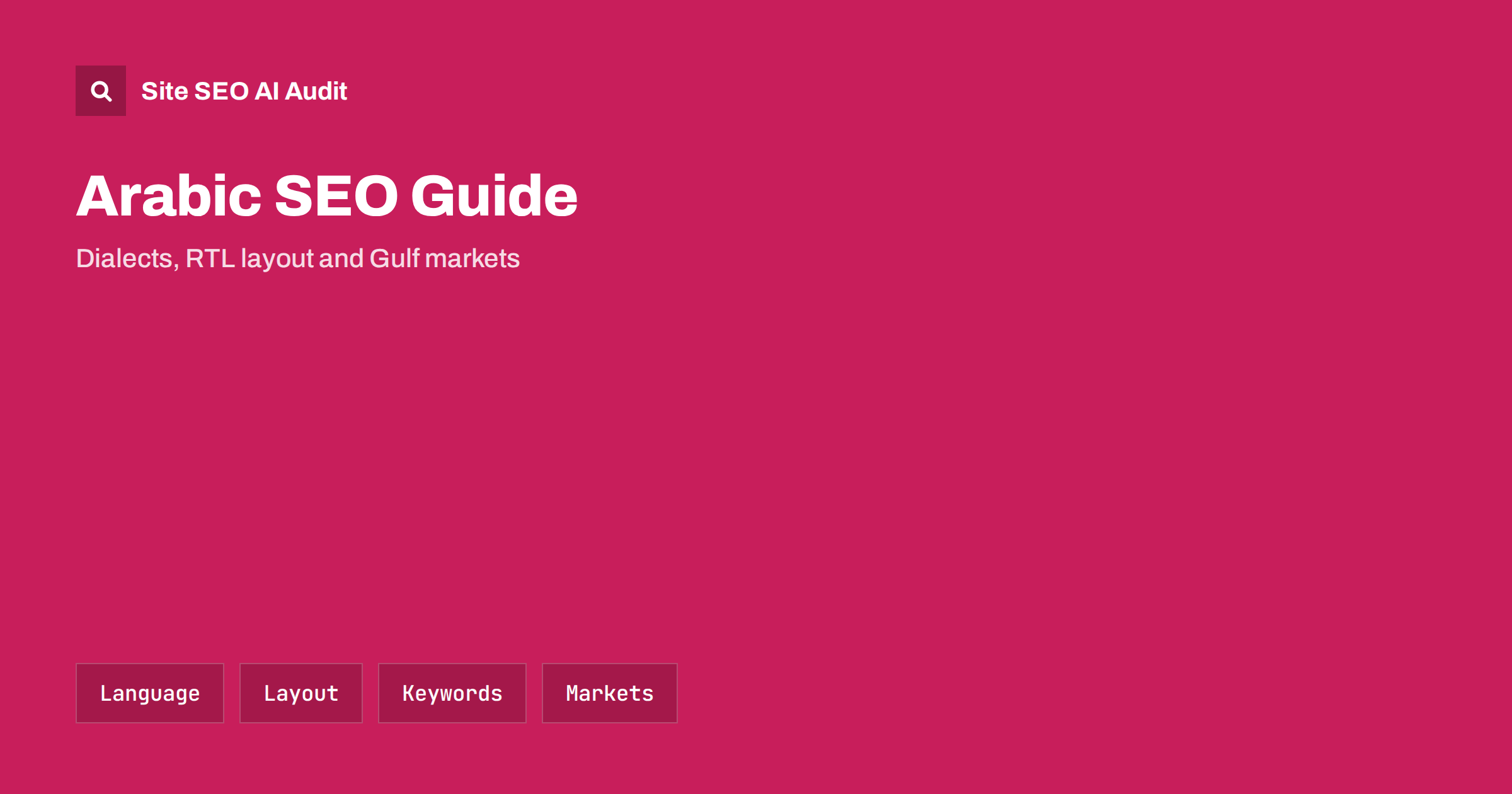
Short answer: Arabic SEO starts with decisions that most languages do not require: which form of Arabic to write, how to lay out right-to-left text, and which countries you serve. Most sites write in Modern Standard Arabic, add proper RTL support, research keywords in Arabic rather than translating them, mark the language with hreflang and html lang values, and adapt details such as currency, address format and tone to each market.
Arabic is an official language in more than twenty countries and is read by hundreds of millions of people, but a website in Arabic is not simply an English site with translated words. The script runs from right to left, spelling can vary, spoken dialects differ widely from the written standard, and users in different countries search in different ways. For international SEO this raises both opportunity and risk. This guide gives a practical path for small and mid-sized sites: what to decide first, how to build the pages and how to measure progress. It does not promise rankings; it explains how to remove the avoidable technical and linguistic mistakes.
Choose the form of Arabic first
Arabic has a formal written standard, usually called Modern Standard Arabic, and many regional spoken varieties, such as Gulf, Egyptian, Levantine and Maghrebi Arabic. News, official documents, education and most professional websites use Modern Standard Arabic, and readers across countries understand it. Spoken dialects appear in social media, advertising and informal brand voices.
For most business sites, Modern Standard Arabic is the safest base, because it works across markets and lets you maintain a single version of each page. If your brand voice is informal and aimed at one country, you can add dialect elements in headlines, social posts or short copy, but test them with local readers first. Search queries often mix both forms, so research real queries before you decide. If you have several target countries, treat country-level differences as localisation work on top of the shared language; the difference between the two is explained in translation vs localization.
Language codes and hreflang
The language code for Arabic is ar. A region can be added, for example ar-SA for Saudi Arabia, ar-AE for the United Arab Emirates or ar-EG for Egypt. Use the plain ar code when one Arabic version serves all countries, and region codes when you have separate versions with different prices, shipping or legal text. Set the html lang attribute to match, and use hreflang annotations with return links between all versions, including the English or other language alternatives. The mechanics are described in the hreflang guide, and the code rules in hreflang language and country codes.
Do not use a region code as a language, and do not target a country by code alone when the page content is identical to another version. Add an x-default only if there is a real fallback page; see hreflang x-default.
Right-to-left layout done properly
Arabic text is read from right to left, and the whole interface should follow it. Set the dir attribute to rtl on the html element for Arabic pages, rather than relying only on text alignment. Navigation, menus, breadcrumbs, form fields, icons that show direction (for example arrows) and image positions usually need to be mirrored. Numbers, Latin brand names and code fragments inside Arabic text are displayed left to right, which can produce confusing ordering if the markup is careless. Test headings, buttons and tables that mix Arabic with Latin characters on real devices.
A broken layout is an SEO problem as well as a design problem. If text overflows, buttons are unreadable or content hides on mobile, visitors leave quickly. Our guide to RTL languages and SEO covers the technical details that apply to Arabic, Hebrew, Persian and Urdu alike. Remember also that fonts must include the Arabic glyphs you need; a fallback font that renders poorly makes text hard to read.
Research keywords in Arabic
Do not translate an English keyword list word by word. Start with how people in the target country describe the product or problem, then confirm it with data from Search Console, keyword tools and the autocomplete suggestions of search engines. Check these points:
- Spelling variants: the same word can be written with or without diacritics, and some letters have common alternative forms. Users often type the simplest form.
- Mixed script queries: many users search for brands and technical terms in Latin letters or in Arabic transliteration.
- Dialect words: a term popular in one country may be unusual in another. Look at the results pages to see which words competitors use.
- Intent: check whether the results are shopping pages, guides or local listings before you create the page.
The workflow in multilingual keyword research describes this process step by step. Titles and headings should include the main phrase in natural Arabic, not a literal copy of the English page. Avoid machine translation without review, because the quality gap between machine and human Arabic can be visible, as described in machine translation and SEO.
Localise for each market
Gulf markets, Egypt and North Africa differ in currency, payment methods, delivery, laws, holidays and even the days of the working week. Show prices in the local currency where you sell, use the correct address and phone formats and mention local shipping and returns. Dates and numbers also deserve attention: some countries use Western digits, others Eastern Arabic digits, and both may appear in the same region. The article on local formats for dates and numbers helps you choose consistently.
Seasonality is different too. Religious and national holidays shape demand and the calendar, so plan content and offers in advance; see local seasonality and market calendars. Do not copy a page for each country with only the flag changed. Duplicate pages with minimal differences compete with each other and add little value. Create separate versions only where the content truly differs.
Site structure for Arabic content
A subfolder such as /ar/ is the simplest structure for most sites: it shares the domain’s authority and is easy to maintain. Country-specific folders, such as /ar-sa/ and /ar-ae/, make sense only when you have real regional differences. A country-code domain gives the strongest local signal but costs more to run, and the trade-offs appear in ccTLD, subdomain or subfolder. Use readable URLs; Arabic characters in slugs work, but they are encoded when copied, so some sites prefer transliterated Latin slugs. Pick one policy and apply it everywhere; see translating URL slugs.
Include Arabic pages in the XML sitemap and link between language versions with a visible language switcher, so that users can move between them without being redirected automatically. Avoid forced redirects by browser language, which can hide versions from crawlers.
Common mistakes in Arabic SEO
- Translating only the visible text. Titles, meta descriptions, image alt text, form labels, error messages and structured data stay in English, which confuses users and search engines about the language of the page.
- Mirroring nothing. The text is right to left but the menu, slider and breadcrumbs still follow the English layout, which makes the page awkward to use.
- Automatic redirects by browser language. Visitors and crawlers cannot reach every version, and users who want another language are trapped.
- Missing return links in hreflang. Annotations are ignored when the other version does not point back.
- One version for every country with local details wrong. Prices in the wrong currency or a phone number without the right country code lose sales quickly.
Fixing these basics usually has more effect than any advanced tactic, and each one can be found with a crawl before it costs you traffic.
Content, trust and search engines
Arabic users still rely on Google in most markets, but regional services, social platforms and marketplaces play a major role, so consider where your audience actually searches. Write original, useful pages, with clear authorship and contact details. Show a local phone number or address where relevant and make policies available in Arabic. Local trust signals matter for conversion, and the guide to local trust signals on country sites lists what to add.
Check the technical basics after launch: indexing, language and country annotations, speed on mobile networks and crawl errors. Site SEO AI Audit crawls your site, checks languages and hreflang among its seven areas, and ranks fixes by impact. The first audit of up to 200 pages is free, and the pricing page shows how to re-check after each release.
Related reading
- RTL Languages and SEO: Arabic, Hebrew, Persian and Urdu
- Hreflang Tags: The Complete Guide
- Multilingual Keyword Research: Find What Each Market Searches
- Translation vs Localization: What SEO Needs
The bottom line
Arabic SEO rewards careful decisions: a base language form that suits your audience, solid right-to-left layout, correct language codes, keyword research in Arabic and real localisation for each market. Start with one well-built version, measure it, and expand to more countries when you can give each one genuinely local content.
FAQ
Should I write in Modern Standard Arabic or a dialect?
Most business sites use Modern Standard Arabic, because readers across countries understand it. Add dialect touches only when you know the audience and have tested them.
Do I need a separate version for each Arabic-speaking country?
Not always. Use one ar version when content, prices and legal text are shared, and add country versions when they truly differ.
Is the dir attribute enough for right-to-left support?
It is the foundation, but you also need to mirror layouts, check mixed Arabic and Latin text and test fonts and icons on real devices.
Can I use machine translation for Arabic pages?
You can use it as a first draft, but a native speaker should review titles, headings and key pages. Unreviewed text often sounds unnatural and can hurt trust.
Should URL slugs be in Arabic script?
Both work. Arabic slugs read well on screen but are encoded when copied, while Latin slugs are simpler to share. Choose one approach and use it consistently.