ENEnglish
 LTLietuviškai
 DEDeutsch
 FRFrançais
 RUРусский
 ESEspañol
 PLPolski
 ITItaliano
 UKУкраїнська
 CSČeština
 PTPortuguês
 JA日本語
 LVLatviešu valoda
 ETEesti
 HUMagyar
 IDBahasa Indonesia
 TRTürkçe
 HIहिन्दी
 ELΕλληνικά
 ARالعربية
 THไทย
 VITiếng Việt
 RORomână
 MSBahasa Melayu
 BNবাংলা
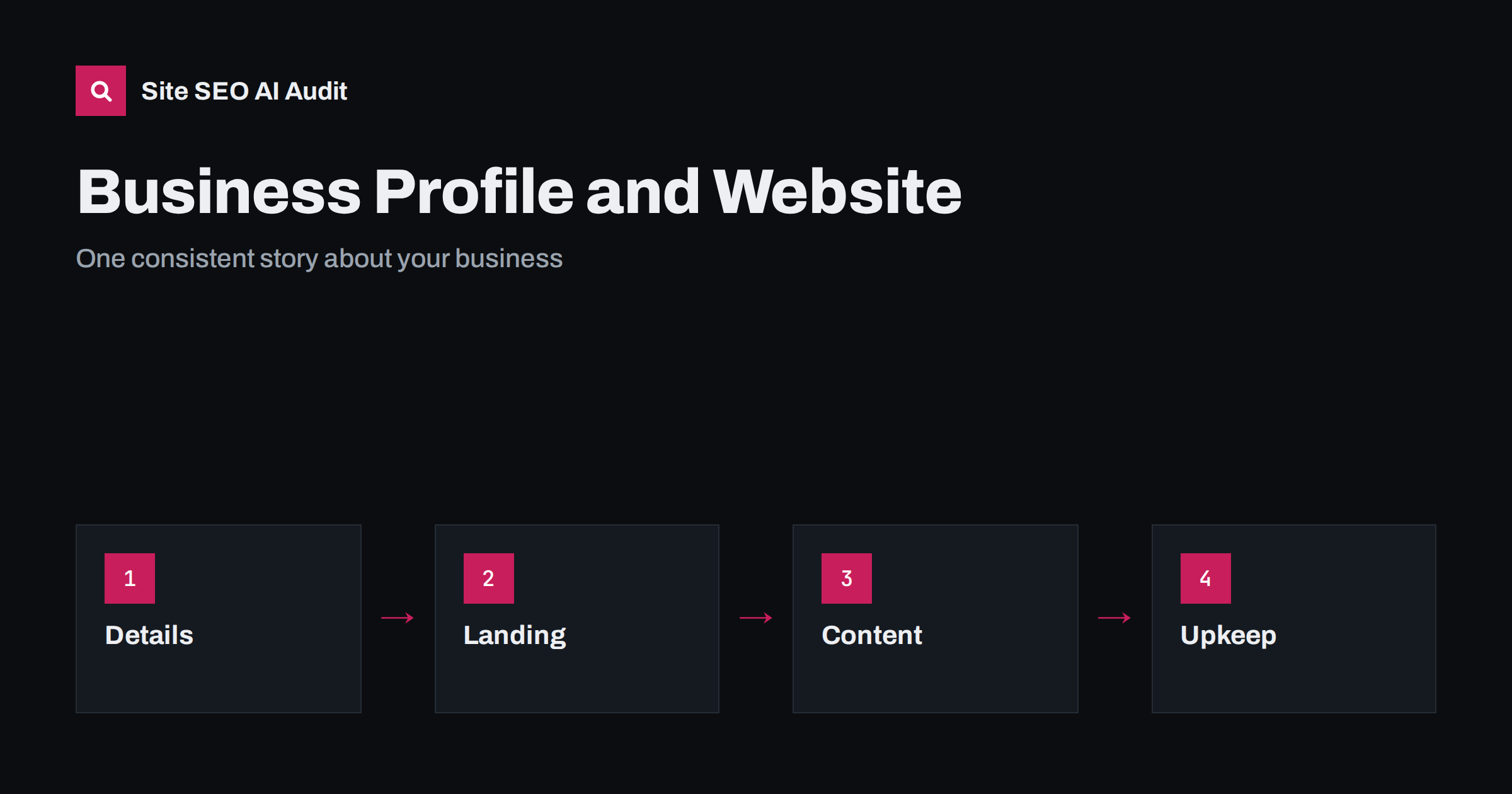
Short answer: Your Google Business Profile and your website should present the same facts: the business name, address, phone number, opening hours, categories, services and links. Point the profile to the most relevant page, usually the home page for a single location or a dedicated location page for each branch, make sure that page repeats the profile details in text, add matching LocalBusiness structured data, and review both places whenever something changes. Conflicting details confuse customers, reduce trust and make it harder for search engines and assistants to decide which information is right.
For a local business, the profile is often the first thing a customer sees: a name, a map pin, a few photos, reviews and a button that leads to the website. The website then has to confirm and extend what the profile promised. When the two disagree, because the hours differ, the phone number changed in one place or the services listed do not appear on the site, people lose confidence and some give up. Search engines and AI assistants also compare sources, and inconsistent facts lower the chance that yours will be shown or quoted. This guide explains how to keep the two in step with a simple routine. For the broader picture of local visibility, see AI search for local businesses.
Match the core business details exactly
Start with the basic facts, often called name, address and phone. Decide on one official form of each and use it everywhere: the profile, the website header and footer, the contact page, structured data, invoices and other directories. The business name should be the one customers know and see on the sign, without added keywords. The address should follow one format, including the unit or floor, and the phone number should use the same digits and country code. If you have a tracking number on one channel, make sure the main number is still easy to find on the site. Small differences, such as an abbreviation of a street name, are usually handled well, but real differences, such as an old address, cause problems that last. The same principle applies on a larger scale in multi-country local SEO.
Keep opening hours and special dates current
Opening hours are among the most frequent causes of complaints. Customers travel to a closed shop because the profile showed old hours, or the website said something different. Put the regular hours on the website in text, not only in an image, and keep them identical to the profile. Plan for holidays, seasonal changes and temporary closures: update the profile first, then place a short notice on the website near the top of the contact page and in the footer if the change is important. Remove notices when they expire. If your hours differ by department or service, such as a showroom and a workshop, list each clearly. Mark hours in structured data only when they match the visible text.
Link to the most useful landing page
The website link in the profile should lead to the page that best serves a person who has just seen the listing. For a single location, that is usually the home page, provided it shows the address, hours, services and a clear way to contact you. For a business with several locations, use a separate page for each branch with its own address, hours, phone number, staff, local details and map, and link each profile to its own page, not to the home page. Avoid sending every profile to one generic page. Avoid thin duplicates that only change the city name, a problem explained in location pages and SEO. If you add tracking parameters to the profile link, choose a simple, stable format and make sure the page sets a canonical address, so that tracked versions are not indexed separately. See URL parameters and duplicate content.
Describe the same services and categories
The profile lets you pick a primary category and add services, products and attributes. Choose the category that describes your main business, and use additional categories only if they are accurate. Then make sure the website supports every claim. If the profile lists ten services, the website should have a page or section for each, with a description, who it is for, how it works and what customers should expect. If the website lists services you no longer offer, remove them from both. Use the language customers use, which you can learn from reviews, questions and the search queries that reach the site. A clear service page structure is described in service page SEO, and the principle of describing one thing per page in the keyword mapping guide.
Add structured data that mirrors the visible facts
LocalBusiness structured data tells machines who you are. Use the most specific type that fits, and include the name, address, telephone number, opening hours, URL, logo, images and links to your official profiles. Add the data to the home page or the relevant location page, and keep it identical to the visible text. Do not include hours, prices or services that are not shown on the page, and do not invent review ratings. After any change in the business, update the markup together with the visible text and test it with a validation tool. More detail is in the LocalBusiness schema guide and organization schema for AI search.
Handle reviews, photos and updates consistently
Reviews and photos on the profile influence customers, and the website can support them. Show a few genuine, recent reviews on the site and link to the profile where customers can read the rest, but do not copy reviews you do not own or mark up ratings that the page does not support. Use the same quality of photos on both: the exterior, entrance, team, interior and products, without stock images that mislead. Use the profile’s posting features for offers and news only if you can maintain them, and make sure each post leads to a page that exists and states the same terms. Respond to reviews politely and use recurring comments to improve the website, such as adding missing parking or accessibility information. The wider topic of reputation is covered in reviews and reputation in AI recommendations.
Make contact and directions easy on the site
Customers who click from the profile expect to find directions, a phone number and a form quickly. Place the address, a click-to-call link, an embedded map or a link to directions, the opening hours and parking or transport information on the contact page, and repeat the main details in the footer. Describe how to find the entrance if it is not obvious, and add accessibility information. Keep the page short and text-based, with the key facts near the top, as recommended in contact page SEO. Add a short note about what to bring or expect, such as appointments, deposits or delivery options, when it prevents wasted trips. Check that the page is fast on a phone, because most local searches happen on mobile devices, and that the buttons are large enough to tap.
Review both places on a schedule
Alignment is a routine, not a one-time project. Once a month, compare the profile with the website: name, address, phone, hours, categories, services, links, photos and posts. Check other directories and map services too, since old data tends to survive there. Assign one person to own the facts and one place to record changes, and update everything when anything changes, such as a move, a new phone number, a new service or a holiday schedule. Ask a few customers or colleagues to search for the business and report what they find. Keep a short checklist, and review it whenever staff change. Repeating the check is cheaper than correcting the confusion later. Note who made each change and when, because a short history makes it easy to find the source of a mismatch. Small businesses can do this with a shared document and a monthly reminder; larger ones may need a formal process that covers every branch, every directory and every person allowed to edit the listings.
Site SEO AI Audit crawls your site, checks the contact page, titles, structured data, status codes, internal links and speed on each page, and lists the fixes ranked by the points they add. The first audit of up to 200 pages is free; larger sites can see the pricing page.
Related reading
- Local Trust Signals for Country Versions
- About Page SEO
- Entity SEO and AI Search
- AI Search for Home Services
The bottom line
A profile and a website that agree are easier to trust and easier for machines to understand. Use one official version of the core details, link each profile to the right page, mirror services and hours in text and structured data, and review everything on a schedule.
FAQ
Which page should my Business Profile link to?
For one location, usually the home page, if it shows the address, hours and services. For several locations, link each profile to its own location page.
What if my hours differ on the profile and the website?
Fix both as soon as you notice, starting with the profile. Make the website text the same, and update structured data so that it still matches.
Do I need structured data if I have a profile?
It is recommended. LocalBusiness markup gives machines a clear, consistent description of your business on your own site, and it supports the details in the profile.
Can I add keywords to my business name on the profile?
No. Use the real name that customers see on your sign and documents. Adding keywords can violate the rules and may lead to suspension.
How often should I review the profile and website?
Monthly is a good routine, and whenever something changes, such as a move, a new phone number, new services or holiday hours.