ENEnglish
 LTLietuviškai
 DEDeutsch
 FRFrançais
 RUРусский
 ESEspañol
 PLPolski
 ITItaliano
 UKУкраїнська
 CSČeština
 PTPortuguês
 JA日本語
JA日本語 LVLatviešu valoda
 ETEesti
 HUMagyar
 IDBahasa Indonesia
 TRTürkçe
 HIहिन्दी
 ELΕλληνικά
 ARالعربية
 THไทย
THไทย VITiếng Việt
 RORomână
 MSBahasa Melayu
 BNবাংলা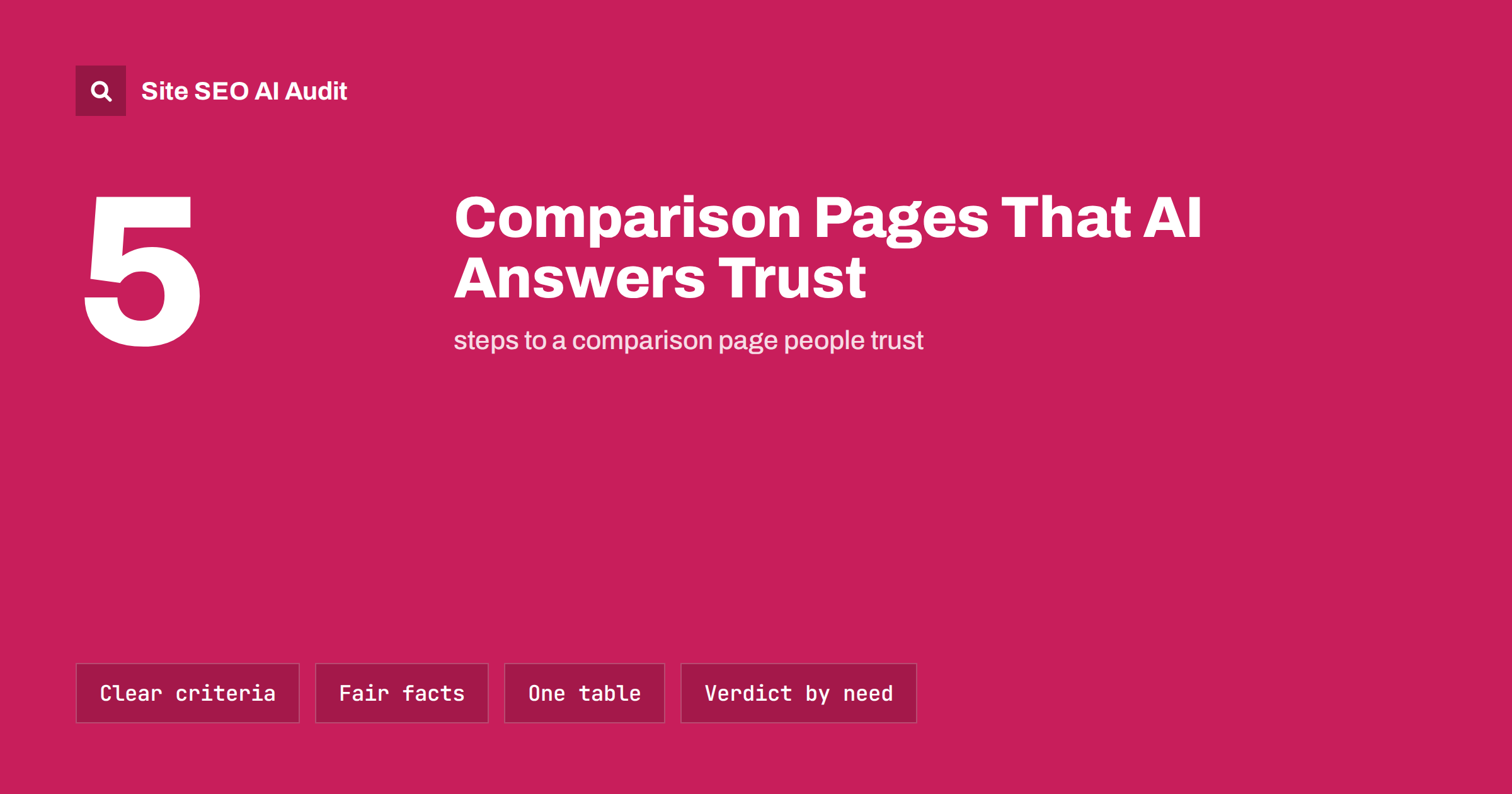
Short answer: A comparison page that AI answers trust compares options on clearly stated criteria, gives accurate and current facts about every option, including competitors’ strengths, presents the key differences in one well-structured table, and ends with a verdict by use case rather than a blanket “we win”. Add dates, sources and disclosure of your own interest. Comparison questions are among the most common in AI assistants, and fair, specific pages are the ones most likely to be quoted.
Why comparison content matters in AI search
People use AI assistants to make decisions. Questions like “Shopify or WooCommerce for a small shop?”, “which accounting software is best for freelancers?” or “heat pump vs gas boiler for an old house” are exactly the kind of multi-factor questions assistants are good at summarising. To answer them, a system needs sources that compare options on specific attributes.
When your business competes in a category, comparison questions are where recommendations are made. If the only comparison content available comes from affiliates or competitors, their framing shapes the answer. A well-made comparison page on your own site puts your facts into the pool, even if it will not be the only source.
The catch is credibility. Pages that obviously exist to declare the author the winner are easy to discount, by readers and by systems trying to give balanced answers.
Types of comparison pages
- Your product vs a competitor (“Example CRM vs Other CRM”). High commercial value, highest credibility risk.
- Alternatives pages (“Alternatives to Other CRM”). Useful when a competitor is well known and people look for options.
- Category comparisons (“Best CRM for small agencies”). Broad; best written with clear selection criteria.
- Method or technology comparisons (“Static site vs WordPress”, “301 vs 302 redirects”). Educational; builds authority without directly selling.
- Plan or model comparisons within your own range. Often overlooked, and very useful for shoppers who have already chosen your brand.
Each type serves a different reader. Someone searching “alternatives to” a known product is usually unhappy with it or checking the market before renewing, so the page should explain what people typically move away from and which alternative suits which reason. Someone reading a method comparison wants to understand trade-offs before choosing an approach, and is often not ready to buy anything yet. Write for the reader’s situation, not only for the keyword.
Start with the comparisons your sales team hears most often. The questions prospects ask on calls, “how are you different from X?”, are the same questions they type into assistants before they ever contact you.
Step 1: define the criteria first
Before writing, decide what matters to the reader and say so on the page. A short section like “How we compared” builds trust immediately. Good criteria are:
- Relevant to real decisions: price structure, key features, ease of use, support, integrations, limits, contract terms.
- Measurable or verifiable where possible, so readers can check them.
- Applied equally to every option, including your own.
- Stated with a date, because products and prices change.
Criteria also give AI systems a structure to work with. A page that clearly compares “pricing model”, “free tier” and “export options” produces passages that map directly onto questions about those attributes.
Limit the criteria to what genuinely separates the options. Eight to twelve rows is usually enough. A table with forty rows, most of them identical across options, hides the differences that matter and makes the page harder to quote.
Step 2: get the facts right, for every option
Accuracy about competitors is where most comparison pages fail. Common problems include outdated prices, features the competitor added long ago described as missing, and vague claims such as “limited functionality”. These errors damage your credibility and can raise legal issues under comparative advertising rules in many countries.
- Check each competitor’s official pages, documentation and pricing when writing and at every review.
- Link to the official sources where appropriate, so readers can verify.
- Describe competitors’ genuine strengths. If they are better for large teams, say so.
- Avoid absolute claims you cannot prove, such as “the fastest” or “the only”.
- Note the date when information was checked, near the table.
If a competitor’s information is hard to verify, for example because pricing is only available on request, say so plainly rather than guessing. “Pricing is not published; quotes are provided after a demo” is a fact readers can use. A guessed number is a liability that can spread into AI answers and stay there long after you correct it.
Step 3: build one clear comparison table
A single table with the same attributes for each option is the heart of a comparison page. It is easy for readers to scan and easy for machines to extract. A simple structure works best:
| Criterion | Option A | Option B | Option C |
|---|---|---|---|
| Best for | Small shops starting out | Growing catalogues | Custom builds |
| Pricing model | Monthly subscription | Free software, paid hosting and add-ons | Project fee plus maintenance |
| Setup effort | Low | Medium | High |
| Flexibility | Medium | High | Very high |
| Main limitation | Transaction fees on some plans | Needs technical upkeep | Higher upfront cost |
Use text in cells, not only ticks and crosses. “Yes, on paid plans” is more useful than a checkmark, and it survives extraction. Keep the table in HTML, not an image.
Step 4: explain the differences that matter
After the table, write a short section for each important difference. Each section should state the difference in its first sentence, explain why it matters and say who it affects. For example: “Option B requires you to manage hosting and updates yourself. That gives more control but means more maintenance, which suits teams with a developer and frustrates owners who want to focus on selling.”
These paragraphs are prime material for AI answers, because they combine a fact with its practical consequence.
Where you have first-hand experience, include it. “We migrated a client from Option B to Option A and the product import took two days because variant data had to be cleaned first” is the kind of detail that no summary site can offer and that makes your page the better source. Only include experiences that really happened, and keep client details anonymous unless you have permission.
Step 5: give a verdict by use case
Readers want a conclusion, but “we are the best” is not a credible one. A verdict by use case is more honest and more useful:
- “Choose Option A if you want to start selling this week without technical help.”
- “Choose Option B if you expect a large catalogue and have someone to maintain the site.”
- “Choose Option C if you have unusual requirements and the budget for custom development.”
If your product is one of the options, it is fine to explain where it fits best. It is also fine, and more convincing, to say where it does not.
Keep the verdict consistent with the table and the text above it. If the table shows that a competitor is cheaper for small teams, the verdict should not quietly recommend your product for small teams on price.
Trust signals and disclosure
Comparison pages need stronger trust signals than most content:
- Disclose your interest clearly near the top: “We make Option A. We have tried to compare fairly.”
- Disclose affiliate relationships if you earn commission from any option.
- Show the author and their relevant experience with the products compared.
- Show the review date and update it only after real checks.
- Invite corrections with a contact link for competitors or readers who spot outdated facts.
Finally, keep comparison pages visible in your site structure. Link to them from relevant product, pricing and category pages, and from related guides. Buried comparison pages are rarely found by crawlers or readers, however good they are.
How Site SEO AI Audit helps
Comparison pages often grow into clusters of similar pages, which creates technical risks: duplicate titles, thin variants, keyword cannibalisation and weak internal linking. Site SEO AI Audit flags these on-page and link issues across the site, checks structured data, and its AI visibility area confirms that AI crawlers can read your pages and that content does not depend on JavaScript. You can run a free audit to check your comparison pages.
Related reading
- How to Write Content That AI Answers Actually Quote
- E-E-A-T and AI Search: Showing Real Expertise on the Page
- Keyword Cannibalization: How to Spot It and Fix It
The bottom line
Comparison questions are where AI assistants help people decide, so fair comparison pages are worth the effort. Define criteria, check facts for every option, present differences in one clear table, explain what each difference means, and give a verdict by use case with honest disclosure. Pages built this way are more useful to readers and more credible as sources.
FAQ
Should I publish comparison pages against competitors?
Yes, if you can keep them accurate and fair. They answer real decision questions. Check local rules on comparative advertising and avoid claims you cannot verify.
How often should comparison pages be updated?
Review them at least every few months and whenever you or a competitor changes pricing or major features. Outdated comparisons damage trust quickly.
Is it acceptable to say my product is the best?
A blanket claim is rarely credible. Explain which needs your product serves best and where another option may suit better. Readers and AI systems find that more trustworthy.
Should comparison tables use ticks and crosses?
Short text is better, such as “Yes, on paid plans” or “Via add-on”. It carries more information and remains meaningful when extracted or quoted.
Do comparison pages need structured data?
There is no specific comparison markup that earns special results. Standard Article markup with author and dates, plus accurate on-page content, is enough.