ENEnglish
 LTLietuviškai
 DEDeutsch
 FRFrançais
 RUРусский
 ESEspañol
 PLPolski
 ITItaliano
 UKУкраїнська
 CSČeština
 PTPortuguês
 JA日本語
JA日本語 LVLatviešu valoda
 ETEesti
 HUMagyar
 IDBahasa Indonesia
 TRTürkçe
 HIहिन्दी
 ELΕλληνικά
 ARالعربية
 THไทย
THไทย VITiếng Việt
 RORomână
 MSBahasa Melayu
 BNবাংলা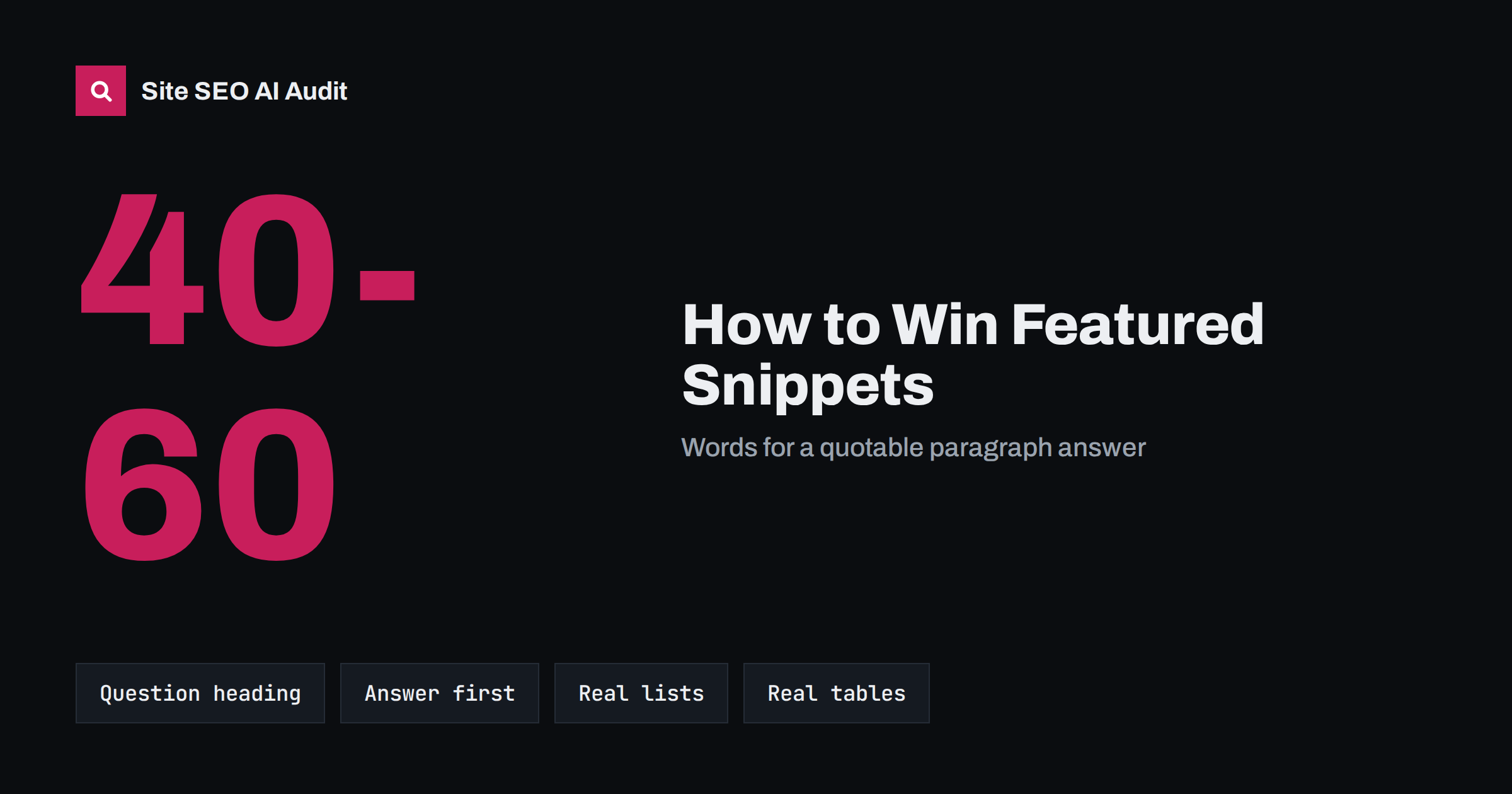
Short answer: Featured snippets are the short answers search engines sometimes show above or among the top results, quoted from one page. To improve your chances, rank on the first page for the query, put a question-style heading on the page, answer it directly in the first 40 to 60 words beneath it, and use lists or tables where the answer is a set of steps or a comparison. There is no markup that guarantees a snippet; clear structure and a genuinely good answer are what search engines look for.
What featured snippets are
For many questions, Google shows a box near the top of the results containing a short extract from one web page, with a link to that page. That extract is a featured snippet. It usually answers the question directly: a definition, a number, a list of steps, a short table.
Featured snippets come in a few common formats:
- Paragraph snippets: a short passage answering “what is”, “why” and “how does” questions.
- List snippets: numbered steps for “how to” queries, or bulleted items for “types of” and “best” queries.
- Table snippets: rows of data for comparisons, prices, specifications or schedules.
The page is chosen algorithmically from pages that already rank well for the query. You cannot apply for a snippet, and there is no special tag that creates one. What you can do is make your answer the easiest one to extract.
Are featured snippets worth pursuing?
It depends on the query. A snippet gives a page very prominent placement and signals that search engines consider it a good answer, which can bring more visits and brand visibility. On the other hand, when the snippet fully answers a simple question, such as a conversion or a date, many searchers get what they need without clicking.
A sensible view:
- Worth it for questions where the snippet gives a taste but the full answer needs more: processes, comparisons, explanations with nuance.
- Less valuable for questions that can be answered completely in one line.
- Always useful as a writing discipline: answering questions directly and clearly improves the page for every reader, snippet or not.
The same structure that wins snippets also tends to make a page easier for AI answer engines to quote, which is another reason to adopt it.
Step 1: find queries where you have a chance
Snippets are almost always taken from pages that already rank on the first page for the query. So start with your own data rather than with a wish list:
- In Google Search Console, find queries where your pages rank roughly in positions 1 to 10.
- Filter for question-style queries: those containing “what”, “how”, “why”, “best”, “vs”, “cost”, “types” and similar words.
- Search each one and see whether a featured snippet is shown, and who holds it.
- Note the format of the existing snippet: paragraph, list or table. Your answer should usually use the same format.
This produces a short list of realistic opportunities, which is much more productive than rewriting every page on the site.
Step 2: structure the answer
Search engines look for a passage that clearly answers the query and can stand on its own. The structure that works most often is simple:
- A heading that states the question, or a close variation of it: “How long should a meta description be?”
- An immediate answer in the first sentence or two under the heading, typically around 40 to 60 words for paragraph snippets.
- Supporting detail after the answer: exceptions, examples, context and nuance.
Write the answer so it makes sense if lifted out of the page. Avoid starting with “As mentioned above” or “It depends” without saying on what. Define the term in the answer itself rather than assuming the reader has read earlier sections.
Step 3: use the right format
| Query type | Best format | Tips |
|---|---|---|
| What is X, why does X happen | Short paragraph | Define in one sentence, add one or two sentences of context |
| How to do X | Numbered list | One step per item, starting with a verb; use real HTML list markup |
| Types of X, best X, signs of X | Bulleted list | Short item names, explained below in their own sections |
| X vs Y, prices, specifications | Table | Clear column headings, consistent units, real HTML table |
Use real HTML elements: <ol> and <ul> for lists, <table> for tables. Lists built from line breaks or tables made from images and styled divs are much harder for search engines to read as structure. Search engines sometimes build list snippets from a page’s H2 or H3 headings, so descriptive, parallel headings also help.
A worked example
Suppose a page about garden sheds ranks eighth for “how to level ground for a shed”, and the current snippet is a numbered list from another site. The page answers the question, but only in the middle of a long section called “Preparation”, after two paragraphs about choosing a shed.
A snippet-friendly rewrite would:
- Add an H2 that matches the question: “How to level ground for a shed”.
- Follow it with one sentence that summarizes the approach, such as “Mark out the base, remove turf and soil, compact a layer of hardcore, then check it with a long spirit level before laying slabs or a timber frame.”
- Add a numbered list of six or seven short steps, each starting with a verb.
- Move the detail on tools, depths and drainage below the list, where readers who want more can find it.
Nothing about the advice changed; only its structure did. That is typical: many pages already contain a snippet-worthy answer, hidden in a form that is hard to extract. Making it easy to find helps search engines and helps the many readers who scan for exactly that answer.
Step 4: make the whole page worth ranking
A perfectly formatted answer on a weak page rarely wins. The page still needs to be among the best results for the query. That means:
- A title tag and H1 that clearly match the question.
- Content that covers the topic thoroughly, including the follow-up questions people ask.
- Accurate, current information. Outdated numbers are a common reason snippets move to another site.
- Internal links from related pages, so search engines see the page as important on your site.
- A page that loads reasonably fast and works well on a phone.
Step 5: measure and adjust
After making changes, give search engines a few weeks to recrawl the page. Then check whether the snippet has changed and watch impressions and clicks for the query in Search Console. Snippets change hands often, sometimes within days, so treat a win as something to maintain rather than a permanent result.
If a competitor holds the snippet, study their answer: is it shorter, clearer, more current, or in a better format? Improve yours on those points rather than simply copying their wording.
Opting out, and common mistakes
If you do not want a page to appear in snippets, for example because the snippet gives away the whole answer, you can limit it with the nosnippet or max-snippet robots directives, or the data-nosnippet attribute on specific parts of the page. Google explains these options in its featured snippets documentation. Use them carefully, as they also affect regular result snippets.
Common mistakes when chasing snippets:
- Burying the answer under a long introduction.
- Answering a different question from the one in the heading.
- Writing answers that only make sense with the preceding paragraphs.
- Faking lists with line breaks or tables with images.
- Adding question headings with no real answer beneath them.
- Optimizing pages that are not yet on the first page for the query.
Structure problems that hold pages back, such as missing H1s, thin content and weak internal links, are the kind of thing Site SEO AI Audit checks on every page, alongside its AI visibility checks for content structure and dates that AI answers quote. See the plans or start with a free first audit.
Related reading
- Heading Structure for SEO: How to Use H2 to H6 Properly
- How to Write Content That AI Answers Actually Quote
- Zero-Click Search: How to Get Value When Nobody Clicks
- Search Intent: How to Match Your Page to What Searchers Want
The bottom line
Featured snippets reward pages that already rank well and answer a question clearly in a form that can be lifted out. Find question queries where you are on the first page, add a heading that states the question, answer it directly in the next 40 to 60 words, use real lists and tables where they fit, and keep the page accurate and thorough. Measure over weeks, maintain what you win, and remember that clear answers help every reader, whether or not a snippet appears.
FAQ
Is there markup that creates a featured snippet?
No. Featured snippets are chosen automatically from page content, and no structured data or tag guarantees one. Clear headings, direct answers and real HTML lists and tables make your content easier to select.
How long should a snippet answer be?
For paragraph snippets, around 40 to 60 words is a practical guideline: long enough to answer fully, short enough to quote. Lists and tables can be longer, but the key information should come first.
Do I need to rank first to get a featured snippet?
No, but the page usually needs to rank on the first page for the query. Snippets are often taken from pages in positions other than first.
Can featured snippets reduce my clicks?
For questions that the snippet answers completely, some searchers will not click. For questions that need more explanation, a snippet often increases visibility and visits. Focus on queries where your full page offers more than the extract.
Why did I lose a featured snippet?
Snippets change often. Common reasons are a competitor publishing a clearer or more current answer, changes to your page that removed the direct answer, or search engines deciding a different format suits the query better.