ENEnglish
 LTLietuviškai
 DEDeutsch
 FRFrançais
 RUРусский
 ESEspañol
 PLPolski
 ITItaliano
 UKУкраїнська
 CSČeština
 PTPortuguês
 JA日本語
JA日本語 LVLatviešu valoda
 ETEesti
 HUMagyar
 IDBahasa Indonesia
 TRTürkçe
 HIहिन्दी
 ELΕλληνικά
 ARالعربية
 THไทย
THไทย VITiếng Việt
 RORomână
 MSBahasa Melayu
 BNবাংলা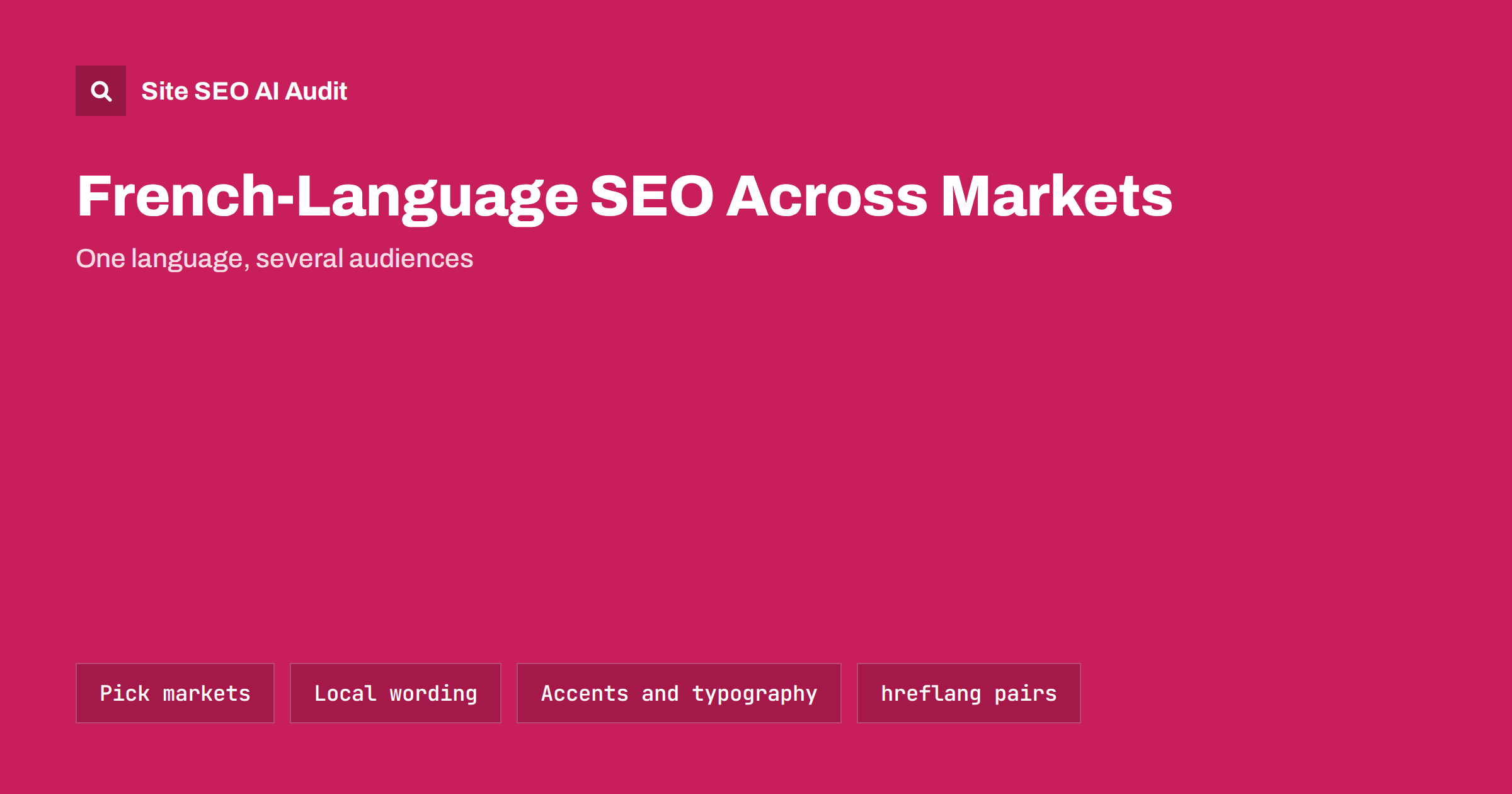
Short answer: French-language SEO is not one project, because French is the main language in several markets with different vocabulary, spelling habits, currencies, laws and search behaviour. Decide which countries you serve, research keywords with local data, handle accents and punctuation correctly, and mark regional versions with hreflang codes such as fr-FR, fr-CA, fr-BE and fr-CH. If you only need one French version, use a neutral variant and the plain fr code. Translate fully, and do not leave mixed-language pages in the index.
French is an official language in many countries, and a large share of the people who search in it live outside France. A single French page can serve all of them reasonably well in some industries. In others, such as retail, travel, legal services or anything with local prices and rules, one version will feel foreign to part of the audience. This guide helps you decide how many versions you need and how to build them without creating duplicate or confusing pages.
Choose the markets before the words
Start with your business, not the language. List where your customers are and where you can actually serve them:
- France: the largest French-speaking market in Europe, with its own consumer law, taxes and payment habits.
- Canada: Quebec is predominantly French-speaking, and French is also used elsewhere in the country. Local vocabulary and expectations differ clearly from France.
- Belgium: French is used in Wallonia and in Brussels, which is officially bilingual with Dutch.
- Switzerland: French is one of the official languages, and Swiss customers expect Swiss prices and delivery terms.
- Other regions such as Luxembourg, parts of Africa and overseas territories may matter if you ship or provide services there.
Only create separate versions for markets you really intend to serve. Our guide on how to choose target markets explains how to make that decision with data.
One French site or several?
The right structure depends on how different the offers are:
- One French version (fr). Suitable when the content is informational and does not depend on location. Write neutral French that every reader understands.
- Country versions (fr-FR, fr-CA and so on). Needed when prices, currency, delivery, legal terms or product ranges differ.
- Mixed approach. A shared French guide section and country-specific product or service pages.
Whatever you choose, avoid publishing several versions with nearly identical text and no clear targeting. Search engines may treat them as duplicates and show the wrong one. For the structural options, see multilingual versus multiregional sites and our comparison of ccTLDs, subdomains and subfolders.
Keyword research in French
Do not translate English keywords word by word. Research the terms people really type in each market. Differences appear in:
- Vocabulary. The same product or concept can have different everyday names in France and Quebec, and Belgian and Swiss French have their own words for numbers and meals.
- English loanwords. Some markets use English terms in search, such as “e-commerce” or “marketing”, while others prefer French forms.
- Formality. Using vous in headings and calls to action is the safe default for most businesses, but some brands deliberately use tu. Pick one style and apply it consistently.
- Spelling with and without accents. Many users type without accents, but search engines normally handle this. Your published text should still use correct accents.
Check suggestions and search results in each country, not only from your own location. The workflow in multilingual keyword research applies directly.
Accents, punctuation and typography
French uses accents, cedillas and ligatures, and these affect technical details:
- Character encoding: use UTF-8 for pages, feeds and databases, so that accented letters never turn into broken symbols.
- URL slugs: many sites remove accents in slugs (for example, “etes” instead of “êtes”) for simplicity. Choose one rule and keep it across the site. See how to translate URL slugs.
- Title length: French text is usually longer than English, so titles and meta descriptions can be cut off. Shorten them rather than letting them truncate.
- Spacing before punctuation: classic French typography uses a space before a colon, question mark and exclamation point, and spaces inside guillemets. A non-breaking space prevents awkward line breaks.
- Dates and numbers: day before month, a comma as the decimal separator and a space or narrow space for thousands. See local formats for dates and numbers.
Set up hreflang for French versions
Hreflang tells search engines which version belongs to which audience. For French, the codes combine the language and the optional region:
<link rel="alternate" hreflang="fr-FR" href="https://example.com/fr-fr/" />
<link rel="alternate" hreflang="fr-CA" href="https://example.com/fr-ca/" />
<link rel="alternate" hreflang="fr-BE" href="https://example.com/fr-be/" />
<link rel="alternate" hreflang="fr" href="https://example.com/fr/" />
<link rel="alternate" hreflang="x-default" href="https://example.com/" />
Remember the basics: every page must list itself and all alternates, each version must link back, and codes must be valid. A plain fr entry acts as a fallback for French speakers in countries without their own version. Read our hreflang guide and the list of hreflang language codes to avoid common errors.
Content, trust and commerce
A translation can be accurate and still fail to convert. Check the local details that make a page believable:
- Currency and prices in the right currency, with taxes shown the way local shoppers expect.
- Legal pages such as terms, privacy policy and returns, adapted to the market rather than translated blindly.
- Contact and address formats with a local phone format and, where relevant, a local address.
- Payment and delivery options that people in that country actually use.
- Examples and images that suit the audience. A French-Canadian reader notices when everything refers to France.
For online shops, our guide on international e-commerce SEO covers these points in more depth.
Common mistakes with French sites
- Automatic translation published with no review. See machine translation and SEO for how to use it safely.
- Translating the body text but leaving titles, buttons, alt text and structured data in English.
- Redirecting visitors by IP address, so that search engines and users in one country cannot reach another version.
- Missing return links in hreflang, or using the wrong region code, for instance “fr-QC” instead of “fr-CA”.
- Duplicating one French text across several country folders with no differences at all.
A practical launch checklist for a French version
Use this list when you add or review French pages. It covers the points that most often go wrong:
- Decide the structure (one fr version or country versions) and write it down, so that every team member follows the same rule.
- Translate everything users and crawlers see: body text, titles, meta descriptions, headings, buttons, form messages, image alt text, breadcrumbs and structured data fields.
- Localise the commercial details: prices, tax display, delivery times, return rules and customer service hours.
- Add hreflang with return links and a sensible x-default, either in the HTML head or in the XML sitemap. See hreflang in sitemaps versus HTML.
- Check the language switcher. It should use real links, not only scripts, and should never force a language based on the visitor’s location. See language switcher SEO.
- Review internal links so that French pages link to other French pages and not back to the English version.
- Measure each market separately in Search Console by country and language, and adjust where one version underperforms.
Treat the first few weeks after launch as a testing period. Look at which queries the French pages really attract, which country the clicks come from and whether visitors land on the right regional version. If French-Canadian visitors keep landing on the page meant for France, review your hreflang and your internal links before changing the content.
Finally, plan for maintenance. A French version that is updated months after the English one will fall behind on prices, products and policies. Decide who updates which pages, and how you will notice when a source page changes.
Check your French versions
With several versions, small errors multiply. Site SEO AI Audit crawls your site like a search engine and checks hreflang return links, broken language versions, x-default and lang attributes, along with titles, links and speed. The first audit of up to 200 pages is free.
Related reading
The bottom line
French SEO works best when you treat each market as a real audience. Decide which countries you serve, research local keywords, write correct French with proper encoding and typography, and use valid hreflang codes with return links. Keep one neutral version when your offer is the same everywhere, and create regional versions only when prices, laws or wording genuinely differ.
FAQ
Do I need separate French pages for France and Canada?
Only if your offer, prices, vocabulary or legal terms differ. For general informational content, one French version often works. For shops and local services, separate versions usually convert better.
Which hreflang code should I use for French?
Use fr for general French, and add region codes such as fr-FR, fr-CA, fr-BE or fr-CH when you have versions for those markets. Use valid ISO codes and include return links on every version.
Should I remove accents from URLs?
Either approach can work. The important thing is to choose one rule, apply it everywhere and redirect old URLs if you change it. Keep accents in visible text and titles.
Is it better to use vous or tu?
Vous is the safer default for most businesses. Some consumer brands prefer tu to sound friendly. Choose one style per audience and keep it consistent across the site.
Can I rely on automatic translation for French pages?
It is a useful first draft, but important pages should be reviewed by a fluent speaker who knows the target market. Publishing unreviewed text can harm trust and quality.