ENEnglish
 LTLietuviškai
 DEDeutsch
 FRFrançais
 RUРусский
 ESEspañol
 PLPolski
 ITItaliano
 UKУкраїнська
 CSČeština
 PTPortuguês
 JA日本語
JA日本語 LVLatviešu valoda
 ETEesti
 HUMagyar
 IDBahasa Indonesia
 TRTürkçe
 HIहिन्दी
 ELΕλληνικά
 ARالعربية
 THไทย
THไทย VITiếng Việt
 RORomână
 MSBahasa Melayu
 BNবাংলা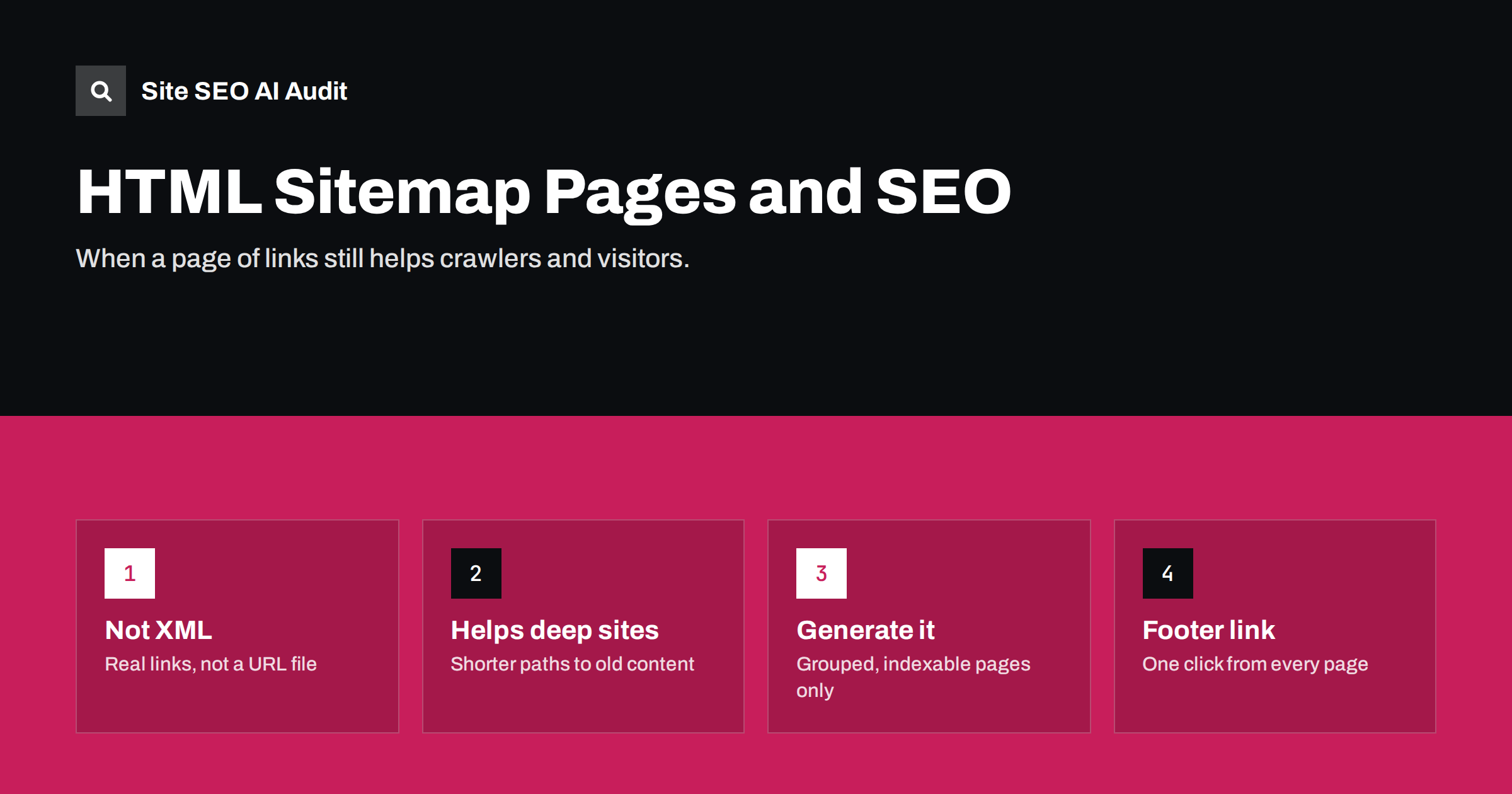
Short answer: An HTML sitemap is a normal web page that lists links to the important pages of a site, grouped by section. It is not a replacement for an XML sitemap and not a ranking factor. It still helps in specific situations: large sites with deep content, sites with weak navigation, blogs with many older posts, and visitors who prefer an overview. It adds little on a small site with clear menus. If you have one, keep it generated automatically, grouped logically and linked from the footer.
HTML sitemap vs XML sitemap
The two share a name but do different jobs:
| HTML sitemap | XML sitemap | |
|---|---|---|
| Audience | Visitors and crawlers | Search engines only |
| Format | A normal web page with links | A machine-readable file of URLs |
| How it helps | Internal links, overview, navigation | Discovery, last-modified dates, alternates |
| Passes internal link value | Yes, like any page with links | No, it is not a web page |
| Required? | No | Not required, but recommended for most sites |
An XML sitemap tells search engines which URLs exist; it does not link pages together. An HTML sitemap is a page of real links, so it contributes to your internal link structure. That is the main reason it can still matter. The XML side is covered in XML sitemap best practices.
What search engines say about HTML sitemaps
Google has long described sitemaps mainly in terms of the XML format. For HTML sitemap pages, its representatives have said over the years that they can be useful for users and for discovery on sites with complicated navigation, but that a site with a good structure does not need one for SEO.
That matches practical experience: an HTML sitemap is a supporting tool. It cannot fix a poor site architecture, but it can reduce the damage while a better structure is built, and it can give deep pages an extra crawlable link.
It is worth remembering where the idea comes from. In the early days of the web, menus were limited, search engines crawled less deeply and many sites had no other way to expose all their pages. HTML sitemaps were a standard recommendation. Today, XML sitemaps handle discovery, and well-built navigation, hub pages and contextual links handle structure. The HTML sitemap survived because it still solves a few specific problems, not because every site needs it.
When an HTML sitemap helps
- Large sites with deep sections. Catalogues, directories and publishers with thousands of pages often have content several clicks from the home page. A sitemap page with links to category hubs can shorten paths. Click depth matters because deeply buried pages tend to be crawled less often.
- Blogs with many older posts. Posts drop off paginated archives over time and end up far from the home page. A sitemap listing posts by category keeps them one or two clicks away.
- Sites with JavaScript-heavy menus. If navigation depends on scripts that crawlers may not run, a plain HTML sitemap provides a crawlable fallback.
- Sites in transition. After a restructuring or merge, a sitemap page can keep content reachable while navigation is rebuilt.
- Accessibility and usability. Some visitors, including many who use assistive technology, prefer a single overview page to complex menus.
When it adds little
- Small sites with clear navigation. If every page is reachable from the menu in one or two clicks, an HTML sitemap duplicates the menu.
- Sitemaps that list everything. A page with 10,000 unsorted links is useless for visitors and weak for crawlers.
- Sitemaps hidden behind noindex, nofollow or robots.txt. If crawlers cannot use the page, it cannot help discovery.
- Stale, manually maintained lists full of broken links and missing new pages.
An HTML sitemap is also not a fix for orphan pages in the deeper sense. If an important page is only linked from the sitemap, it still lacks contextual links from related content, which carry more meaning. Treat the sitemap as a safety net, not the main path.
How to build a useful HTML sitemap
- Generate it automatically. Use your CMS, a plugin or a template that builds the list from live content. Manual sitemaps go out of date within weeks.
- Group by structure. Main pages first, then sections or categories, then posts or products within each group. Headings for each group make the page scannable.
- Include only indexable pages. Leave out noindex pages, redirects, filtered URLs, tag pages you do not want indexed and anything blocked in robots.txt. The list should match what you want in search.
- Use the page titles as link text. Descriptive anchors tell visitors and crawlers what each page is.
- Keep it to a sensible size. On large sites, link to category hubs or split the sitemap into several pages by section, each with a manageable number of links, rather than one enormous page.
- Link it from the footer on every page, so it is always one click away.
- Keep it indexable and followable. The page itself can be indexed; it is harmless and can occasionally help people find content.
On WordPress, several SEO and sitemap plugins can generate an HTML sitemap through a shortcode or block, and many themes include a sitemap page template. Check what the generated list contains before you publish it: some tools include attachment pages, author archives or tag pages by default, which you may not want to promote. Exclude post types and taxonomies that are noindex elsewhere on the site, so the sitemap and your indexing rules agree.
For shops, a sitemap organised by category, with links to the main category and subcategory pages rather than every product, is usually the most useful. Products are then reached through the categories, which also carry context. Very large catalogues can add alphabetical brand indexes for the same purpose.
HTML sitemaps on multilingual sites
If your site has several languages, give each language version its own HTML sitemap listing pages in that language, with the sitemap page itself translated and connected with hreflang like any other page. A single sitemap mixing all languages is confusing for visitors and sends mixed signals about which pages belong together. Make sure the language switcher on the sitemap page leads to the sitemap page of the other language. For the XML side of multilingual sites, see XML sitemaps for multilingual sites.
HTML sitemaps vs other navigation aids
An HTML sitemap is one of several ways to make content reachable. Often a combination works better than relying on any one of them:
- Main navigation for the most important sections.
- Category and hub pages that group related content with short introductions. These carry more context than a sitemap list.
- Breadcrumbs that show each page’s place in the structure and link back up. See breadcrumbs for SEO.
- Contextual links in content, the strongest internal links because they say why a page is relevant. The method is described in the internal linking strategy guide.
- Related posts and products blocks.
- The HTML sitemap as a complete overview and safety net.
Common HTML sitemap mistakes
- Listing URLs that redirect or return errors. Every link on the sitemap should return status 200.
- Including non-canonical URLs, such as parameter versions or print pages.
- Different lists in the HTML and XML sitemaps without a reason. Both should reflect the same set of indexable pages.
- A sitemap page that loads its list with JavaScript, which defeats the purpose for crawlers that do not run scripts.
- A page title like “Sitemap” in every language, which duplicates titles across versions. Use a translated, descriptive title.
How an audit helps
An HTML sitemap is only as good as the links on it and the structure behind it. Site SEO AI Audit crawls your site like a search engine and reports broken internal links, links to redirects, orphan and weakly linked pages, click depth and sitemap problems, weighted by how many pages each issue affects. Comparing those results before and after adding or cleaning up an HTML sitemap shows whether it actually improved reachability. Paid plans let you re-audit after changes.
Related reading
- Sitemap errors in Search Console: what they mean and fixes
- Blog category and tag pages: how to make them useful for SEO
- Broken links: how to find and fix them across your site
The bottom line
An HTML sitemap is a helpful supporting page, not an SEO requirement. It earns its place on large or deep sites, blogs with many older posts and sites with script-heavy menus. Generate it automatically, group it logically, list only indexable pages and link it from the footer. Keep your XML sitemap as well, and remember that good navigation and contextual links do more than any sitemap page.
FAQ
Do I need an HTML sitemap if I have an XML sitemap?
Not necessarily. An XML sitemap handles discovery for search engines. An HTML sitemap adds value mainly on large or deep sites and for visitors who want an overview.
Can an HTML sitemap improve rankings?
Not directly. It can help pages get discovered and crawled more reliably by adding internal links, which supports rankings indirectly on sites with weak navigation.
Should the HTML sitemap page be noindex?
There is no need. Leaving it indexable and followable is harmless. What matters is that crawlers can follow its links.
How many links should an HTML sitemap have?
Keep it usable. On large sites, link to category hubs or split the sitemap into several section pages rather than listing tens of thousands of URLs on one page.
Should the HTML sitemap include blog posts?
On blogs with many posts, yes, grouped by category or date. It keeps older posts within a few clicks of every page.