ENEnglish
 LTLietuviškai
 DEDeutsch
 FRFrançais
 RUРусский
 ESEspañol
 PLPolski
 ITItaliano
 UKУкраїнська
 CSČeština
 PTPortuguês
 JA日本語
JA日本語 LVLatviešu valoda
 ETEesti
 HUMagyar
 IDBahasa Indonesia
 TRTürkçe
 HIहिन्दी
 ELΕλληνικά
 ARالعربية
 THไทย
THไทย VITiếng Việt
 RORomână
 MSBahasa Melayu
 BNবাংলা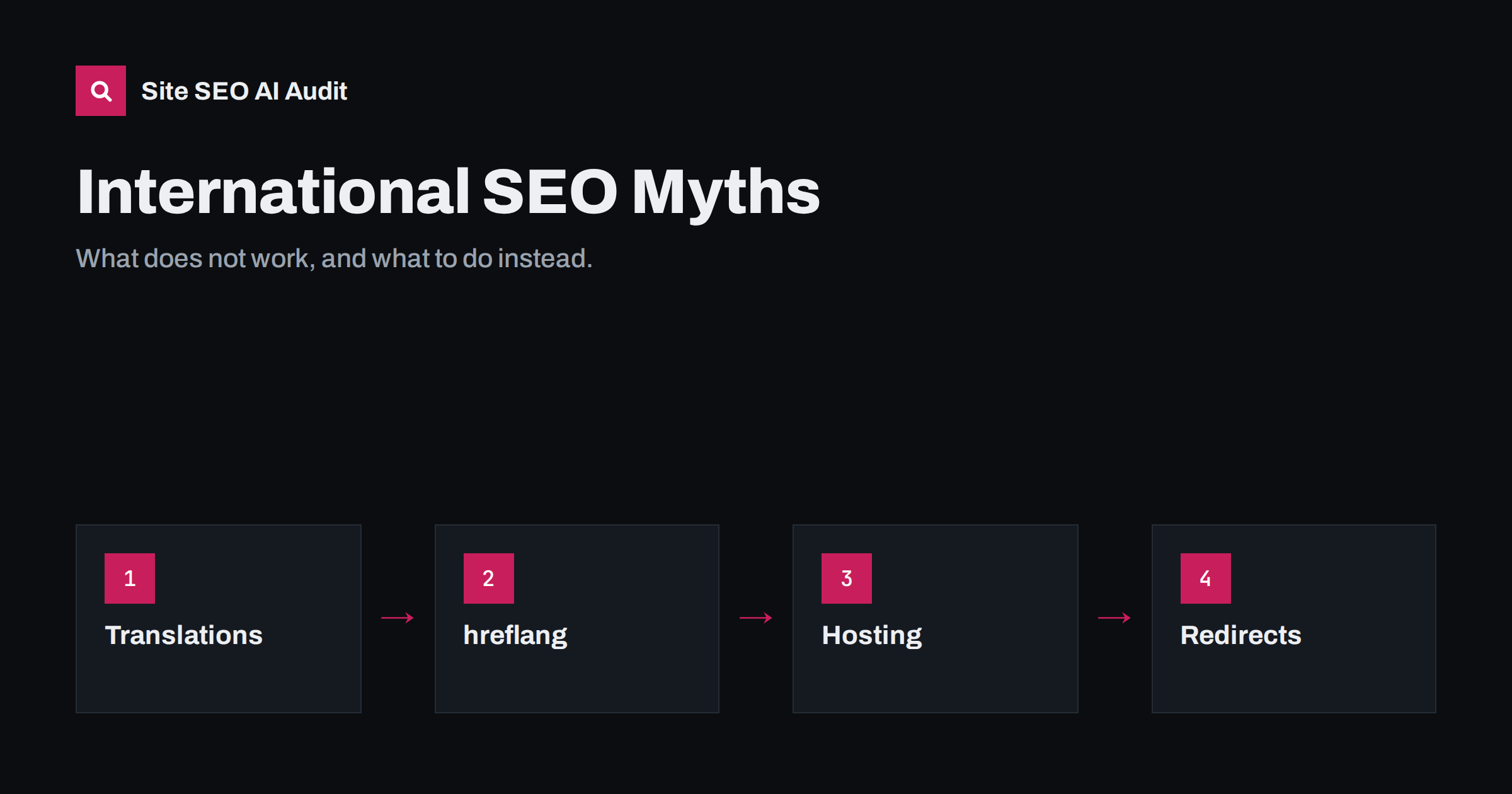
Short answer: Many international SEO decisions are based on myths: that translations count as duplicate content, that hreflang boosts rankings, that you need a local server or a country domain to rank abroad, that automatic redirects help, that the lang attribute decides a page’s language for Google, or that machine translation is either banned or harmless. The reality is simpler: separate URLs per version, correct hreflang, fully localized content and honest signals do most of the work.
Myths persist in international SEO for understandable reasons. Advice that was true many years ago, such as the value of local hosting, keeps circulating. Search engines differ in which signals they use, so something true for one engine is repeated as if it applied to all. And international problems are hard to see, so it is difficult to test claims without crawls and per-market data. The sections below group the most common myths by topic, with what is actually known instead.
Myths about duplicate content
Myth: translated pages are duplicate content and will be penalised. Content in different languages is not duplicate content. A German translation of an English page serves different readers, and search engines index both. There is no need to canonicalise translations to the original, and doing so actually removes them from search.
Myth: same-language country versions get penalised. Near-identical pages for the US, the UK and Australia are not penalised. The real issue is that search engines may group them and show one version everywhere. hreflang helps them choose, and real differences, such as prices, spelling and delivery details, make the choice easier. It is a question of which page is shown, not of punishment.
Myth: you should block other language versions to avoid confusion. Blocking language folders in robots.txt or with noindex prevents those versions from appearing where they are needed. Let every version be crawled and indexed, and use hreflang to guide which one is shown.
Myths about hreflang
Myth: hreflang improves rankings. hreflang does not make a page rank higher. It tells search engines which version of a page to show to which audience. A page that does not rank in a market will not start ranking because of hreflang alone.
Myth: once hreflang is set up, it keeps working. hreflang breaks easily and silently: renamed slugs, plugin updates, new pages without linked translations and redirects all create errors. It needs regular checks, especially after changes.
Myth: hreflang is only needed for different languages. It is also used for different countries sharing a language, such as en-us and en-gb, where it is often most important, because the content is similar.
Myth: x-default is required. x-default is optional. It is useful when you have a language selector or many searchers who match none of your versions, but clusters without it are valid.
Myth: country codes alone are fine. A value like hreflang="de" means German language, not Germany. A country code on its own, such as us, is invalid. hreflang always starts with a language.
Myths about domains and hosting
Myth: you need a country-code domain to rank in a country. A ccTLD is a strong signal, but many sites rank well abroad with subfolders on a generic domain, using hreflang and local content. For most businesses, subfolders are simpler and share the authority of the main domain.
Myth: the server must be in the target country. Server location is at most a weak signal. Speed for visitors matters far more, and a CDN can serve pages quickly in every market regardless of where the origin server is.
Myth: any two-letter domain signals a country. Some country-code domains, such as .io, .co and .tv, are treated by Google as generic, because they are widely used without any link to their country.
Myths about redirects and detection
Myth: automatically redirecting visitors to their language is best practice. Forced redirects by IP address or browser language can hide versions from crawlers, which often come from one country without a language preference. They also frustrate travellers, expats and VPN users. Suggesting the local version with a banner and letting visitors choose is safer.
Myth: one URL can serve all languages if it detects the visitor. Locale-adaptive pages usually get only one version indexed. Each language needs its own URL.
Myth: redirecting only the home page is always harmless. It is less harmful than redirecting every URL, but crawlers without a language preference may never see the root as a page, and x-default pointing at a redirect is invalid. A language selector or a default version with a banner is cleaner.
Myths about language signals
Myth: the lang attribute tells Google what language the page is in. Google has said it uses the visible content to determine language, not the lang attribute. The attribute still matters for accessibility and some other tools, but a wrong translation cannot be fixed by markup.
Myth: meta geo tags help with country targeting. Tags such as geo.region are not used by Google for targeting. hreflang, local content and local links matter instead.
Myth: there is still a country targeting setting. Google retired the International Targeting report and its country setting in Search Console in 2022.
Myths about translation
Myth: machine translation is banned by Google. It is not. What search engine spam policies target is content produced at scale with little value for users. Reviewed, useful machine-assisted translation is fine.
Myth: machine translation is good enough to publish without review. Unreviewed translations often miss local keywords, contain terminology errors and leave prices, formats and examples unlocalized. Key pages deserve a fluent human review.
Myth: translating keywords is keyword research. People in other markets often search with different words, loanwords or different intent. Keywords have to be researched per market.
Myth: every page must exist in every language. Partial translation is normal and fine. Translate what serves each market, and leave hreflang out for pages without equivalents.
Myths about effort and results
Myth: translating the site means international traffic will follow quickly. A new language version often behaves like a new site and needs months to build visibility, local relevance and links.
Myth: more languages always mean more traffic. Several half-maintained versions usually perform worse than one well-localized market. Quality and maintenance matter more than the number of flags in the switcher.
Myth: international SEO is a one-time project. Content changes, plugins update and markets evolve. International sites need regular checks and updates to keep versions in sync.
Myths about measurement and tools
Myth: site-wide traffic tells you whether international SEO works. Totals hide problems in individual markets. Growth in English can mask a German version that disappeared from German results. Measure each market separately: impressions and clicks by country and language folder, indexed pages per language and conversions per market.
Myth: Search Console will warn you about hreflang errors. It used to, in the International Targeting report, but that report was retired in 2022. Today, hreflang errors have to be found with a crawler; Search Console shows only their effects, such as the wrong version appearing in a country.
Myth: checking a few pages by hand is enough. Manual checks are useful for understanding how a site builds hreflang, but template differences mean one section can be correct while another is broken. Only a full crawl, following hreflang links and respecting robots.txt, shows the whole picture.
Myth: a green validator result means the set-up works. Validators check syntax. They do not check whether targets redirect, are noindex, canonicalise elsewhere or are in the right language. Correct syntax is only the first step.
Myth: rankings in one country tell you how the site does everywhere. Search results differ by country, language, device and personalisation. Rank checks need the right location and language settings for each market, and even then they show a sample, not the full picture. Search Console data filtered by country is usually a more reliable guide.
What actually works
- Separate, crawlable URLs for each language or country version.
- Correct hreflang with return links, valid codes and live, canonical targets.
- Full localization: content, metadata, templates, prices and details.
- Local keyword research for every market.
- No forced redirects; clear language switchers instead.
- Regular technical checks, especially after changes.
- Measurement per market, not just site-wide.
Site SEO AI Audit supports the technical part of this list. It crawls a site like a search engine, scores seven areas including Languages (hreflang return links, broken language versions, x-default and lang attributes) and ranks fixes by impact. The first audit is free.
Related reading
- International SEO for beginners: how to take a site global
- What is hreflang? A plain-English guide for site owners
- Automatic language redirects: why they hurt international SEO
The bottom line
Most international SEO myths lead to one of two mistakes: doing things that do not help, such as geo tags, local servers or canonicalising translations, or skipping things that do, such as correct hreflang, full localization and per-market measurement. Focus on separate URLs, honest signals, real localization and regular checks, and ignore the shortcuts.
FAQ
Are translated pages duplicate content?
No. Content in different languages is not treated as duplicate content, and each language version can be indexed and ranked on its own.
Does hreflang help my rankings?
Not directly. hreflang helps search engines show the right version of a page to the right audience, but it does not make a page rank higher.
Do I need a server in each country I target?
No. Server location is at most a weak signal. Page speed matters more, and a CDN can make pages fast in every market.
Is machine translation against Google’s rules?
No. Google’s spam policies target low-value content produced at scale. Machine-assisted translation that is reviewed and useful for readers is acceptable.
Should I redirect visitors to their language automatically?
It is safer not to force it. Suggest the local version with a banner, remember the visitor’s choice and use hreflang for search engines.