ENEnglish
 LTLietuviškai
 DEDeutsch
 FRFrançais
 RUРусский
 ESEspañol
 PLPolski
 ITItaliano
 UKУкраїнська
 CSČeština
 PTPortuguês
 JA日本語
JA日本語 LVLatviešu valoda
 ETEesti
 HUMagyar
 IDBahasa Indonesia
 TRTürkçe
 HIहिन्दी
 ELΕλληνικά
 ARالعربية
 THไทย
THไทย VITiếng Việt
 RORomână
 MSBahasa Melayu
 BNবাংলা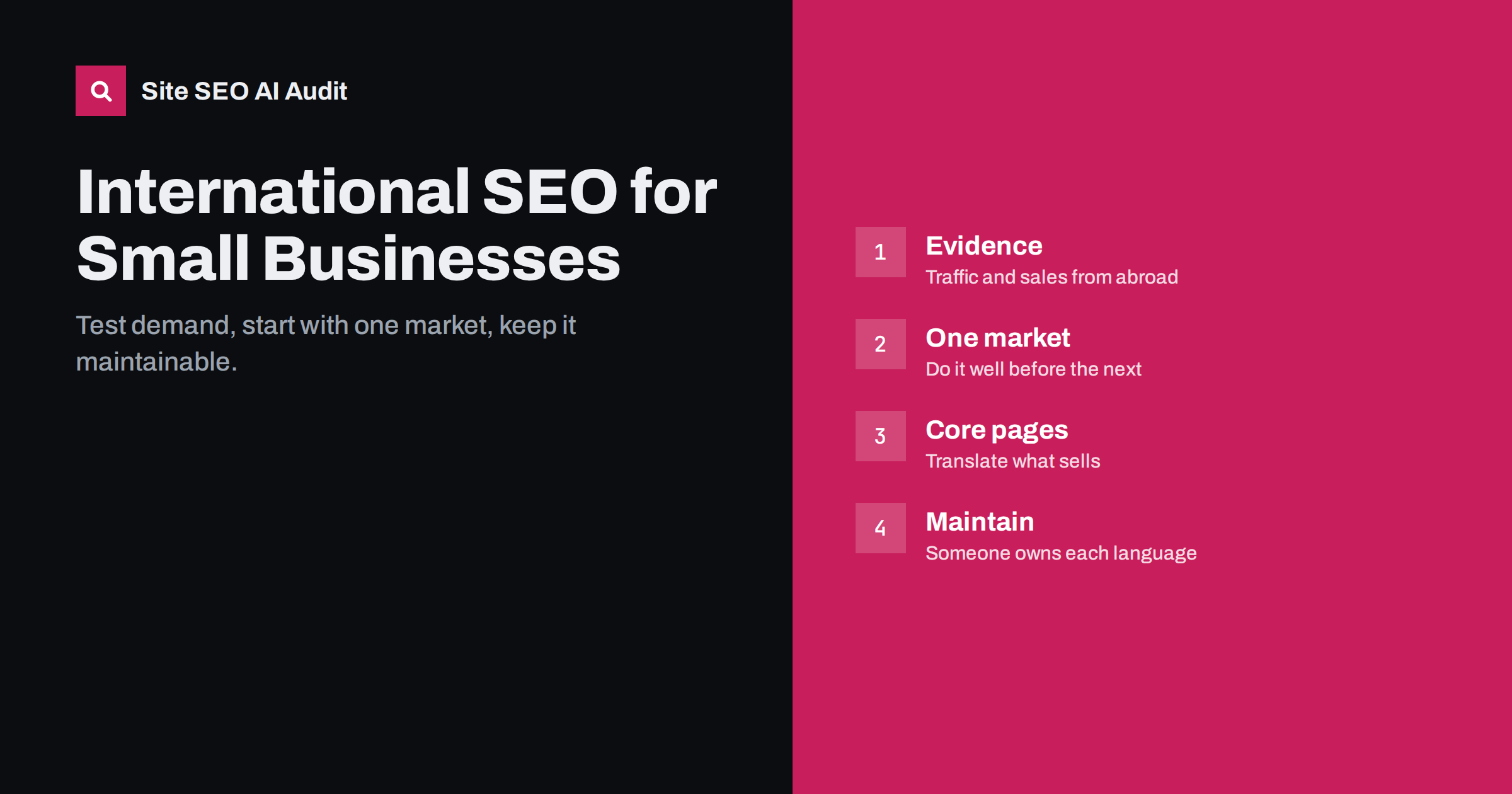
Short answer: International SEO pays off for a small business when there is real demand from another market and the business can actually serve it: deliver, support customers and handle payments there. Start with evidence from your own analytics and enquiries, choose one market, translate and localize the pages that sell rather than the whole site, use a simple subfolder structure with correct hreflang, and make sure someone maintains the new language. Expanding to many languages at once is the most common and most expensive mistake.
Signs that going international makes sense
Small businesses rarely decide to go international out of nowhere. Usually there are signs that a foreign market already wants what they offer. Look for:
- Visitors from abroad in analytics, especially ones who engage with product or service pages rather than leaving immediately.
- Impressions from other countries in Search Console, which show that people there already search for your topics.
- Enquiries and orders from customers who found you despite the language barrier, often writing in English or in their own language.
- Partners or distributors asking for materials in their language.
- Competitors in your home market that already serve a neighbouring country successfully.
If none of these signs exist, international SEO is a speculative investment. It may still be worth trying, but in a smaller, testable way.
A small, testable way can be as simple as one well-localized landing page for your main service in the target language, promoted to a few local contacts, with the rest of the site left as it is. If that page attracts impressions, visits and enquiries over a few months, you have evidence for a larger investment. If it attracts nothing, you have learned something useful at low cost.
Check that you can serve the market
SEO can bring visitors, but it cannot fix an offer that does not work for them. Before investing in content, check the basics:
- Delivery and logistics: can you ship there at a reasonable cost and speed, or deliver the service remotely?
- Payments: can customers pay with methods they trust and use?
- Legal and tax: what rules apply to selling there, including consumer rights, VAT or sales tax, and required information on the website?
- Support: can you answer questions in the customer’s language, at reasonable hours?
- Pricing: does your pricing make sense in that market, including currency and local competition?
A market that fails several of these checks will produce visitors who do not buy, which is expensive traffic.
Talk to a few potential customers or partners in the market before you commit. Ask how they currently solve the problem you solve, which suppliers they use and what would make them consider a foreign provider. These conversations cost little and often reveal practical obstacles, such as a required certification or a preferred payment method, that no amount of SEO could overcome.
Start with one market and do it well
The biggest temptation is to add many languages at once, especially when machine translation makes it look cheap. The result is usually several half-finished versions that nobody maintains. One well-localized market almost always outperforms five neglected ones.
Choose the first market based on the evidence you gathered: where demand is strongest and where you can serve customers best. Treat it as a project with a clear scope, a budget and a review date, for example six or twelve months after launch.
What you learn in the first market, about translation workflows, keyword research, customer questions and technical set-up, makes the second market faster and cheaper.
Neighbouring markets are often a good first choice for small businesses. Shipping is easier, time zones overlap, and business customs are often similar. A market that shares a language with an existing version, such as Austria for a German site, may even need only localized details rather than full translation.
Translate what sells, not everything
A small business site might have a few dozen service or product pages and a blog with many articles. You do not need to translate all of it. A typical first scope includes:
- The home page.
- Main product, service or category pages.
- Pricing or quote pages.
- Contact, about, shipping, returns and legal pages.
- A handful of the most useful articles, chosen by what local searchers look for.
Everything else can remain in the original language. Pages without translations simply have no hreflang alternates, which is perfectly fine. Add more pages over time, guided by local search data and customer questions.
When choosing articles to translate, prefer evergreen guides that answer questions local customers actually ask, and skip news items, announcements and posts tied to events in your home market. An article that already brings international visitors in the original language, as shown in Search Console, is often the best candidate.
Keep the technical set-up simple
Small businesses gain most from a simple, robust structure:
- Subfolders such as /de/ on your existing domain. They inherit the domain’s reputation and need no extra hosting or certificates.
- A well-supported multilingual plugin or platform feature that generates hreflang, lang attributes and language-specific sitemaps automatically.
- A clear language switcher with links to equivalent pages.
- No automatic redirects based on location or browser language.
Separate country domains, complex geo-detection and custom-built translation systems are rarely worth it at this scale.
Whatever tools you use, test the set-up once before translating many pages. Create one translated page, check its source for hreflang, canonical and lang attribute, open it in a private window and switch languages with the switcher. Fixing the set-up at this stage takes minutes; fixing it after fifty pages are live takes much longer.
Budget: where the money should go
International SEO costs are mostly people’s time. For a small business, a sensible budget split usually favours:
| Area | Why it deserves budget |
|---|---|
| Native review of key pages | Accuracy and trust on pages that sell |
| Local keyword research | Ensures pages target words people actually use |
| Localized details | Prices, delivery, legal and contact information that convert |
| Ongoing maintenance | Keeps translations up to date as the business changes |
| Technical checks | Catches hreflang and indexing problems early |
Where money is tight, machine translation can produce drafts for less important pages, but key commercial pages deserve a fluent human review.
Measure honestly and decide
Set expectations early. A new language version often takes several months to gain visibility. After launch, track:
- Indexed pages in the new language.
- Impressions and clicks from the target country for the new folder.
- Enquiries, orders or sign-ups from that market.
- Customer questions that reveal missing content.
Be careful with early numbers. A few enquiries in the first weeks may come from people who would have contacted you anyway, and a slow start does not necessarily mean the market is wrong. Look at trends over several months, compare them with the same period for your home market when it was new, and combine the data with what customers tell you. The combination is far more reliable than any single metric.
At the review date, decide whether to invest more, keep the market as it is or scale it back. Scaling back is a legitimate outcome; a well-run test that shows limited demand saves money for better opportunities.
Mistakes that waste small budgets
- Translating the whole site into several languages without evidence of demand.
- Publishing unreviewed machine translations of commercial pages.
- Leaving titles, menus and forms in the original language.
- Adding hreflang only to new pages, so return links are missing.
- No one responsible for answering enquiries in the new language.
- Forgetting to update translated prices and offers when the original changes.
A low-cost way to check your set-up
Small businesses rarely have time for manual technical checks. Site SEO AI Audit crawls a site like a search engine and gives a score across seven areas, including Languages (hreflang return links, broken language versions, x-default and lang attributes), with a fix list ranked by how many points each fix adds. On WordPress sites, each issue comes with the steps to fix it in wp-admin. The first audit of a website is free, and plans for one website with monthly audits are listed on the pricing page.
Related reading
- International SEO for beginners: how to take a site global
- How to launch a new language version without SEO problems
- Machine translation and SEO: what is safe to publish
The bottom line
For a small business, international SEO is worth it when demand already exists and the business can serve the market. Start from evidence, choose one market, translate the pages that sell, keep the structure simple, spend on native review and local details, name an owner for the language and measure honestly before expanding further.
FAQ
How many languages should a small business start with?
Usually one additional language or market. It is easier to do one well, learn from it and then expand than to maintain several half-finished versions.
Can a small business use machine translation?
Yes, as a starting point, especially for less important pages. Key commercial pages should be reviewed by a fluent speaker before publishing.
Do I need a separate domain for another country?
No. A subfolder on your existing domain is usually the simplest and most effective choice for a small business.
How do I know if there is demand abroad?
Check analytics and Search Console for visitors and impressions from other countries, and look at enquiries and orders from abroad. Local keyword research then shows how many people search for your topics.
How long before a new language brings customers?
It varies, but several months is common before a new language version builds steady visibility. Plan a review six to twelve months after launch.