ENEnglish
 LTLietuviškai
 DEDeutsch
 FRFrançais
 RUРусский
 ESEspañol
 PLPolski
 ITItaliano
 UKУкраїнська
 CSČeština
 PTPortuguês
 JA日本語
 LVLatviešu valoda
 ETEesti
 HUMagyar
 IDBahasa Indonesia
 TRTürkçe
 HIहिन्दी
 ELΕλληνικά
 ARالعربية
 THไทย
 VITiếng Việt
 RORomână
 MSBahasa Melayu
 BNবাংলা
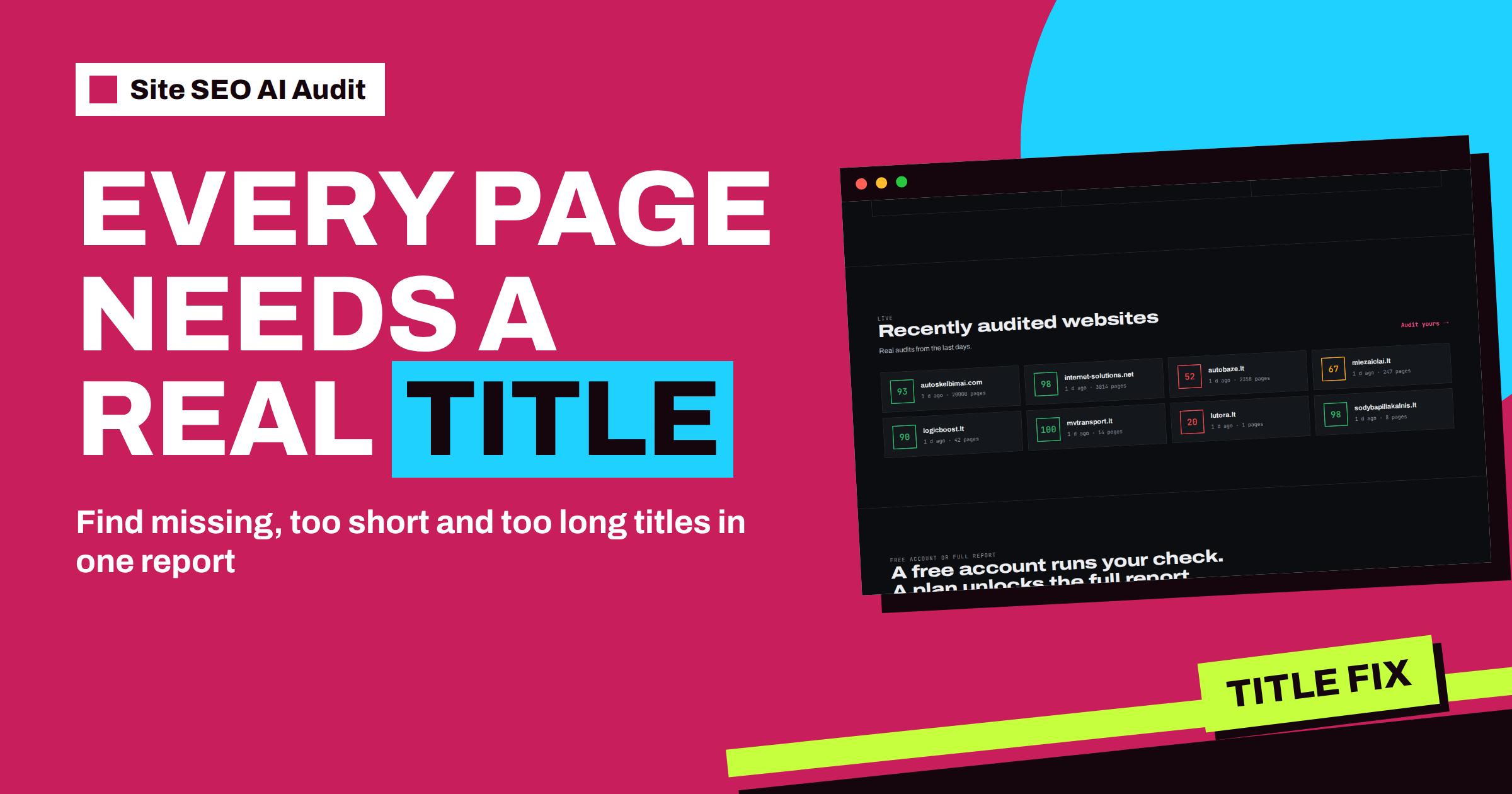
Short answer: Site SEO AI Audit reports two different title problems. “Missing page title” is critical, because without a title Google writes its own headline for the page. “Title too long or too short” is a notice, raised when a title has fewer than 20 or more than 65 characters. The report advises unique titles of 50 to 60 characters with the main topic first. Open the affected pages list, write a proper title for every missing one first, then adjust the length of the rest and run a new check.
The title is the first thing a person reads about your page in search results. It is also one of the strongest signals about the topic of the page. That is why the audit treats a missing title as a critical problem and a badly sized title as a small but real one. Both are cheap to fix compared with the effort that went into the page itself. This guide explains how the two checks work, what the numbers mean and how to correct hundreds of titles without losing your mind.
Two checks, two levels of severity
The checks live in the On-page area, which carries 20 percent of the total score. In the scoring formula, a critical issue counts ten points, a warning four and a notice one, and the penalty is multiplied by the share of indexable pages affected.
| Finding | Severity | When it appears |
|---|---|---|
| Missing page title | Nghiêm trọng | The page has no title, or an empty one |
| Title too long or too short | Notice | The title has fewer than 20 or more than 65 characters |
| Duplicate titles | Cảnh báo | Several pages share the same title |
The third row belongs to a different finding, covered in the article on duplicate titles across pages. It is shown here because the three checks are best fixed together: a title you rewrite for length is a good moment to make it unique.
Why a missing title is critical
When a page has no title, search engines still have to show something in the results. They build a headline from other parts of the page, such as the first heading or even the address. The result can be vague or confusing, and you lose control of the most visible text you have in search. Browser tabs and bookmarks show an empty or generic label as well, and sharing the page is awkward.
Missing titles are usually not a decision but an accident. A page builder leaves the field empty, a theme template prints the title only on some page types, a plugin overwrites it with an empty value, or an imported page never had one. Look at the affected list for a pattern: if every missing title is on archive pages, tag pages or a custom post type, the cause is a template and not forty separate pages.
What “too long” and “too short” mean in the audit
A title under 20 characters wastes the most valuable words on the page. “Shoes” or “Home” tells nobody what the page offers. A title over 65 characters is likely to be cut off in search results, so the end of it, often the brand or the key qualifier, is lost. The audit flags both and advises a range of 50 to 60 characters, which fits the space of a typical result without cutting.
These numbers are a guide, not a law. Search engines measure the title in pixels rather than characters, so a title with many narrow letters can be a little longer, and one with wide capital letters a little shorter. The real test is simple: type the title into a search result preview in your SEO plugin and see where it is cut. The article on writing title tags shows wording and examples for different page types.
How to write a good title in a minute
- Start with the main topic. Put the words a person would search for first, and the brand last.
- Say what makes the page different. A product title can carry the model, a guide title the year or the result, a service page the city.
- Keep one idea. A title is a headline, not a list of keywords separated by pipes.
- Make it unique. If two pages could have the same title, one of them needs a sharper angle.
- Read it aloud. If it sounds like a person wrote it for a person, it is probably right.
Avoid stuffing the same word three times. It makes the title look spammy and does not help rankings. The note on emojis and symbols in titles covers a related question that people often ask when they rewrite many titles at once.
Step by step: from report to repair
- Open the issue cards. Start with “Missing page title”, because it is critical, then open “Title too long or too short”.
- Export the list in your head, not on paper. Group the affected pages by type: products, articles, categories, tags, custom pages. Each group usually shares a template.
- Fix the template first. If a whole group has no title or an oversized one, change the title pattern in your SEO plugin or theme. On WordPress, the card tells you to edit the page and use the SEO title field in the SEO plugin box, and most plugins show a length bar there.
- Handle the important pages by hand. The home page, main category pages and best-selling products deserve a title written for people.
- Use patterns for the long tail. For large sites, a template such as product name, key attribute and brand works well, as described in the guide to title and meta description templates for large sites.
- Run a new check. Starter, Pro and Agency include re-checks. The critical issue should be gone, and the notice list should be shorter.
Titles and the other on-page findings
Titles rarely come alone. The On-page area also checks meta descriptions, H1 headings, thin content, duplicate content and image alt text. When you open a page to fix its title, take a minute to look at the other findings that include the same address in the pages list. A page with a missing title often also lacks a description and a heading, because the same template is responsible for all three. Fixing them together saves a second round of editing. The article on missing meta descriptions shows how to handle the description in the same visit.
Check that the change worked
After you save the new titles, run the check again and compare the numbers. The area score for On-page should rise, and the total score should increase by about the points the report promised. If a few pages remain, open one and look at the source: a cached copy, a different template or a plugin that overrides the title are the usual reasons. Search engines will need time to recrawl before the new titles appear in results, and they may still rewrite a title if they think another one fits the query better. That is normal, and a clear, accurate title makes a rewrite less likely.
Plans count checks per month, as the pricing page shows, so you can fix a batch of titles, check, and repeat for the next batch without worrying about the limit on a paid plan.
Different page types need different titles
A single rule does not fit every page. On a blog, the title is usually the article headline, trimmed to fit, with the site name added at the end. On a product page it works best as the product name plus the one attribute that people search for, such as size, material or model number. On a category page it should name the category and what the visitor finds there. A service page benefits from the service and the place. Archive, tag and search pages often inherit a generic title from the theme, which is why they dominate the lists of missing or duplicate titles. If those pages are thin and not meant for search, the better fix may be to keep them out of the index instead of polishing their titles.
Whatever the page type, test your pattern on three real pages before applying it to three thousand. Read the results in a search preview, look for odd line breaks or doubled brand names, and only then roll it out. One mistake in a template is multiplied by every page that uses it.
Related reading
- How to Write Title Tags: Length, Wording and Examples
- Duplicate Titles Across Pages: Fix Them With Your Report
- Title and Meta Description Templates for Large Sites
The bottom line
A missing title is a critical gap, and a title that is too short or too long is a small leak. Fix the missing ones first, set the length to about 50 to 60 characters with the topic first, change templates before single pages and run a new check to see the score rise.
FAQ
Why does the audit flag titles over 65 characters?
Because long titles are likely to be cut off in search results, and the end of the title is lost. The advice is to keep titles near 50 to 60 characters.
Is a short title always bad?
A title under 20 characters is flagged as a notice because it wastes the most important words. A short brand name on the home page may be fine, but most pages benefit from a descriptive title.
Will Google use the title I write?
Often, but not always. Search engines may rewrite a title when they think another version fits the query better. A clear, accurate title makes that less likely.
Which is more important, the title or the H1 heading?
They do different jobs. The title appears in search results and browser tabs, while the H1 is the visible headline on the page. They can be similar, but they do not have to be identical.
Which plan lists the affected pages?
Any paid plan. A free account runs one check and shows the report locked, while Starter, Pro and Agency unlock every issue and the affected pages.