ENEnglish
 LTLietuviškai
 DEDeutsch
 FRFrançais
 RUРусский
 ESEspañol
 PLPolski
 ITItaliano
 UKУкраїнська
 CSČeština
 PTPortuguês
 JA日本語
JA日本語 LVLatviešu valoda
 ETEesti
 HUMagyar
 IDBahasa Indonesia
 TRTürkçe
 HIहिन्दी
 ELΕλληνικά
 ARالعربية
 THไทย
THไทย VITiếng Việt
 RORomână
 MSBahasa Melayu
 BNবাংলা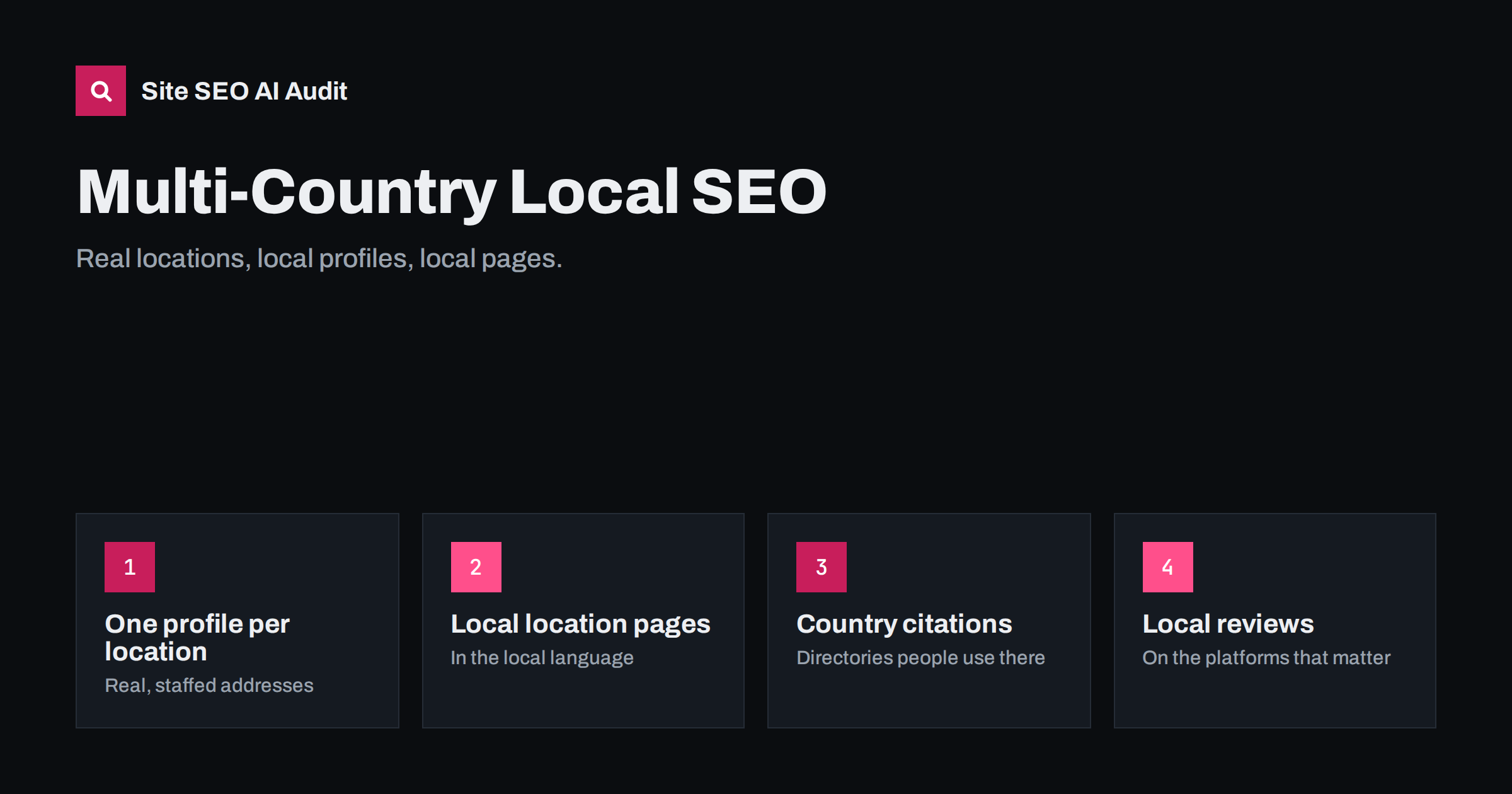
Short answer: local SEO across several countries means doing local SEO properly in each country rather than once for the whole business. Each real, staffed location needs its own business profile, a location page on the matching country or language version of your site, local contact details in local formats, LocalBusiness markup, listings in the directories people actually use in that country, and genuine local reviews. Keep names, addresses and phone numbers consistent everywhere, and never create profiles for addresses where you have no real presence.
How multi-country local SEO differs from international SEO
International SEO is about making the right language or country version of a website appear in each market’s search results. Local SEO is about appearing in map results and “near me” searches for a physical location. A business with offices, shops, clinics or warehouses in several countries needs both, and they have to fit together:
- A searcher in Vienna looking for your service should find the Vienna location in maps, and the page they land on should be in German with Austrian contact details.
- A searcher in Lyon should see the Lyon office, with French content, a French phone number and a French address format.
The international structure of your site determines where location pages live, and the local signals for each location have to point to those pages. Our guide on local trust signals for country versions covers the site-wide signals; this article focuses on physical locations.
Business profiles: one per real location
Map results in Google, Bing and Apple Maps are driven by business profiles. The rules are broadly similar across platforms:
- Create a profile only for locations with a real presence: an address where customers can visit or where staff work during stated hours. Virtual offices and mail-forwarding addresses generally violate Google Business Profile guidelines unless staffed.
- Service-area businesses that visit customers can hide their address and define service areas, but each still needs a real base.
- Use the business name as it appears in the real world in that country, without adding keywords or city names that are not part of the actual name.
- Fill in local details: local categories, opening hours including local public holidays, local phone number, website link to the matching location page.
- Write descriptions in the local language. Profiles written only in English for non-English markets feel out of place and may match fewer local searches.
Google offers bulk verification for businesses that manage ten or more locations of the same brand, which makes large rollouts more manageable. Keep access to all profiles under company-owned accounts rather than individual employees’ accounts.
Location pages on the right version of the site
Each location profile should link to a dedicated location page, not to the global home page. Place it in the country or language version where local searchers will read it:
| Site structure | Example location page | Notes |
|---|---|---|
| Language subfolders | /de/standorte/wien/ |
Location pages sit in the language most local visitors read |
| Country subfolders | /at/standorte/wien/ |
Clear country targeting for Austria |
| Country domains | example.at/standorte/wien/ |
Each domain holds its own locations |
A useful location page includes the address in local format, phone number with the international prefix, opening hours, directions and parking or transport information, the services offered at that location, local staff or team information, photos of the actual premises, and a map. Our guide to location pages that avoid duplicate city pages explains how to make each one genuinely distinct.
If a location page exists in several languages, for example the Brussels office in French, Dutch and English, connect those translations with hreflang. Do not use hreflang to connect pages for different locations; the Vienna and Lyon pages are not equivalents of each other.
Contact details in local formats
Consistency of name, address and phone number (often called NAP) matters in every country, but “consistent” means consistent within local conventions:
- Addresses follow local order and formats: postcode before the city in Germany and France, after the city in the UK, with local street abbreviations used consistently.
- Phone numbers should be local numbers for each location, displayed in local format on local pages and with the international prefix in markup.
- Opening hours use the local clock format and reflect local holidays.
- Business names should match the legal or trading name used in that country, including local legal forms if you display them.
Pick one format per location and use it everywhere: the profile, the website, directories and social profiles.
LocalBusiness structured data per location
Mark up each location page with LocalBusiness structured data, or a more specific type such as Dentist, Store or ProfessionalService:
name,address(withaddressCountryas a two-letter code),telephonein international format,openingHoursSpecificationandgeocoordinates.urlpointing to the location page itself.parentOrganizationor a reference to the main Organization, to show the locations belong to one company.
Translate the human-readable parts, such as descriptions, on each language version, but keep the address and phone values identical to the business profile. Our article on structured data on multilingual sites explains which properties to translate.
Local citations and directories in each country
Local directories differ by country, and the ones that matter in one market may not exist in another. Well-known examples include Yelp in the United States, Gelbe Seiten in Germany and PagesJaunes in France, alongside industry-specific directories, chambers of commerce and professional registers.
- Research which directories rank for your service in each city and which your local competitors use.
- Prioritise quality: official registers, industry associations and well-used directories over bulk listing sites.
- Use the same NAP details as the business profile.
- Keep a spreadsheet of listings per location, with login details stored securely, so they can be updated when something changes.
Reviews and reputation per market
Reviews influence local rankings and, increasingly, which businesses AI assistants recommend. Review habits vary by country: the platforms people use, how often they leave reviews and what they expect in a response.
- Ask satisfied customers for reviews on the platforms popular in their country, in a way that follows each platform’s rules.
- Reply to reviews in the language they were written in, ideally by someone local.
- Monitor all locations, not only the flagship; one neglected profile can collect unanswered complaints for months.
Our guide on how reviews shape AI recommendations explains why this matters beyond maps.
Managing many locations over time
Setting up profiles and pages is a project; keeping them accurate is ongoing work. Locations move, phone numbers change, opening hours shift for holidays and staff leave. A few habits keep a multi-country setup healthy:
- One master list. Keep a single source of truth for every location: name, address, phone, hours, profile URLs, location page URLs and who is responsible locally. Update it first, then push changes everywhere else.
- Local owners. Give someone in each country responsibility for their profiles and reviews, with central guidelines on naming, photos and responses.
- Scheduled checks. Review every profile at least quarterly, and before local holidays, for hours, photos, categories and suggested edits made by the public.
- Change procedures. When a location closes or moves, mark the profile correctly, update or redirect the location page and update directory listings, rather than simply deleting things.
- Access control. Keep ownership of all profiles in company accounts, and remove access for people who leave.
These routines matter more as the number of locations grows. Ten locations in four countries can mean dozens of profiles and listings, and small inconsistencies multiply quickly without a clear process.
Common mistakes in multi-country local SEO
- One business profile listing a head office address for customers in several countries.
- Profiles for virtual offices or addresses without staff.
- All profiles linking to the global English home page.
- Location pages that are copies of each other with only the city name changed.
- Different phone numbers or name spellings across profile, site and directories.
- hreflang connecting different locations as if they were translations.
- Opening hours that ignore local public holidays.
Location pages and their markup are easy to break during site updates. Site SEO AI Audit checks structured data and invalid JSON-LD on every page, hreflang and language versions, thin and duplicate content and broken links, so problems across location pages in several countries surface together. Start with a free audit.
Related reading
- AI Search for Local Businesses: What to Fix First
- How to Target a Specific Country in Google Search Today
- International SEO for Small Businesses: When It Pays Off
The bottom line
Treat every country, and every location within it, as its own local SEO project connected to your international site structure. One business profile per real location, a distinct location page in the local language, consistent local contact details, LocalBusiness markup, country-specific directories and local reviews together make each office visible to the people nearby.
FAQ
Do I need a separate Google Business Profile for each country?
You need one profile per real location, not per country. A business with two offices in Germany and one in France needs three profiles, each linked to its own location page.
Can I create a business profile for a virtual office abroad?
Generally no. Google’s guidelines require a real location where the business operates or meets customers. Virtual offices and mail-forwarding addresses usually do not qualify unless they are staffed during business hours.
Should location pages use hreflang?
Only between translations of the same location page, such as the Brussels office in French and Dutch. Pages for different locations are not equivalents and should not be connected with hreflang.
Which language should a location page be in?
The language most local customers use, placed in the matching country or language version of your site. Add other languages when the location serves significant groups who speak them.
Are local directories still useful for SEO?
Quality directories that people in that country actually use still help with consistency and visibility. Bulk listing sites add little and can create inconsistent data that is hard to clean up.