ENEnglish
 LTLietuviškai
 DEDeutsch
 FRFrançais
 RUРусский
 ESEspañol
 PLPolski
 ITItaliano
 UKУкраїнська
 CSČeština
 PTPortuguês
 JA日本語
JA日本語 LVLatviešu valoda
 ETEesti
 HUMagyar
 IDBahasa Indonesia
 TRTürkçe
 HIहिन्दी
 ELΕλληνικά
 ARالعربية
 THไทย
THไทย VITiếng Việt
 RORomână
 MSBahasa Melayu
 BNবাংলা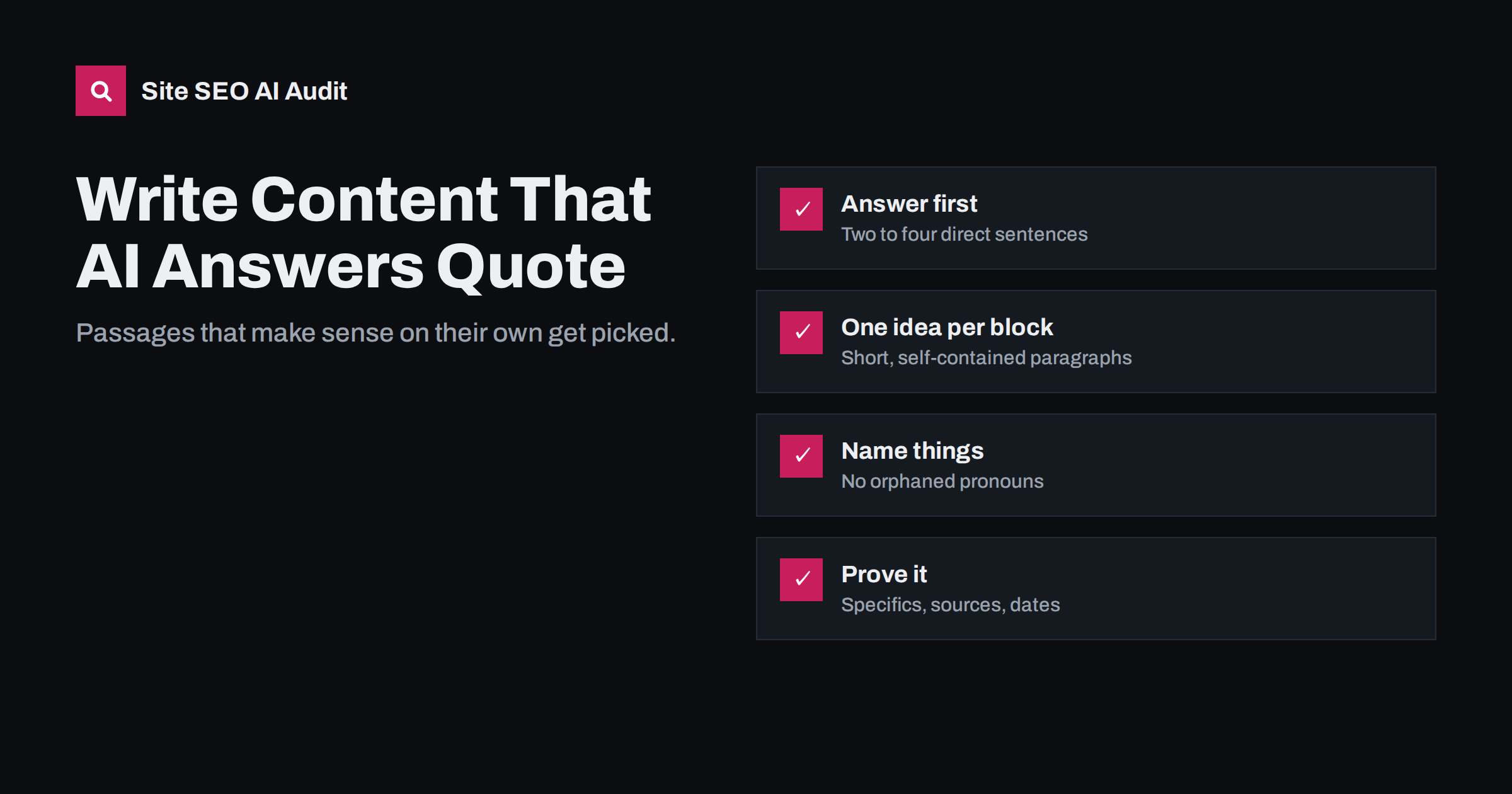
Short answer: AI answers quote passages, not whole pages, so write every important paragraph so it makes sense on its own. Open with a direct answer, use headings that match real questions, name the subject instead of relying on “it” or “this”, and include specific facts such as steps, conditions and numbers you can support. Content written this way is also faster for busy human readers, which is the point: you are writing for both at once.
How AI systems read your page
When an AI assistant or an AI search feature answers a question, it usually retrieves a small number of pages, splits them into passages and chooses the passages most relevant to the query. Those passages go into the model’s working context, and the model writes an answer from them, sometimes quoting closely and sometimes paraphrasing.
Two consequences follow. First, the system rarely reads your page top to bottom the way a person might. It works with chunks, often a few paragraphs at a time, separated by headings or length limits. Second, a chunk that loses its meaning when separated from the rest of the page is a weak candidate. If the key sentence says “this approach halves the cost” and “this approach” was defined three paragraphs earlier, the passage is harder to use.
None of the major AI companies publish their exact chunking or selection methods, and they change often. But the principle of passage-level retrieval is widely described in research on retrieval-augmented generation, and it matches how answers look in practice: a sentence or two from one site, a list from another.
Pattern 1: answer first, then explain
The most reliable habit is to answer the question in the first two to four sentences of the page and again at the start of each major section. Journalists call this the inverted pyramid. It works because both readers and retrieval systems give most weight to what comes first.
Compare two openings for a page about changing a domain name:
- Weak: “Your domain is one of your most important digital assets, and there are many reasons a business might consider a change. In this article we explore the considerations involved.”
- Strong: “To change a domain without losing search traffic, move the site to the new domain, add a 301 redirect from every old URL to its matching new URL, and use the Change of Address tool in Google Search Console. Keep the redirects in place for at least a year.”
The strong version is quotable as it stands. It names the task, the steps and a time frame. The weak version contains nothing a system could use to answer anything.
Pattern 2: headings that match real questions
Headings do two jobs: they help people scan, and they signal to machines where one topic ends and the next begins. Vague headings such as “Overview”, “Things to consider” or “Our thoughts” carry no meaning when separated from the page.
- Phrase important headings as the question people actually ask: “How long does a domain transfer take?”
- Or use a descriptive topic label: “Domain transfer timeline and costs”.
- Keep one topic per section. If a section answers two questions, split it.
- Use a logical hierarchy, with H2 for main sections and H3 for subtopics, so the structure is clear in the HTML and not only in the visual design.
Good sources for question wording include the “People also ask” boxes in search results, your own site search logs, support tickets and sales call notes. Real phrasing beats invented phrasing.
Pattern 3: self-contained paragraphs
A self-contained paragraph states its subject, makes one point and includes the detail needed to understand it. It can refer back to earlier content, but it does not depend on it.
- Name the subject at the start of each new idea. Write “A canonical tag tells search engines…” instead of “It tells search engines…”.
- Keep paragraphs short, typically two to four sentences. Long blocks mix several ideas and dilute relevance.
- Avoid cross-references as the main content. “As mentioned above” is fine as a bridge, but the paragraph should still carry its own meaning.
- Define terms where they are used. A one-clause definition, such as “LCP, the time until the largest visible element loads”, makes the passage usable on its own.
This is also good accessibility practice. People using screen readers often jump between headings and paragraphs, and they benefit from the same independence.
Pattern 4: specific, checkable facts
AI systems are designed to ground their answers in sources, and specific statements are easier to ground than general ones. Adjectives like “fast”, “affordable” or “industry-leading” give a model nothing to repeat. Facts do.
| Vague | Specific |
|---|---|
| We deliver quickly. | Orders placed before 14:00 ship the same working day. |
| Our tool supports many formats. | Exports are available as CSV, XLSX and PDF. |
| Results take some time. | Search engines usually recrawl changed pages within days to a few weeks. |
| Suitable for most businesses. | Designed for sites with up to a few thousand pages. |
Only state what is true and what you can support. Invented statistics are a liability: they can be repeated widely, and they damage trust when someone checks them. When you cite a public fact, link to the original source rather than to a site that repeated it.
Pattern 5: lists, steps and comparisons
Structured formats are easy to extract and easy to read. Use them where the content really is a list:
- Numbered steps for processes, with one action per step and the expected result where useful.
- Bulleted lists for options, requirements, pros and cons, or symptoms.
- Tables for comparisons across the same attributes, such as plans, methods or tools.
- Definition-style lines with a bold term followed by a short explanation, as in this list.
For steps in particular, include the details that people get stuck on: where a setting lives, what a button is called, what the screen should show afterwards and what to do if it does not. These details are exactly what generic content leaves out, and they are what makes a page the best available source for a practical question. A system choosing between a vague overview and a precise walkthrough will usually prefer the walkthrough for a “how do I” query.
Do not force everything into bullets. A narrative explanation of why something happens often works better as prose. The test is whether the structure reflects the content or just decorates it.
Pattern 6: signals of trust and freshness
When several sources say similar things, systems and people both lean towards the ones that look reliable and current. You can make those signals visible:
- Show an author with relevant experience and link to an author page that explains it.
- Show a published date and an updated date, and change the updated date only when you make meaningful changes.
- Explain how you know. “We tested this on our own shop” or “based on our support tickets” signals first-hand experience, provided it is true.
- Use consistent names for your brand, products and people across all pages.
- Keep facts in sync between your articles, product pages and pricing page, so that no source contradicts another.
Mistakes that make content hard to quote
- Long preambles before the answer, such as stories or definitions of obvious terms.
- Key information in images, such as prices or specifications shown only in a graphic without text.
- Content hidden behind interactions that load only when clicked, which non-rendering crawlers never see.
- Keyword repetition that makes sentences awkward and does nothing for relevance.
- Several pages competing for one question with slightly different answers, which confuses both search engines and assistants.
- Generic AI-written filler that repeats what every other page says without adding facts or experience.
How Site SEO AI Audit helps
Good writing only pays off if the page can be read. Site SEO AI Audit checks each page for the structural signals discussed here, including headings, thin content, missing dates and content that depends on JavaScript, and it checks whether AI crawlers are allowed to fetch the site at all. Issues are ranked by how many pages they affect, so template problems surface before one-off ones. You can run a free audit to check your own pages.
Related reading
- What Is Generative Engine Optimization? A Plain Guide
- Google AI Overviews: How Sources Are Chosen and How to Be One
- Why AI Crawlers Miss JavaScript Content and How to Fix It
- What Is On-Page SEO? The Elements That Actually Matter
The bottom line
Write for passages. Put the answer first, use headings that match real questions, make every paragraph stand on its own, and replace vague claims with specific, true facts. Add clear authorship and dates, keep your facts consistent across the site, and you will have content that AI answers can use and that busy readers will thank you for.
FAQ
What is answer-first writing?
Answer-first writing puts a direct answer to the main question in the opening sentences and then adds detail. It helps readers who skim and gives AI systems a clear passage to quote.
Should every heading be a question?
No. Question headings work well for sections that answer a specific query, while descriptive labels suit other sections. The goal is that each heading clearly says what the section covers.
Does longer content get quoted more often?
Not necessarily. AI systems work with passages, so a focused page with a clear answer can be more useful than a long page. Length helps only when it adds relevant detail.
Can I write content just for AI assistants?
Writing differently for bots than for people rarely helps and risks being treated as spam. Content that is clear, specific and trustworthy for readers is the same content that AI systems find easiest to use.
Do I need to rewrite my whole site?
Usually not. Start with the pages that matter most for your business, add direct answers and clearer headings, and fix vague claims. Improve the rest gradually as you update pages.