ENEnglish
 LTLietuviškai
 DEDeutsch
 FRFrançais
 RUРусский
 ESEspañol
 PLPolski
 ITItaliano
 UKУкраїнська
 CSČeština
 PTPortuguês
 JA日本語
 LVLatviešu valoda
 ETEesti
 HUMagyar
 IDBahasa Indonesia
 TRTürkçe
 HIहिन्दी
 ELΕλληνικά
 ARالعربية
 THไทย
 VITiếng Việt
 RORomână
 MSBahasa Melayu
 BNবাংলা
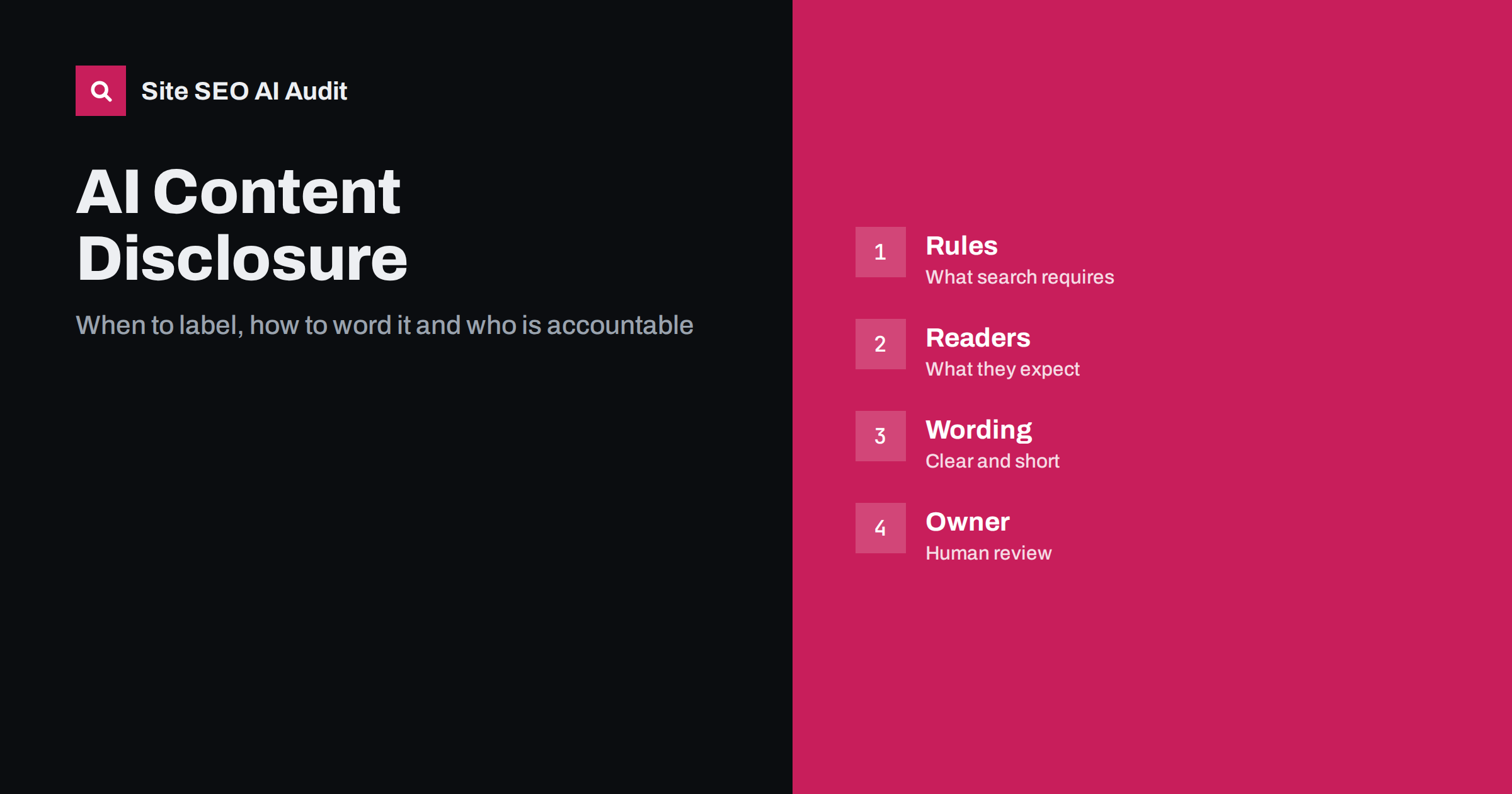
Short answer: Search engines do not require a label saying that content was written with the help of AI, and they judge pages by quality and usefulness, not by how they were produced. Disclosure is nevertheless wise when AI plays a significant part, when readers might be misled about authorship, or when laws and platform rules require it. Write a short, specific note, name the human who is accountable, and make sure review, fact-checking and original value are real, not decoration.
Tools that draft text, summarise sources and translate pages are now part of normal publishing. That raises a question for site owners: do we have to say so? The answer depends on what you mean by “have to”. Search guidance, advertising rules, platform policies and the expectations of your audience point in slightly different directions. This guide separates them, suggests practical wording and explains how disclosure relates to quality and trust. For the quality side, see the guide to AI-written content and SEO.
What search engines say
Major search engines have stated that they reward helpful, reliable, people-first content regardless of how it is produced, and that using automation mainly to manipulate rankings breaks their spam policies. They do not ask publishers to add a technical flag for AI. In some cases, such as images, they support metadata that describes how an image was created, and some platforms add their own labels. For text, there is no standard signal that you need to send.
What matters is the result. A page that is accurate, original in its value, clear about who wrote it and useful to its audience can perform well. A page that repeats what is already everywhere, includes errors or exists only to capture traffic is likely to struggle, whether a human or a machine typed it. The key principle is accountability, as described in the guide to E-E-A-T and AI search.
What the law and platforms may require
Rules are developing. Some jurisdictions have introduced transparency obligations for certain AI-generated or manipulated media, such as synthetic images, audio or video that could be mistaken for real, and for systems that interact with people. Advertising platforms and marketplaces may require labels for certain categories of content. Publishers in regulated sectors may have specific duties about authorship and review. Because the details differ by country and change often, ask a legal adviser if you work in finance, health, law, politics or children’s content.
Also check the terms of the tools you use. Some restrict certain uses or require attribution in particular contexts. And remember that consumer protection law forbids misleading claims, including fake authors or invented expertise, regardless of whether AI is involved.
What readers expect
Surveys and everyday behaviour suggest that readers care less about the tool than about honesty and quality. They are unhappy when a page pretends that a named expert wrote something they never saw, when a review is invented, or when a confident answer turns out to be wrong. They are comfortable when a business explains that a draft was prepared with software and then checked by a named editor.
The sensitivity varies. For a recipe collection or a product description, a note may be unnecessary. For personal advice, medical information, news or opinion, readers are entitled to know who stands behind the words. Consider your audience and the stakes: the higher the potential harm from a mistake, the more important it is to be transparent and to show human review.
When disclosure is a good idea
A label is advisable in several cases. When most of the text was generated and only lightly edited. When content is translated automatically and has not been checked by a fluent reviewer. When images, voices or video are synthetic and realistic. When a persona or a chat assistant might be mistaken for a person. When your own policy or industry guidance promises transparency. And whenever omission could reasonably mislead a reader about the source of advice.
It may be unnecessary when AI is used for spelling checks, minor rewording, outline brainstorming or similar assistance, and a human writes and takes responsibility for the content. The test is whether a reasonable reader would feel misled if they learned how it was produced.
How to word a disclosure
Keep it short, plain and specific. Instead of “this page may contain AI”, say what actually happened: “This guide was drafted with the help of AI software and reviewed, fact-checked and edited by our team. Last reviewed on 3 November.” Place it where readers will see it, for example near the byline or at the end of the article, and link to a policy page that explains your approach in more detail.
Avoid hiding the note in small print or using it as a shield against responsibility. Do not write “errors are not our fault”. Name an accountable person or role, show the date of review and provide a way to report mistakes. For images, add a caption or alt text that says what is synthetic where it matters, following the guide to image alt text.
Write an AI use policy
A short public policy page helps readers and gives your team clear rules. State where you use AI tools, for what tasks and where you do not. Describe the human review process: who checks facts, how sources are verified, how corrections are handled. Say how you treat customer data and whether you ever publish unreviewed output. Keep it factual and avoid promises you cannot keep.
Inside the organisation, set rules about prohibited uses, such as inventing quotes, creating fake reviews, copying other people’s work or entering confidential data into tools that retain it. Review the policy every few months, as tools and rules change quickly. This also helps with questions from clients, partners and regulators.
Special cases: images, translation and chat assistants
Different formats raise different questions. For images, realistic synthetic pictures of people, places or events can mislead if presented as photographs. Say so in a caption when the image illustrates a real situation, and never use generated images as evidence of a product’s results. For translation, a machine translation that nobody has reviewed can contain errors that change meaning; mark such pages clearly or have a fluent reviewer check them, particularly for legal, medical and pricing text.
For chat assistants and automated replies, tell users that they are talking to software, and offer a route to a human for complicated or sensitive cases. For reviews and testimonials, never generate them; fake endorsements break consumer protection rules in many countries. For summaries of other people’s work, give credit and link to the source. Treat each format with the same principle: no reader should be misled about who or what produced the material they rely on.
Keeping records and handling corrections
Documentation protects you if a question arises. Record for important pages who drafted, who reviewed, which sources were used and when the page was last checked. Keep versions so that you can show what changed. Publish a corrections process: an email address or form, a promise to review reports promptly and a visible note when a significant correction is made.
Corrections build trust with readers and with systems that read your pages. A clearly marked update with the date and a short explanation shows that the page is maintained. Avoid silent changes to facts that readers may have relied on. If an error caused harm, contact the affected people directly where possible, and fix the underlying process, not only the sentence.
Disclosure does not replace quality
A label does not make weak content acceptable, and its absence does not make good content suspect. Quality comes from original examples, accurate facts, clear structure and real expertise. Build a review checklist: verify every number and claim against a source, check names and dates, remove generic filler, add experience that only your organisation has, and test links. Keep records of sources for important pages.
The practices in the guide to thin content and in refreshing old posts apply equally to machine-assisted drafts. Pages should also keep dates honest, as covered in the guide to content dates and freshness.
In practice, start small. Audit where AI is already used in your workflow, choose a consistent wording for the cases that need a note, and add it to your publishing template so that it appears automatically where applicable. Train editors on the policy, and review a sample of published pages every quarter to confirm that the practice matches the promise. Transparency that is easy to apply is far more likely to be kept than a complicated rule that nobody remembers.
Site SEO AI Audit crawls your website and checks status codes, titles, descriptions, headings, thin and duplicate content, broken links, structured data, page speed and AI visibility settings, which helps you find weak or duplicated pages whatever way they were written. It does not detect or judge how text was produced. The first audit of up to 200 pages is free, and larger sites can see the pricing page.
Related reading
The bottom line
Disclose when it matters to readers, name a responsible human and make the quality real.
الأسئلة الشائعة
Do I have to label AI-assisted articles for Google?
No technical label is required. Pages are judged on usefulness and quality, though other rules or your audience may call for disclosure.
Will a label hurt my rankings?
There is no sign that an honest note reduces rankings. Poor quality content is the real risk.
Where should the note go?
Near the byline or at the end of the article, with a link to your policy page.
Is minor AI help such as spell-checking worth mentioning?
Usually not. Disclose when AI produced a significant part of the content or when readers could be misled.
Who is responsible for errors?
The publisher. Name an accountable person or role and offer a way to report corrections.