ENEnglish
 LTLietuviškai
 DEDeutsch
 FRFrançais
 RUРусский
 ESEspañol
 PLPolski
 ITItaliano
 UKУкраїнська
 CSČeština
 PTPortuguês
 JA日本語
JA日本語 LVLatviešu valoda
 ETEesti
 HUMagyar
 IDBahasa Indonesia
 TRTürkçe
 HIहिन्दी
 ELΕλληνικά
 ARالعربية
 THไทย
THไทย VITiếng Việt
 RORomână
 MSBahasa Melayu
 BNবাংলা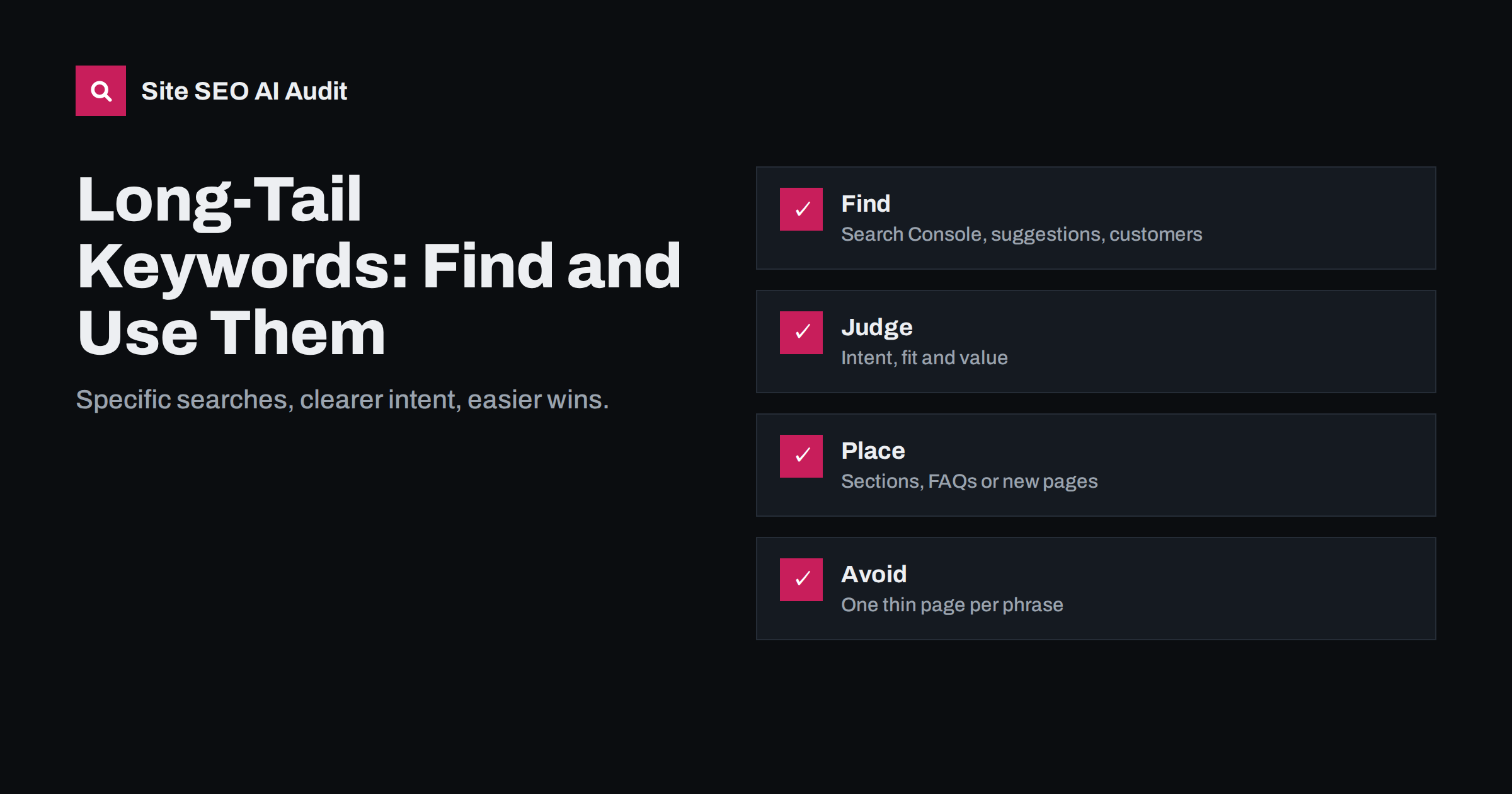
Short answer: Long-tail keywords are specific, usually longer search phrases with lower individual volume and a clearer intent, such as “seo audit for a wordpress shop” instead of “seo audit”. Together they often make up a large share of a site’s search traffic, they are usually easier to rank for and they convert well because the searcher knows what they want. Find them in Search Console, search suggestions and customer questions, then cover them inside relevant pages or as dedicated pages only when the intent is truly different.
What makes a keyword long-tail
The name comes from a chart of keywords sorted by search volume. A few popular terms form the tall “head” on the left; a very long line of rare, specific searches forms the “tail” on the right. Each tail query is searched rarely, but there are so many of them that together they add up to a large share of all searches.
Length is a symptom, not the definition. What really characterises a long-tail keyword is specificity:
- “running shoes” is a head term. “trail running shoes for wide feet” is long-tail.
- “accounting software” is a head term. “accounting software for freelancers in Germany” is long-tail.
- “canonical tag” is fairly broad. “canonical tag pointing to redirected page” is long-tail.
A two-word query can be long-tail if it is rare and precise, such as a specific model number. A five-word query can still be broad if millions of people type it.
Why long-tail keywords matter
For small and medium-sized sites, long-tail searches are often the most realistic source of traffic.
- Clearer intent. A specific query tells you what the searcher needs, which makes it easier to write a page that satisfies it. The guide on search intent explains why that matters so much for rankings.
- Less competition. Large sites fight over head terms. Specific questions are often answered poorly or not at all.
- Better conversion. Someone searching for a precise solution is typically further along in their decision.
- Stability. Traffic spread over hundreds of queries is less vulnerable to one ranking change.
- Natural fit with AI answers. People ask assistants detailed, conversational questions. Content that answers specific questions clearly is easier to quote.
The trade-off is that volume data for rare queries is unreliable. Keyword tools often show zero or very low numbers for phrases that do bring real visitors. Treat low volume estimates as a rough signal, not a verdict.
Where to find long-tail keywords
The best sources are the ones closest to real searchers.
- Google Search Console. The Performance report shows queries your pages already appear for. Sort by impressions and look for specific queries with many impressions but a low position or low click-through rate. They are your quickest opportunities because search engines already associate your site with them.
- Search suggestions. Autocomplete, “People also ask” boxes and related searches at the bottom of results reveal how people phrase questions around a topic.
- Customer conversations. Sales calls, support tickets, chat logs and e-mails contain the exact words customers use. These often include phrases no keyword tool knows.
- Your site search. Internal search queries show what visitors expected to find but could not locate easily.
- Forums and communities. Threads where people describe problems in their own words are rich in natural long-tail phrasing.
- Keyword tools. Use them to expand seed terms with modifiers, but verify ideas against the sources above.
Common long-tail patterns
Most long-tail queries are a head term plus one or more modifiers. Knowing the patterns makes it easier to spot gaps in your content.
| Modifier type | Example | Typical intent |
|---|---|---|
| Audience | seo checklist for photographers | Tailored guidance |
| Platform or tool | fix duplicate titles in wordpress | Specific how-to |
| Problem or error | sitemap couldn’t fetch error | Troubleshooting |
| Comparison | subfolder vs subdomain for blog | Decision support |
| Location | bookkeeper for startups in vilnius | Local service |
| Attribute | waterproof hiking boots under 150 euros | Product selection |
| Question | how long does a site migration take | Information |
Go through your main topics and ask which of these modifiers your customers actually use. Each combination is a candidate.
How to judge whether a long-tail keyword is worth it
Not every specific phrase deserves attention. Ask four questions before adding one to your plan.
- Does it fit what you offer? A phrase that brings visitors who can never become customers is rarely worth the effort.
- What does the current result page look like? Search it. If the top results are forums, outdated posts or pages that only half answer the question, there is room for a better page.
- Is the intent different from pages you already have? This decides whether you need a new page or a better existing one.
- Is it part of a cluster? Several related long-tail queries together may justify a comprehensive guide even if each one alone looks small.
New page or section of an existing page?
The most common mistake with long-tail keywords is creating a separate thin page for every phrase. Search engines understand that “how to fix duplicate titles” and “duplicate title tags fix” mean the same thing. Separate pages for each variation compete with each other and dilute your signals, which is exactly the problem described in keyword cannibalisation.
Use a simple rule: same intent, same page; different intent, different page.
- If the long-tail query is a variation or a detail of an existing topic, add a section, an FAQ answer or an example to the page that already covers it.
- If it represents a different task or audience, for example a platform-specific tutorial or a comparison, it may deserve its own page.
Our guides on keyword mapping and on whether one page can rank for multiple keywords go into this decision in more detail.
How to use long-tail keywords on the page
Once a phrase is assigned to a page, use it naturally where it helps the reader.
- Headings. A long-tail question often works well as an H2 or H3, followed directly by a clear answer.
- Title and description. If the phrase is the page’s main topic, include it or a close variant in the title tag. Otherwise leave the title for the main keyword.
- First sentences of a section. Answer the specific question immediately, then add detail.
- FAQ blocks. Related questions that need only a short answer fit well in an FAQ section, as described in FAQ sections that work for readers and AI answers.
- Examples and specifics. Long-tail searchers want concrete details: exact steps, settings, numbers, screenshots. Specificity is what makes the page better than a generic one.
Avoid stuffing variations into the text. Repeating “best seo audit tool for small business” five times reads badly and adds nothing that search engines need.
Measuring long-tail results
Because individual queries are small, judge long-tail work at the page or topic level. In Search Console, filter the Performance report by page and watch the number of distinct queries and total impressions grow over the weeks after an update. A page that answers a topic well usually starts appearing for many phrasings you never targeted directly.
Useful signals to track for each updated page:
- Number of ranking queries. A growing count shows that search engines see the page as relevant for more variations of the topic.
- Impressions for the target phrases. Check whether the specific questions you added now appear, and at which position.
- Click-through rate. If impressions rise but clicks do not, the title and description may not match the specific wording people use.
- Conversions from the page. Long-tail visitors often have clearer intent, so enquiries, sign-ups or sales per visit are a better success measure than raw traffic.
Give changes several weeks before judging them. Rare queries need time to accumulate enough impressions to show a trend, and a single week of data can be misleading.
How Site SEO AI Audit helps
Site SEO AI Audit does not do keyword research. It helps with the page side: it checks titles, descriptions, H1s and thin or duplicate content across your whole site, which is where long-tail efforts often go wrong when many similar pages are created. Duplicate titles or clusters of thin pages in the report are a common sign of one-page-per-phrase content that should be merged. You can see the current state with a free audit.
Related reading
- Keyword Placement: Where to Use Keywords on a Page
- Semantic SEO: How to Cover a Topic, Not Just a Keyword
- Thin Content: How to Find and Fix Low-Value Pages
The bottom line
Long-tail keywords are specific searches with clear intent and less competition. Find them in Search Console, suggestions and customer conversations, judge them by fit and intent rather than by volume estimates, and cover them within the page that already owns the topic unless the intent is truly different. Specific, useful answers win the long tail; thin pages for every variation do not.
الأسئلة الشائعة
What is a long-tail keyword?
It is a specific search phrase with relatively low search volume and a clear intent, often three or more words long. Examples include queries with a platform, audience, problem or location added to a broader term.
Are long-tail keywords easier to rank for?
Usually yes, because fewer pages target them precisely. They still require a page that answers the specific question better than the current results.
Should I target long-tail keywords with zero search volume?
Volume estimates for rare phrases are unreliable. If customers really ask the question and it fits your offer, answering it is often worthwhile, especially within an existing page.
How many long-tail keywords can one page target?
A good page often ranks for dozens or hundreds of related phrases. What matters is that they share the same intent; different intents need different pages.
Where can I find long-tail keywords for free?
Search Console queries, autocomplete, “People also ask” boxes, related searches, your site search data and customer support conversations are all free and reliable sources.