ENEnglish
 LTLietuviškai
 DEDeutsch
 FRFrançais
 RUРусский
 ESEspañol
 PLPolski
 ITItaliano
 UKУкраїнська
 CSČeština
 PTPortuguês
 JA日本語
 LVLatviešu valoda
 ETEesti
 HUMagyar
 IDBahasa Indonesia
 TRTürkçe
 HIहिन्दी
 ELΕλληνικά
 ARالعربية
 THไทย
 VITiếng Việt
 RORomână
 MSBahasa Melayu
 BNবাংলা
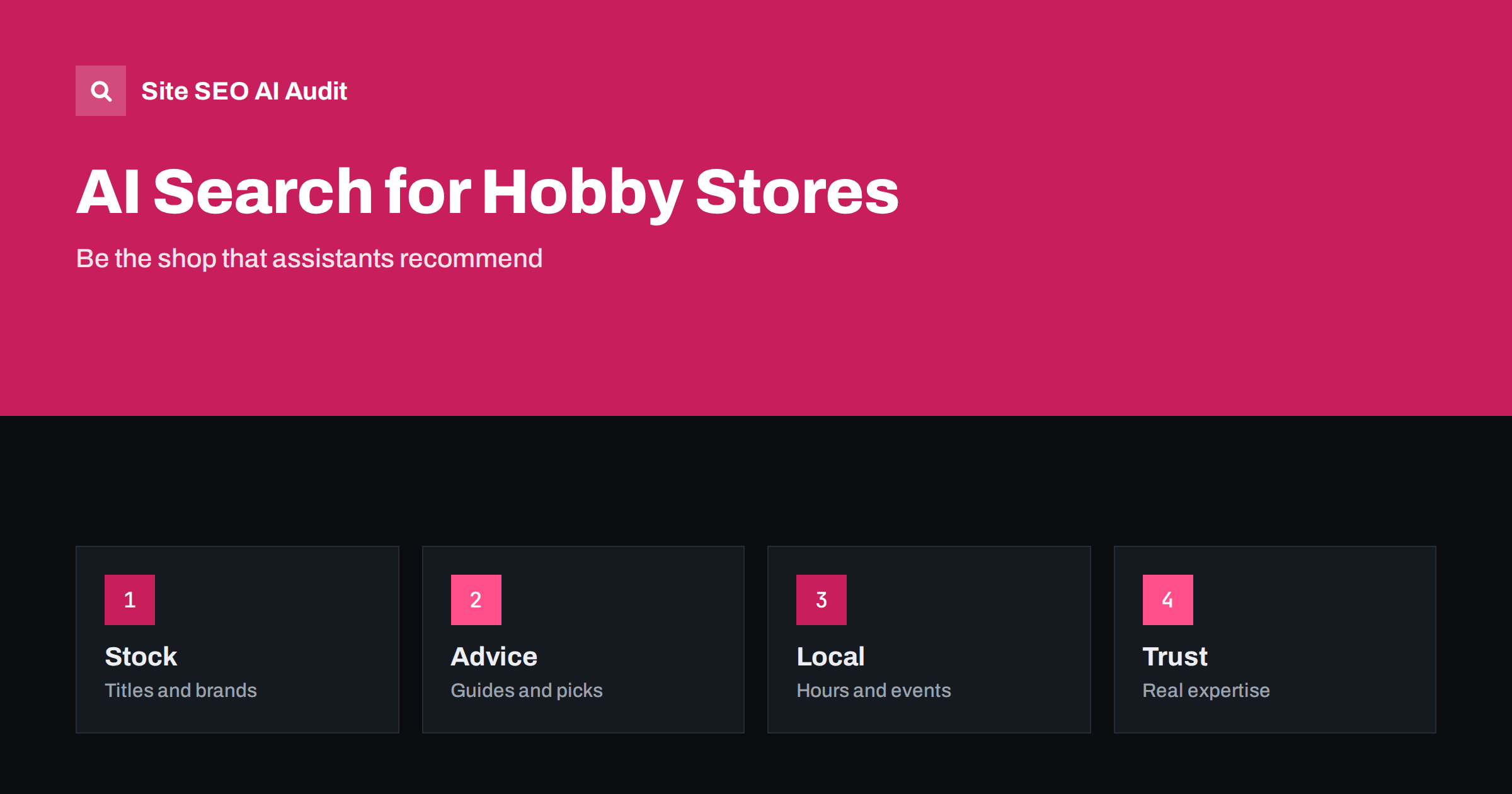
Short answer: Hobby shoppers ask assistants for specific help: a first acoustic guitar for a teenager, a beginner watercolour set, a model kit for a rainy weekend or a novel like one they just finished. Independent shops can be named in such answers when their pages show real stock, give honest expert advice, explain who a product suits and state local facts such as opening hours, events and services. Specific, helpful text beats a catalogue of names and prices.
Large marketplaces win on range and price, but they are weak on advice. A person choosing a ukulele or a paint brush wants to know which one is right for them, and many ask an assistant first. The shop that explains differences in plain language can be the source the assistant quotes, and it can also be the place where the buyer then goes. This guide covers what independent bookshops, music shops, craft stores, model and game shops and similar specialists can publish. For general principles, see the guide to generative engine optimization.
How hobby buyers ask
Questions are practical and personal. Which beginner telescope works from a city balcony? What is the best first sewing machine? Which graphic novels suit a twelve year old who likes mysteries? Is there a shop nearby that repairs violins? Each question contains a use, a level and often a constraint such as budget, space or age. A page that states these things clearly can match.
Product pages that only list a name, a code and a price give an assistant almost nothing to use. Add a plain description of what the item is for, who it suits, what else is needed to use it and how it compares with the next model up or down. Honest statements about limits build trust, for example that a kit needs paint bought separately.
Make stock understandable
Use clear, consistent product data: title, brand, model, format, size, age range, material, compatibility, edition and condition for second-hand items. For books, give author, publisher, language, year, binding and the standard book number. For instruments, state the scale length, the wood where known and the included accessories. For model kits, give scale, number of parts and skill level. These attributes are what buyers filter on, and they are what an assistant extracts.
Mark up products and offers with structured data that matches the page, including price, currency and availability. Keep availability honest: a page that says in stock when it is not frustrates both customers and systems. The details are in the guide to product schema. If you carry many variants, make sure each is clear and not buried, as described in the guide to product variants.
Publish advice that helps
Advice is your advantage. Write guides in the voice of the person who works in the shop: how to choose a first guitar, how to look after a vinyl record, what to read after a particular author, how to start a model railway, which brushes suit which paints. Keep them specific, with examples from your stock and clear recommendations at several budgets. Add the name and role of the author, and a short note on their experience. This supports the kind of trust discussed in the guide to E-E-A-T and AI search.
Curated lists work well for shops with a personality: staff picks, seasonal reading, gift ideas by age, best sellers in a niche. Each list should explain why the items are included, not just show covers. Lists that repeat the same names without reasoning add little. The structure of such pages is covered in the guide to listicle SEO.
Describe local services
Independent shops offer things that online sellers cannot: repairs, fittings, lessons, trial play, special orders, framing, restringing, clubs and workshops. Give each service a page with a description, the prices or a starting price, the time needed and how to book. A page titled violin repair and setup, with what is done and how long it takes, will answer a local question directly.
Keep local details accurate on the site and on business listings: address, phone, opening hours including holidays, parking, accessibility and whether a booking is needed. Consistency across all places makes the shop easier to identify, a point discussed in the guide to aligning your business profile with your website. Add a page for the area you serve, but avoid copying the same text for several towns, since duplicated location pages add no value, as covered in the guide to location pages.
Events, clubs and community
Readings, signings, open mic evenings, painting workshops, game nights and swap meets give the shop a place in the community and give assistants current facts. Create an event page for each with date, time, price, place, age suitability and how to register, and keep the archive. Events are also a source of local links and mentions, from newspapers and clubs, that support your reputation, which relates to the guide to unlinked brand mentions.
If you run a club or a loyalty scheme, explain its terms clearly. Do not promise benefits that you cannot deliver. Publish only terms that exist in your actual practice.
Reviews and reputation
Customer reviews on map listings and review sites tell assistants how the shop is regarded. Ask satisfied customers to leave an honest review after a purchase or a repair, and reply to all reviews with courtesy. Do not buy reviews or write them yourself. Add real customer comments to your site only with permission, and follow the rules for review markup. The principles are in the guide to reviews and reputation.
Used, rare and second-hand items
Many hobby shops sell used books, records, instruments, cameras and games. These items are unique, so each page needs a clear description of condition, edition, any flaws and the price, with real photos taken in good light. Grading terms should be defined on a single page, and used consistently. When an item sells, keep the page if it has value as a reference, marked sold, with links to similar items. Removing pages for one-off items creates a steady stream of missing pages, and a sold page that explains the edition can still attract readers who become buyers of something else. The matter is addressed in the guide to out-of-stock product pages.
Pay attention to how your pages read when quoted in an answer. An assistant may take two sentences from a page, so make the first lines of each section complete. A paragraph that starts with a clear statement of what the product is and who it suits will survive being quoted out of context. Avoid wording that only makes sense with a photo beside it.
Check that crawlers can reach the pages. Online shops built with scripts sometimes show products only after interaction. Make sure that product lists have crawlable links, that filters do not create endless addresses and that AI crawlers are not blocked by accident. The control decisions are covered in the guide to AI crawlers and robots.txt.
Here is a short example. An independent music shop had a webshop with product names, codes and prices. After a rewrite, each guitar page said who the model suited, how it sounded, what the action was like, which strings it came with and what a beginner should add to the order. The shop also published a guide to choosing a first guitar for different ages, a page for its setup service and an event page for a monthly open mic night. Within a few months, customers began mentioning that an assistant had pointed them to the shop when they asked about first guitars in their city.
A bookshop followed a different path. It wrote short, honest reviews of books it stocked, grouped by mood and age, and always named the staff member who recommended each. Its pages gave assistants quotable, personal advice, and local readers began arriving with the title in hand. The shop did not need a large catalogue, because the advice was the product.
Gift buyers deserve a special mention. Many questions come from people who do not know the hobby, such as someone buying a present for a relative who paints or plays chess. Create gift guides by budget, level and occasion, written in plain words that avoid jargon, and explain what else the recipient will need. Offer gift wrapping, vouchers and delivery times clearly, with the last order date for holidays. Such pages answer the exact questions that assistants receive before seasonal peaks, and they bring in customers who may become regulars once they see that the shop understands the hobby as well as the people in it.
Site SEO AI Audit crawls your shop or blog and checks status codes, titles, descriptions, duplicate and thin content, links, structured data, speed and AI visibility settings such as robots.txt and llms.txt, which helps you spot weak product pages. It does not manage stock or write advice for you. The first audit of up to 200 pages is free, and the pricing page lists plans for larger shops.
Related reading
- AI Search for Craft and Handmade Sellers
- AI Search for Toys and Kids Brands
- Product Pages for AI Shopping
The bottom line
Independent hobby shops are recommended when pages give specific product facts, honest advice, clear local services and real events, kept accurate and crawlable.
FAQ
What should a product page include?
What the item is, who it suits, key attributes, what else is needed, price and honest availability.
Do advice articles really help a shop?
Yes. They answer the questions buyers ask assistants and show real expertise that marketplaces lack.
How do I handle one-off used items?
Describe condition precisely, use real photos and keep sold pages with links to similar items.
Should I list repair services?
Yes, with a page per service, a starting price, timing and how to book.
Can I use staff reviews on the site?
Yes, if they are honest and named. Do not fake customer reviews.