ENEnglish
 LTLietuviškai
 DEDeutsch
 FRFrançais
 RUРусский
 ESEspañol
 PLPolski
 ITItaliano
 UKУкраїнська
 CSČeština
 PTPortuguês
 JA日本語
 LVLatviešu valoda
 ETEesti
 HUMagyar
 IDBahasa Indonesia
 TRTürkçe
 HIहिन्दी
 ELΕλληνικά
 ARالعربية
 THไทย
 VITiếng Việt
 RORomână
 MSBahasa Melayu
 BNবাংলা

Short answer: “Pages return an error (4xx)” is a critical finding in Site SEO AI Audit. It lists pages that the crawler reached but that answered with an error status in the 400 range, most often 404 “not found”. Visitors and search engines hit a dead end, and links pointing to those pages lose their value. For each address, restore the page, redirect it with a 301 to the closest live page, or remove the links to it if it is gone for good. Then run a new check to confirm the list is empty.
Almost every website has a few dead pages. A product was removed, a post was renamed, a menu item points to a page that was deleted last year. One or two of them are not a disaster. The audit still treats the finding as critical, because the damage grows with the share of pages affected: a visitor who lands on an error page usually leaves, and a search engine that keeps meeting errors on addresses it has seen before slowly stops trusting them. This guide explains what the finding means, how the report shows it and how to decide what to do with each address.
What a 4xx status means
Every page answers a request with a three-digit status code. Codes starting with 2 mean success. Codes starting with 3 mean a redirect. Codes starting with 4 mean that the request could not be fulfilled because of something about the request or the address: the most common is 404, “not found”, but 403 (forbidden), 410 (gone) and 401 (login required) belong to the same family. The finding in the report covers the whole 400 range, so a page that blocks the crawler with 403 is listed next to a page that was simply deleted.
The key point is that the browser may still show a friendly designed page. Many themes display a nice “Sorry, we could not find that” message, but the technical status behind it is still 404. The audit reads the status, not the design, which is why it can find problems you never see when you click around.
How Site SEO AI Audit finds these pages
The crawler, SEOAuditBot, starts from your home page and your XML sitemap. It follows internal links and reads each page it can reach, respecting your robots.txt. For every address it records the status code. If an address answers with an error, it becomes part of the finding “Pages return an error (4xx)”.
The finding sits in the Crawl and index area, which carries 25 percent of the total score, the largest weight of the seven areas. Severity also matters. In the scoring formula a critical issue counts ten points, a warning four and a notice one, and the penalty is multiplied by the share of your indexable pages that are affected, softened so that a single forgotten address does not wreck the score. A handful of error pages on a large site costs little. Dozens of them on a small site cost a lot.
The report also has a separate finding in the Links area, “Broken internal links”, which shows the other side of the same problem: the pages that link to the dead address. Use the two together. The 4xx finding tells you which addresses are dead, and the links finding tells you where the links come from. The article about broken internal links in your report explains the second list in detail.
Where dead pages usually come from
- Deleted content. A product, post or landing page was removed, but the menu, a related-posts block or an old article still links to it.
- Changed address. A slug was edited, a category folder was renamed or a permalink structure changed, and no redirect was added from the old address.
- Typos in links. A link was typed by hand with a missing letter, a wrong slash or a different upper and lower case.
- A migration. After a move to a new platform some old addresses were not carried over, and the sitemap or internal links still use them.
- Sitemap leftovers. The sitemap lists addresses that no longer exist, so the crawler finds them even if no page links to them.
- Access rules. A firewall, a login rule or a security plugin answers with 403 to crawlers, so a perfectly healthy page looks broken to the audit.
Look at the list of affected pages in the report. If many addresses share a folder or a pattern, one rule probably explains them all, and fixing the rule is faster than editing each page.
Restore, redirect or remove: how to decide
There is no single right answer for all addresses. Decide for each one by asking whether the content still has a home on your site.
| Situation | Best action | Why |
|---|---|---|
| The page should still exist | Restore it so it returns 200 | Keeps its links and rankings |
| The content moved or was replaced | 301 redirect to the closest matching page | Passes visitors and signals to the new address |
| The page is gone and has no equivalent | Leave it as 404 or 410 and remove every link to it | An honest error is better than a misleading redirect |
| The crawler is blocked with 403 | Allow the crawler in the firewall or security plugin | The page is healthy, only the access rule is wrong |
The report gives you the recommendation in the issue card: restore the page or redirect it with a 301 to the closest live page, and update the links that point to it. On a WordPress site the card also shows the steps in wp-admin, such as installing a redirect plugin and adding a 301 for each address.
Do not send everything to the home page
It is tempting to fix a long list in one move by redirecting every dead address to the home page. Search engines often treat such a redirect as a “soft 404”, because the destination has nothing to do with the old page, and visitors feel tricked. Redirect only when there is a real equivalent: an old product to its successor, an old guide to the updated guide, an old category to the new category. When there is nothing similar, an honest 404 or 410 is the better answer. The article on soft 404 errors explains why, and the comparison of 410 Gone and 404 Not Found helps you choose between the two honest options.
Step by step: from report to repair
- Open the issue card. Read why it matters and open the list of affected pages.
- Sort the list into groups. Put addresses with the same folder or pattern together. Treat each group as one task.
- Open three addresses in a browser. Confirm the status and see whether the content exists elsewhere on the site.
- Choose an action for each group. Restore, redirect, or leave as an honest error.
- Fix the links. Use the broken internal links finding to find every page that links to a dead address, and update the link. A redirect is a safety net, but a direct link to a live page is better and faster.
- Clean the sitemap. Remove dead addresses from the XML sitemap so crawlers stop finding them there.
- Run a new check. Starter, Pro and Agency include re-checks. The finding should shrink or disappear, and the score should rise by about the points the report showed.
If you are new to the whole process, the guide to finding and fixing broken links gives the general method that this report speeds up.
Give the visitor somewhere to go
Some error pages will always exist, because people mistype addresses and old links on other websites never disappear. Make those moments useful. A custom error page that keeps the site menu, offers a search box and links to your main sections turns a dead end into a second chance. It should still answer with the 404 status, so search engines understand that the address does not exist. The guide to custom 404 pages lists what such a page needs.
Keep the list empty
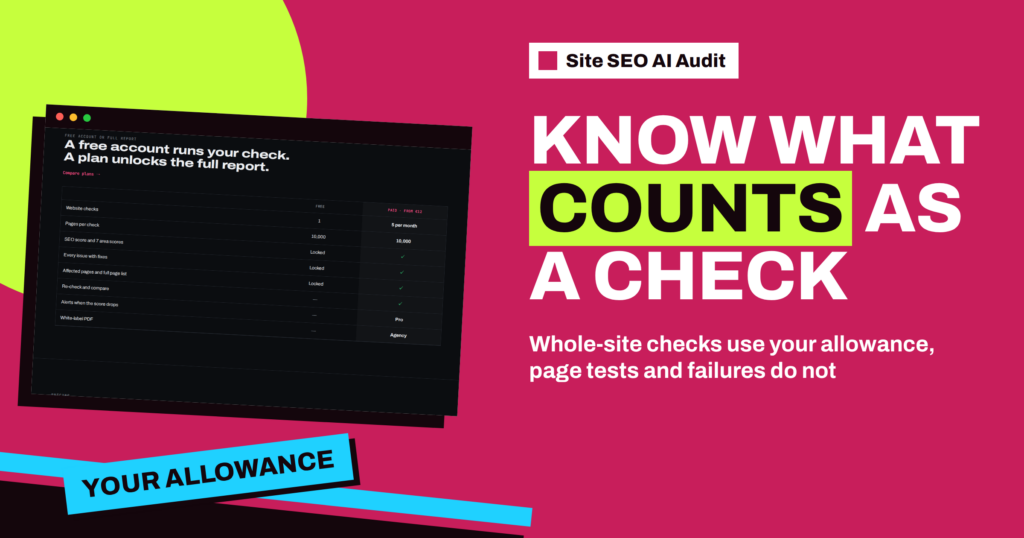
Dead pages return whenever content changes. Run a check after every redesign, migration, plugin switch or large clean-up of old content. A check covers your whole website, up to 10,000 pages, and plans count checks per month: Starter five, Pro twenty and Agency one hundred, as the pricing page shows. A short release checklist helps as well: before deleting or renaming a page, search for links that point to it, and add the redirect in the same change. Pro adds e-mail alerts when the score drops, which is a useful second line of defence when a release slips through.
Related reading
- Broken Links: How to Find and Fix Them Across Your Site
- Soft 404 Errors: What They Are and How to Fix Them
- 410 Gone vs 404 Not Found: Which Should You Use?
- Custom 404 Pages: What a Helpful Not Found Page Needs
The bottom line
Error pages are dead ends for visitors and for search engines. Use the finding to list every address, decide for each whether it should be restored, redirected or honestly removed, fix the links that lead to it and run a new check to confirm the list is clean.
FAQ
Is every 404 a problem for SEO?
No. A page that is truly gone can honestly answer 404 or 410. The problem is a dead address that still receives links, appears in the sitemap or ranks, because visitors and crawlers keep arriving there.
Why is the finding critical?
Because a visitor or crawler that reaches the address gets nothing, and links pointing to it lose their value. In the score, a critical issue counts ten points, multiplied by the share of pages affected.
Why does a working page appear in the list?
It may answer the crawler with 403 because of a firewall or security plugin, or it may answer with an error only sometimes. Open it in a browser, check the rule that blocks crawlers and run the check again.
Should I redirect every dead page to the home page?
No. Redirect only to a page with a similar purpose. A blanket redirect to the home page is often treated as a soft 404 and does not help visitors.
Which plan shows the affected pages?
Any paid plan. A free account runs one check and shows the report locked, while Starter, Pro and Agency unlock every issue and affected page.