ENEnglish
 LTLietuviškai
 DEDeutsch
 FRFrançais
 RUРусский
 ESEspañol
 PLPolski
 ITItaliano
 UKУкраїнська
 CSČeština
 PTPortuguês
 JA日本語
JA日本語 LVLatviešu valoda
 ETEesti
 HUMagyar
 IDBahasa Indonesia
 TRTürkçe
 HIहिन्दी
 ELΕλληνικά
 ARالعربية
 THไทย
THไทย VITiếng Việt
 RORomână
 MSBahasa Melayu
 BNবাংলা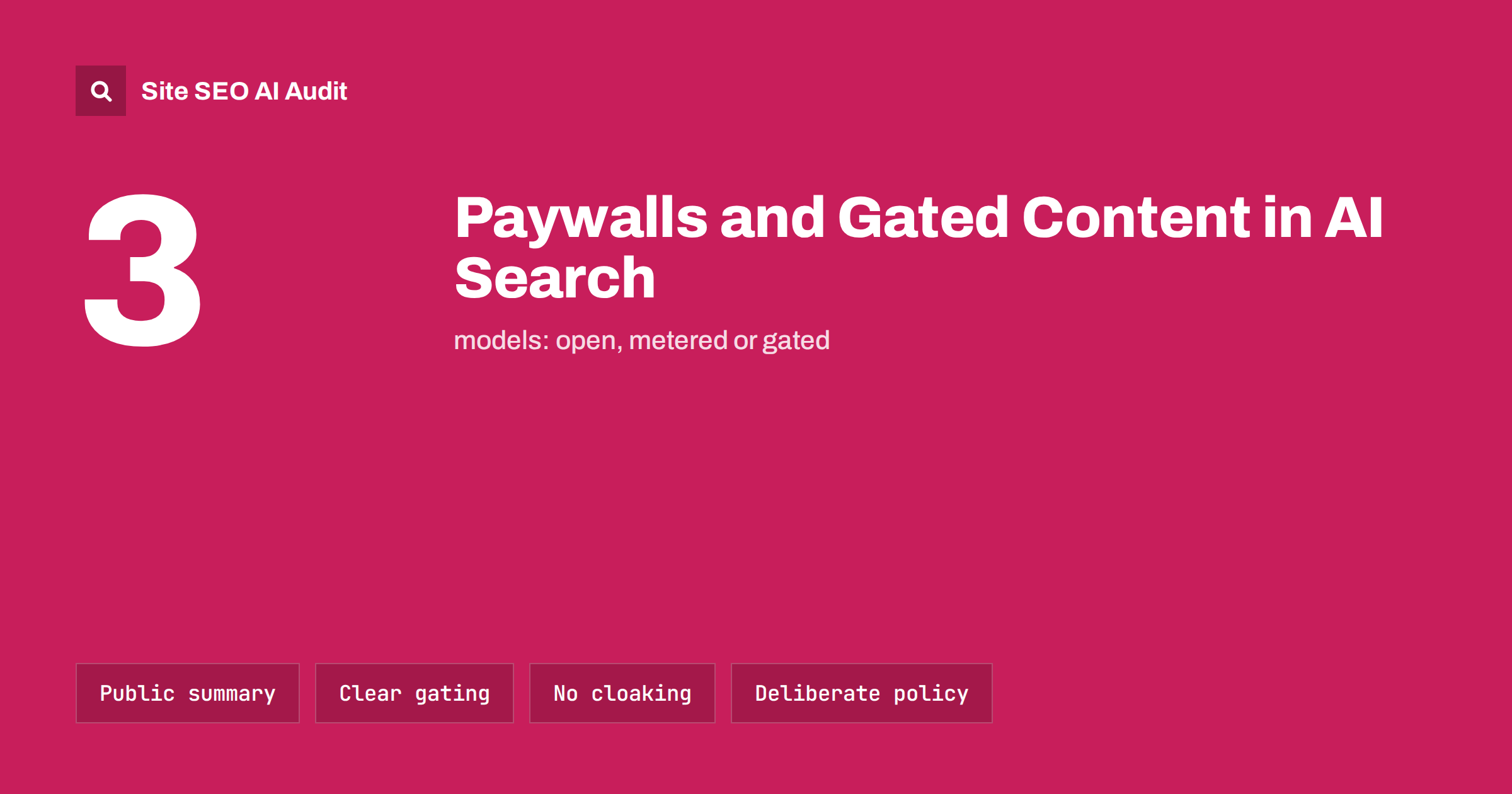
Short answer: AI crawlers generally see only what an anonymous visitor sees, so content behind a login, paywall or lead form is usually invisible to AI search and cannot be cited. If you want gated content to be discoverable, publish a substantial public summary or preview, mark paywalled sections with the appropriate structured data so search engines do not mistake them for cloaking, and decide deliberately which content stays private. Showing full content to bots while hiding it from users is cloaking and carries real risk.
Why gated content and AI search clash
Many businesses keep their most valuable material behind some form of gate: subscription articles, member resources, research reports behind an email form, course lessons, client portals, detailed pricing for logged-in users. The gate has a purpose, whether revenue, leads or privacy. But AI search works by retrieving and quoting accessible text. A crawler cannot fill in a form, log in or pay, so from its point of view the gated page contains only the gate.
That creates a genuine trade-off. The more you gate, the less AI systems can say about you, and the more likely an answer is to cite a competitor or a third party summarising your topic. The more you open, the more value you may give away to answers that users read without visiting. There is no universal right answer, but there are sensible middle positions.
It also helps to separate two goals that are often mixed up: being found and being read in full. Most businesses want their premium content to be found, so that people know it exists and who created it. Few need it to be readable in full by every machine. Once you separate the two, the design of previews and gates becomes much easier.
What crawlers actually see
Understanding the mechanics helps you choose the right approach:
- Login walls: content that requires an account is not crawled at all. Crawlers receive the login page or a redirect.
- Lead forms: gated downloads such as whitepapers are invisible unless the file is linked publicly somewhere, which defeats the gate.
- Hard paywalls: the server returns only a teaser to non-subscribers, so crawlers see the teaser.
- Soft or JavaScript paywalls: the full article is in the HTML but hidden by a script or overlay. Crawlers that do not run JavaScript may read the full text, which is why publishers use paywall markup to signal what is going on.
- Metered access: a limited number of free articles; crawlers are usually treated as new visitors.
Some publishers go further and license content directly to AI companies under commercial agreements. That is a business negotiation rather than a technical setting, and it is mainly relevant to large media organisations.
Three models and their trade-offs
| Model | What is public | AI দৃশ্যমানতা | Main risk |
|---|---|---|---|
| Open | Everything | Highest | Answers may replace visits |
| Metered or preview | Summary, first sections, key facts | Medium | Previews too thin to be useful |
| Fully gated | Landing page only | Low | Competitors define the topic in answers |
Most businesses end up with a mix: open marketing, product and help content; previews for premium resources; fully gated client or member areas.
Whichever model you choose, apply it consistently across similar content, and explain it to readers. A short note such as “The full report is free for subscribers” sets expectations and reduces frustration for visitors arriving from an AI answer.
Designing a useful public preview
A preview is your gated content’s ambassador in search and AI answers. A thin teaser of two sentences gives systems nothing to cite and gives readers no reason to sign up. A good preview:
- States what the resource answers, in the opening paragraph, with a direct summary of the main finding or method.
- Includes a few genuine insights or key facts, enough to demonstrate expertise and be quotable.
- Shows the structure of the full resource, such as chapter headings, so readers see the depth.
- Names the author and explains their expertise.
- Explains what the full version adds: data tables, templates, detailed steps, case examples.
For research reports, publishing the headline findings openly and gating the full data set is a common and effective balance. The findings get cited, with your brand attached, and people who need the detail come to you.
Keep previews updated when the full resource changes, so that the public summary never contradicts the paid version.
Paywall markup and the cloaking risk
Search engines forbid cloaking: showing different content to crawlers than to users. A paywall that shows full text to Googlebot but a teaser to users could look like cloaking. To avoid this, Google supports structured data for paywalled content. In the Article markup you set isAccessibleForFree to false and use hasPart with a cssSelector pointing to the paywalled section, so Google understands the arrangement. Google documents this in its guidance on subscription and paywalled content.
A few rules keep you safe:
- Do not serve full content only to user agents that claim to be crawlers. Anyone can fake a user agent, and it is cloaking.
- If you use flexible sampling, such as metered access, apply it consistently.
- Mark up paywalled sections correctly and validate the markup.
- Remember that non-Google AI crawlers may not interpret this markup, and a JavaScript paywall with full text in the HTML exposes that text to any crawler that reads raw HTML.
If you are unsure how your paywall behaves for crawlers, fetch an article with a simple command-line request, without cookies or JavaScript, and look at what text comes back. That is roughly what a non-rendering AI crawler receives.
Lead-generation content
B2B companies often gate guides, templates and reports behind forms to collect leads. In an AI search world, this deserves a rethink. Buyers increasingly research through assistants before visiting any vendor site. If your best thinking is gated, the assistant cannot use it, and the buyer may form a shortlist without you.
Consider ungating educational content that builds awareness, and keeping gates for material with clear practical value at the decision stage, such as templates, calculators, benchmarks or consultations. Measure the effect: fewer form fills but more qualified inbound interest can be a good trade.
Private areas that should stay private
Some content must never appear in search or AI answers: client portals, invoices, internal documents, personal data. For these, rely on authentication, not on robots.txt or noindex alone. A robots.txt disallow does not protect content; it only asks crawlers not to fetch it, and it lists the path publicly. Make sure private areas require login, return appropriate status codes to anonymous requests and are not linked from public pages or sitemaps.
Measuring the effect of gating decisions
Gating decisions are often made once and never revisited. Treat them as experiments instead. Before changing a resource from gated to open, or the reverse, record the baseline: organic impressions and clicks to the landing page, form submissions, sign-ups or sales attributed to the resource, AI referral visits, and whether assistants mention the resource or your brand when asked about its topic.
After the change, give it at least two to three months, then compare. Useful questions include:
- Did impressions and AI citations of the page increase after opening it?
- Did form submissions fall, and if so, did the quality of remaining leads change?
- Did branded search or direct traffic rise, suggesting more awareness?
- Did sales conversations mention the resource more often?
The answers differ by business and by resource. A benchmark report may generate valuable leads only when gated, while an educational guide may do more good as an open, citable page. Deciding case by case, with data, beats a blanket policy in either direction.
How Site SEO AI Audit helps
Site SEO AI Audit crawls your site as an anonymous visitor, which is exactly how AI crawlers see it. Pages that return login redirects, thin previews or errors show up in the crawl, together with noindex tags, invalid structured data and content that depends on JavaScript. The AI visibility area checks whether AI crawlers are allowed in robots.txt. You can run a free audit to see what your public pages expose.
Related reading
- nosnippet, max-snippet and AI: Controlling What Gets Quoted
- Does Structured Data Help in AI Search? An Honest Look
- AI Search for B2B SaaS: How to Get on the Shortlist
The bottom line
Gated content is invisible to AI search by design. Decide what must stay private, what can be previewed and what should be open. Give premium resources substantial public previews, mark paywalls correctly, never show bots different content from users, and protect truly private areas with authentication. The goal is to be findable for what you know while keeping the value you sell.
FAQ
Can AI assistants read content behind a login?
No. Crawlers cannot log in, so content that requires an account is not crawled or indexed. Only what an anonymous visitor can see is available to them.
Is showing full text to Googlebot but not to users allowed?
Not without correct paywall markup and consistent treatment. Serving different content to crawlers based on user agent is cloaking and can lead to penalties.
What is paywalled content structured data?
It is Article markup that sets isAccessibleForFree to false and identifies the paywalled section with a CSS selector. It tells Google that the hidden content is behind a paywall, not cloaked.
Should B2B companies stop gating content?
Not entirely. Ungating educational content can improve visibility in AI answers, while gating high-value decision tools can still generate qualified leads. Test and measure the effect.
Does robots.txt protect private content?
No. It only asks crawlers not to fetch paths and makes those paths public in the file. Use authentication to protect anything private.