ENEnglish
 LTLietuviškai
 DEDeutsch
 FRFrançais
 RUРусский
 ESEspañol
 PLPolski
 ITItaliano
 UKУкраїнська
 CSČeština
 PTPortuguês
 JA日本語
 LVLatviešu valoda
 ETEesti
 HUMagyar
 IDBahasa Indonesia
 TRTürkçe
 HIहिन्दी
 ELΕλληνικά
 ARالعربية
 THไทย
 VITiếng Việt
 RORomână
 MSBahasa Melayu
 BNবাংলা
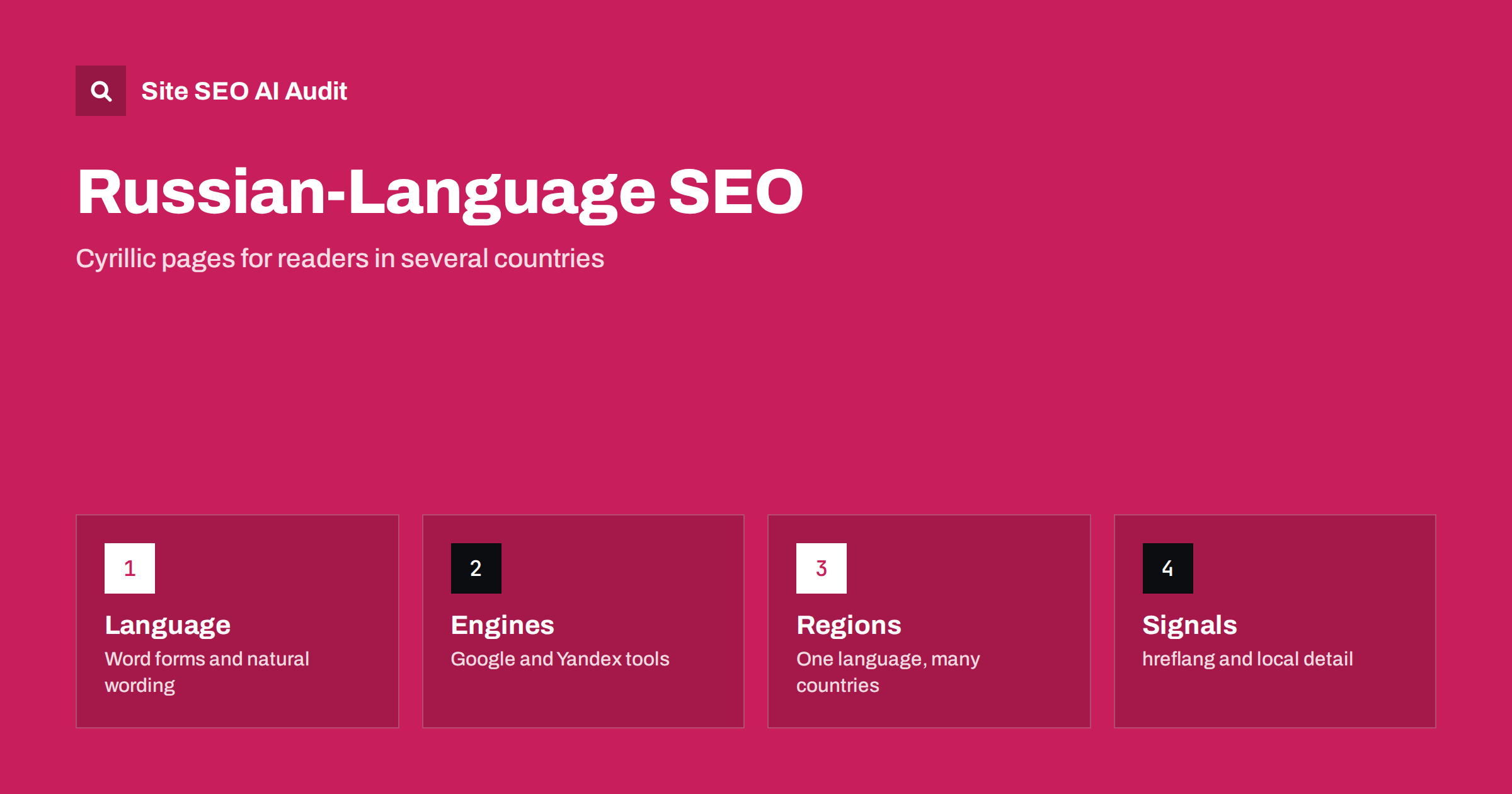
Short answer: Russian-language SEO starts with content written by a fluent speaker for a specific audience, not a machine translation of an English page. Research real queries in Cyrillic, write naturally instead of repeating one exact word form, set the language attribute to Russian, add hreflang annotations when you publish several country versions, verify the site in the webmaster tools of the search engines you target and make sure pages load quickly from the regions where your readers live. Treat each country as its own market with its own prices, units and expectations.
Russian is spoken as a first or second language across a wide area, and the readers of one Russian page may live in very different places with different laws, currencies, shops and search habits. Some of them use Google, others prefer Yandex, and many use both on different devices. This guide covers the practical parts of building and maintaining Russian-language pages: how the language works in search, which tools to set up, how to separate country versions and what to check before launch. It assumes you already know the basics of international SEO. Where search engines publish their own rules, read their current documentation, because details change.
Write Russian content for Russian readers
Machine-translated pages are easy to spot. Russian is a highly inflected language: nouns, adjectives and verbs change their endings by case, number and gender, and word order carries emphasis. A literal translation often produces stiff phrases, wrong endings or unnatural terms that no one would type into a search box. Modern search engines understand word forms well, so you do not need to repeat every variant of a keyword. Write complete, natural sentences, use the correct form for each context and let the engine connect the variants. The same advice about avoiding unnatural repetition applies as in keyword stuffing and how to fix it.
Decide on tone early. Russian has a formal and an informal form of address, and business sites usually choose the formal one. Decide how to treat English terms that readers know in the original, such as technical words and product names, and keep the choice consistent. Have a native editor read the final text, and keep a short glossary of approved terms so that several writers use the same wording. Machine translation can create a first draft, but its risks are described in machine translation and SEO.
Research keywords in Cyrillic
Do not translate an English keyword list. Start with the questions and phrases that people really use: look at the queries that already reach the site in Search Console, study the suggestions that appear as you type in Cyrillic, read forums, reviews and marketplaces in the language, and ask customers and sales staff how they describe the problem. Note that some phrases differ by country, that slang changes quickly and that some readers type Russian words with Latin letters, which is covered in transliteration and SEO. Search volumes for similar phrases can differ greatly, so group them by intent and choose one primary topic for each page.
Spelling variants matter. For example, the letter ё is often written as е, and both forms appear in queries. Search engines normally treat them as equivalent, but your visible text should follow the standard spelling of your style guide. Compound product names, abbreviations and foreign brand names are written in several ways, so check what readers actually search. Use the same process as in multilingual keyword research, and map every topic to one page, as in the keyword mapping guide.
Set up Google and Yandex properly
Many Russian-speaking readers use Google, and its rules are the same as for any language: crawlable pages, correct canonicals, structured data and good page experience. If you also want to be found in Yandex, add the site to Yandex Webmaster, verify ownership and submit your XML sitemap. The tool shows indexing status, crawl errors, search queries and site quality information, in a similar way to Search Console. Yandex also offers a free analytics service that many sites in the region use alongside or instead of other tools. Install only the tools you need, and check consent requirements for each of them, as in cookie banners and SEO.
The engines differ in some details. Yandex supports a robots.txt directive for ignoring URL parameters, which Google does not use. Both engines can use the sitemap, and Yandex lets you set a region for the site in its webmaster tool. Because behaviour can change, test with the tools of each engine rather than relying on rules of thumb. For the wider picture, see search engines beyond Google.
Separate country versions when the market differs
A Russian page for one country is not automatically right for another. Prices, currencies, delivery options, payment methods, legal pages, contact details, units and examples all change. If the differences are real, create separate versions with their own addresses, such as subfolders for each country, and describe the relationship with hreflang annotations. Use codes such as ru for the language alone, or a combination of language and country where you have separate pages. Every version must link back to the others, and each page should have a self-referencing annotation, as explained in the hreflang tags guide.
If the content is identical in every country, one Russian page is usually enough, and it is better to keep authority on one address than to publish near-duplicate copies. Do not redirect visitors automatically by IP address or browser language, because crawlers and travelling readers then cannot reach the version they want. Offer a visible language and country selector instead, and follow the language switcher guidelines. For choosing between markets, see how to choose target markets.
Check technical details for Cyrillic pages
Use UTF-8 for every page, template, database and feed, and declare it in the response headers or the document head. Wrong encoding produces garbled text that damages titles, snippets and links. Set the language attribute on the html element to the right code, and do not rely on it alone, because engines detect the language from the visible text, as described in how Google detects the language of a page. Check that fonts used on the site include the Cyrillic alphabet, since a fallback font can change layout and slow rendering. Test titles and descriptions in the real display, because Cyrillic letters are often wider, so character counts that work in English may truncate sooner.
For URLs, choose one policy and keep it. You can use Latin slugs, which are short and easy to copy, or Cyrillic slugs, which are readable but get encoded when shared and can look long. Whichever you choose, apply it consistently across the site and keep redirects simple. If you are considering a domain name in Cyrillic, read internationalized domain names and SEO first.
Handle local trust, formats and legal details
Readers decide quickly whether a site is meant for them. Show the local currency, the date and number formats they expect, delivery and payment methods that work in their country and support hours in their time zone, following localizing dates, numbers and units. Provide contact details for the country, and explain returns, guarantees and data handling in plain language. Laws on consumer rights, advertising, personal data and where data may be stored differ between countries, so check the rules for each market you serve with a qualified adviser rather than copying a legal page from another site. Trust signals are discussed in local trust signals for country versions.
Think about speed and availability
A site that is slow or unreachable from the target country loses readers whatever its content. Check how pages load from the regions that matter, using tests from several locations and real user data when you have it. Choose hosting or a content delivery network that serves those regions well, and make sure that security rules do not block legitimate visitors or search crawlers. Heavy scripts, large images and third-party widgets cause the same problems as everywhere, and mobile connections may be slower than you expect. Guidance for this is in server location, CDNs and speed for international SEO.
Measure results by country and language
Track results separately for each country version and for each search engine. In Search Console and the Yandex tool, compare impressions, clicks and average position for Russian-language queries, and check which pages are indexed. In analytics, segment by country and language, and look at the pages where readers leave. Compare the results of Google and Yandex separately, because their audiences and algorithms differ. Review the data every month and update pages that lose visibility. A fixed process helps, and you can adapt international SEO reporting KPIs for this purpose.
Site SEO AI Audit crawls a Russian-language site like a search engine, checks the language attribute, titles, canonicals, hreflang annotations, status codes and speed on each page, and lists the fixes ranked by the points they add. The first audit of up to 200 pages is free; larger sites can see the pricing page.
Related reading
- Eastern Europe SEO Guide
- Transliteration and SEO
- hreflang Language and Region Codes
- SEO for Multilingual Countries
The bottom line
Russian-language SEO rewards natural writing, careful keyword research in Cyrillic, correct technical setup and respect for the differences between countries. Verify the site in the tools of each engine, publish separate versions only when the market really differs, annotate them with hreflang and measure each country on its own.
FAQ
Do I need Yandex-specific SEO for a Russian-language website?
It depends on your audience. If you want readers who use Yandex, verify the site in its webmaster tool and follow its documentation. The core practices of good content and clean technical setup help in both engines.
Should I use Cyrillic or Latin letters in URLs?
Both work. Latin slugs are shorter when shared, while Cyrillic slugs are readable. Choose one policy, apply it everywhere and keep redirects simple.
Do I need hreflang if I publish one Russian page for all countries?
No. Hreflang is for separate versions of the same page. If one address serves everyone, there is nothing to connect.
Can I translate my English pages automatically?
You can use translation to create a draft, but a fluent editor should review it. Natural wording, correct terms and local details decide whether readers trust the page.
How do I handle readers in different countries?
Create separate versions when prices, delivery, legal details or examples differ, and connect them with hreflang. Otherwise keep one page and measure results by country.