ENEnglish
 LTLietuviškai
 DEDeutsch
 FRFrançais
 RUРусский
 ESEspañol
 PLPolski
 ITItaliano
 UKУкраїнська
 CSČeština
 PTPortuguês
 JA日本語
 LVLatviešu valoda
 ETEesti
 HUMagyar
 IDBahasa Indonesia
 TRTürkçe
 HIहिन्दी
 ELΕλληνικά
 ARالعربية
 THไทย
 VITiếng Việt
 RORomână
 MSBahasa Melayu
 BNবাংলা
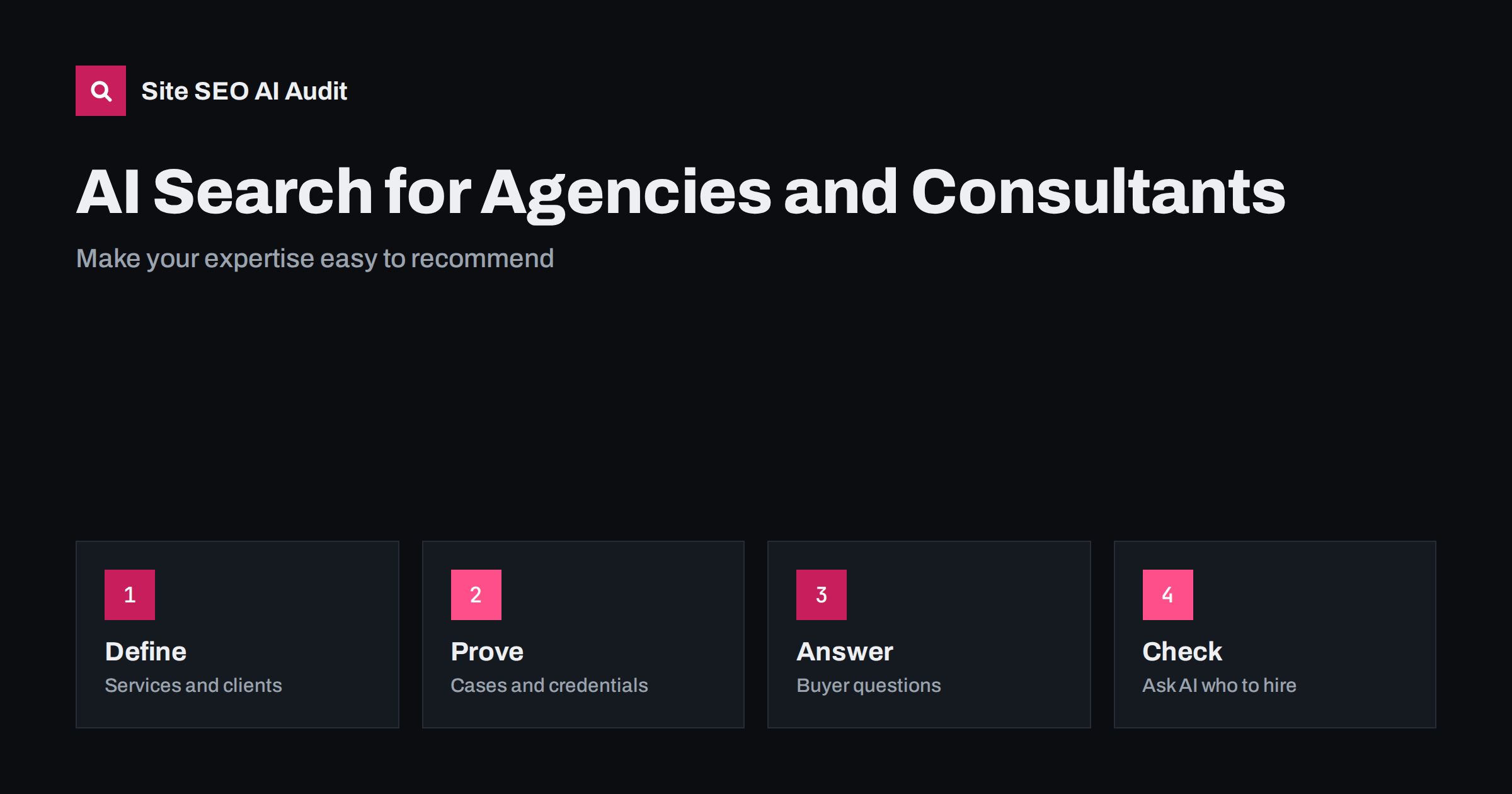
Short answer: AI tools recommend agencies, consultants and freelancers they can describe with confidence. That means a clear statement of what you do and for whom, named people with real credentials, specific evidence of results, consistent profiles on other sites and pages that answer the questions buyers ask before they hire. Vague claims such as “full-service solutions” give an assistant nothing to quote. Precise, checkable statements do.
Buyers of professional services increasingly ask an assistant for a shortlist: who can help a small shop with international SEO, which consultant understands medical regulation or what a fair price is for a brand refresh. The answers draw on your website, directories, reviews, articles and mentions elsewhere. Service businesses often have a polished home page and very little that a machine can use. This guide shows what to publish and how to check the result. For the wider picture, see AI search for professional services.
State what you do and for whom
Start with a plain sentence on the home page and the services page: “We help online shops in Europe fix technical SEO and expand into new markets.” It names the service, the type of client and the area. Avoid slogans and lists of buzzwords. If you serve several segments, give each its own page with its own language, examples and questions. Assistants match a request such as “an accountant for freelancers in Germany” to pages that say so clearly. A site that says everything for everyone is matched to nothing. Be honest about what you do not do, because this also helps the right clients find you.
Make the people visible
Professional services are bought from people. Create a page for each key expert with their role, experience, areas of focus, qualifications, talks or publications and a short, factual biography. Link the page to their professional profiles and use the same name everywhere. Where your work calls for credentials, such as a licence, a membership or a certification, state them accurately and link to the register where it can be checked. Do not claim awards that you cannot document. The reasoning behind this approach is in the E-E-A-T and AI search guide.
Show evidence, not adjectives
Case studies, before-and-after results, project descriptions and client quotes give assistants specific facts to repeat. Describe the situation, what you did and what changed, with numbers where you are allowed to share them and with the permission of the client. If confidentiality prevents naming a client, describe the type of client and the outcome. Keep each case study on its own page with a clear title and a short summary at the top. Avoid inventing statistics or inflating results; wrong claims are quoted just as easily as right ones, and they harm trust when discovered. For a model, see the case study pages guide.
Answer the questions buyers ask
Before hiring, people ask how much it costs, how long it takes, how the work is organised, what they need to provide, how you report and how you differ from others. Write pages that answer these questions directly, in plain language, and keep them up to date. A pricing page with ranges or examples, even when final prices depend on the project, is much more useful than “contact us for a quote”. A process page that describes the stages of a project reduces uncertainty. Add a short question-and-answer section to each service page, following the guidance on FAQ sections.
Publish original thinking in your field
Articles, guides and talks that show how you solve problems demonstrate expertise and give assistants material to cite. Focus on questions your clients actually raise, add your own experience and examples, and date and update the pieces. Original data, such as a small survey of your clients or an analysis of anonymised project results, is especially valuable because it cannot be copied from elsewhere. Quality matters more than volume: ten solid pieces that answer real questions will outperform a hundred generic posts. Read about original research and AI citations for ideas.
Keep profiles and directories consistent
Assistants cross-check your website against directories, review sites, social profiles, conference pages and press mentions. Use the same business name, description, location, services and website address everywhere, and update old profiles that describe a former focus. Claim your profiles on the sites that matter in your sector and country. Ask clients for honest reviews on the platforms that buyers use, and respond to feedback professionally. Mentions in industry publications and partner websites strengthen the picture, as discussed in unlinked brand mentions.
Use structured data for the basics
Organisation and person markup can state your name, logo, address, contact details, social profiles and the people who work with you, and service markup can describe what you offer. It does not replace good content, but it helps machines connect your pages to the right entity. Keep the markup accurate and consistent with what is visible on the page. If you operate from several offices, mark up each one with its own details. Review the markup after each redesign, because themes and plugins often change it silently.
Test the questions your buyers would ask
Every month or two, ask several AI tools the questions a buyer would ask, in the language and market you serve, and record whether you appear, how you are described and which sources are used. Check that prices, locations and specialisations are correct. When you find an error, correct the source: your own page, a directory entry or an outdated article. When you do not appear, look at who does, and study what their pages say that yours do not. The checklist in the AI search visibility guide gives a routine for this.
Agencies should also think about their clients. If you build or optimise sites for others, your own site must show the standard you offer: fast, accessible, clear and technically clean. Visitors and assistants both notice when an SEO consultant has a site with broken links, missing titles or blocked crawlers. Treat your own site as the first case study, and keep a short note of the improvements you made and what they achieved.
Freelancers and small studios sometimes worry that they cannot compete with large firms in this new setting. In practice, AI answers often favour specificity over size. A freelancer who writes clearly about one niche, such as accessibility audits for municipal sites or bookkeeping for online sellers, can be a better match for a precise question than a general agency. Build your reputation around a focused topic, show real work and keep your facts consistent, and let the breadth come later.
Consider how a buyer might phrase a request: “Which agency can move our online shop to a new platform without losing search traffic?” An assistant looks for pages that name that exact problem. If your site has a page on platform migrations that explains your process, lists the risks you manage, shows two examples and names the person who leads such projects, it has everything it needs. If your only mention is a line in a list of twenty services, it has almost nothing. Build one strong page for each service you want to be known for, and link those pages from your home page and from related articles, so that both visitors and crawlers find them quickly.
Pay attention to the language you use. Clients rarely use your internal terms. They describe problems in everyday words: “my website does not show on Google”, “we need a new logo for a restaurant”, “someone to handle our accounts”. Use those words in headings and answers, and add the professional term alongside for precision. Look at the emails and calls you receive, the questions asked in sales meetings and the words used in reviews. These are the best source of phrasing, and they cost nothing to collect.
Be careful with claims about guaranteed outcomes. Promises such as “first place on Google” or “double your leads” are risky, hard to prove and often repeated by assistants with a warning or not at all. Describe what you do, what you have achieved for others and what a client can reasonably expect, with the factors that affect results. Honest limits build more trust than big promises, and they protect you from complaints and legal trouble. Where rules for advertising professional services apply in your country, follow them.
If you work with partners or subcontractors, say so clearly, and name the team members who will handle the work. If you offer remote services, state the countries and languages you cover. If you have a physical office, include the address and opening times. These practical details prevent wrong answers, such as an assistant saying that you work only locally when you serve clients worldwide, or the reverse.
Site SEO AI Audit crawls your own website and checks titles, descriptions, headings, structured data, broken links, robots.txt rules, AI crawler access and speed, so you can make sure your services pages are readable by search engines and AI tools. It does not recommend you to anyone or judge the quality of your work. The first audit of up to 200 pages is free; larger sites can see the pricing page.
Related reading
- How to Explain AI Search to Clients
- How to Choose an SEO Provider: Red Flags
- Author Pages and Bylines for SEO
The bottom line
Say precisely what you do and for whom, show named experts and real evidence, answer buyer questions, keep profiles consistent and test what AI tools say about you.
DUK
Can a one-person business appear in AI answers?
Yes. A clear niche, a real profile, honest reviews and helpful articles can make a small business a strong match for specific questions.
Should I publish my prices?
Ranges or examples help buyers and give assistants facts to quote. If you cannot give prices, explain what affects them.
Do awards and badges matter?
Only when they are real and checkable. State them accurately and link to the source where possible.
How long does it take to see results?
It varies. Changes to your site can be picked up within weeks, but reputation across other sites builds over months.
Can I pay to be recommended by AI tools?
You cannot buy a place in organic answers. Focus on clear information, evidence and reputation instead.