ENEnglish
 LTLietuviškai
 DEDeutsch
 FRFrançais
 RUРусский
 ESEspañol
 PLPolski
 ITItaliano
 UKУкраїнська
 CSČeština
 PTPortuguês
 JA日本語
 LVLatviešu valoda
 ETEesti
 HUMagyar
 IDBahasa Indonesia
 TRTürkçe
 HIहिन्दी
 ELΕλληνικά
 ARالعربية
 THไทย
 VITiếng Việt
 RORomână
 MSBahasa Melayu
 BNবাংলা
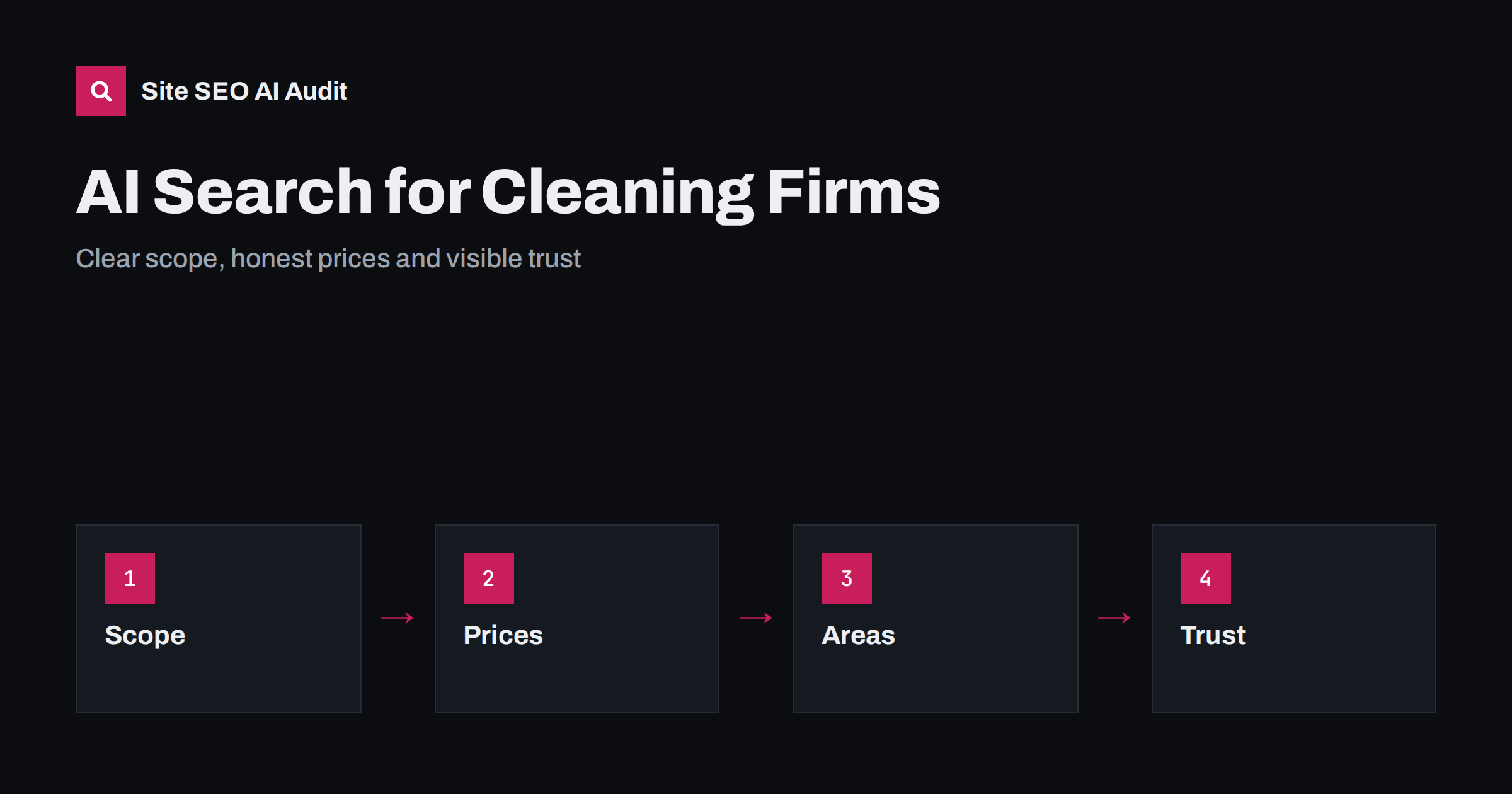
Short answer: People ask assistants how much a cleaner costs, what a deep clean includes and which company is reliable nearby. Cleaning businesses that appear in answers describe each service precisely, explain what is and is not included, publish price ranges and the factors that change them, state service areas and response times, show vetting, insurance and supplies used, and collect genuine reviews. Specific, honest pages beat generic claims such as “top quality service”.
Cleaning is a trust business. Customers let a stranger into their home or leave an office in the care of a contractor, and they want clarity before they call. Yet many cleaning websites say little more than “we offer residential and commercial cleaning”. That leaves assistants and search engines with nothing concrete to quote, and customers with questions the site could easily have answered. This guide shows how to turn everyday knowledge into pages that help people decide. For the general framework, see the AI search visibility checklist.
What customers really ask
Typical questions: how much does a weekly clean of a two-bedroom flat cost; what is the difference between a standard and a deep clean; do you bring your own supplies; can you clean after renovation or before moving out; how do I get a quote; who will come to my home; are your staff insured; what happens if something is broken. Business customers ask about contracts, out-of-hours work, specialist areas such as kitchens or clinics, and how quality is checked.
Write the questions down from calls, messages and quote requests, and sort them by customer type: households, landlords and property managers, offices, shops, schools, medical facilities. Each segment has its own worries and deserves its own page.
Describe every service precisely
Create a page for each service: regular home cleaning, deep cleaning, end-of-tenancy cleaning, post-construction cleaning, office cleaning, window cleaning, carpet and upholstery cleaning, disinfection. Open each with a direct statement of what the service is, who it suits and how long it usually takes. Add a checklist of what is included room by room, and what is excluded or charged extra, such as inside ovens, fridges or wall washing.
Explain how the visit works: who arrives, what they bring, how access is arranged, how long the team stays and how the customer approves the result. Detailed scopes reduce disputes and make your pages far more useful than a list of adjectives. They also supply the concrete statements that assistants prefer to quote. Basic page structure follows the advice in the on-page SEO checklist.
Publish honest prices
Price is the main question and the one most often avoided. You rarely can give a single fixed price, but you can give ranges and explain the drivers: size of the property, number of rooms and bathrooms, condition, frequency, extras, access and travel. Show example prices for typical cases, with the date and what they include. Mention minimum charges, deposits, cancellation terms and how quotes are produced.
If you quote after a visit or a video call, say so and explain how long it takes to receive an offer. If you charge by the hour, state the rate and the minimum booking. Transparent pricing attracts better enquiries and reduces wasted calls. The same logic is explained in the pricing page guide.
Service areas and availability
For local searches, list the towns, districts and postcodes you serve, and say clearly where you do not. Give the opening hours of the office, the days you work, how far ahead customers need to book and whether you handle urgent requests. Keep the same details on your site and your business profiles. Create a page for each major area you actively serve, with real local information, instead of near-identical pages that only change the town name, which are weak, as discussed in the guide to templated pages.
Mark up the business with local data as explained in the LocalBusiness schema guide, making sure the name, address, phone number and hours match everywhere. If you are a service-area business with no storefront, say so and avoid publishing a home address if you prefer privacy.
Vetting, insurance and quality control
Customers worry about safety and liability. Describe how you hire and vet staff, what training they receive, whether they are employees or subcontractors and how you handle keys and alarm codes. State your insurance cover and how claims for damage are handled. If you hold certifications or follow recognised standards, name them and link to proof where possible.
Explain your quality process: inspections, checklists, feedback calls, a re-clean policy if something is missed. Specific commitments, such as reporting a problem within 24 hours and returning to fix it at no charge, are stronger than general promises, but only publish what you can honour. These trust signals relate to the principles in the E-E-A-T and AI search guide.
Products, safety and environmental choices
Many customers care about the products used. If you use eco-labelled products, say which ones and why. If a customer can request fragrance-free or pet-safe products, explain how. For specialist work, such as disinfection in healthcare settings or cleaning in food production, describe the procedures and training in general terms without making unsupported medical claims.
Publish simple advice pages that help your audience and show expertise: how to prepare for a cleaning visit, how often to deep clean, how to care for different floor types, how to remove common stains safely. Keep them practical and accurate, and avoid dangerous tips such as mixing chemicals. These pages attract natural questions and earn trust.
Commercial cleaning and contracts
Business customers need a different kind of page. Explain how a contract works: the length, notice periods, how the schedule is set, how extra requests are handled and how prices are reviewed. Describe the supervision structure, the contact person, reporting and how complaints are escalated. For facilities with special needs, such as clinics, schools, food premises or industrial sites, outline the relevant procedures, training and equipment in plain terms.
Offer a sample specification or checklist that a buyer can adapt when requesting quotes from several companies. Procurement staff and property managers often compare suppliers using exactly this kind of document, and a clear one signals professionalism. Mention health and safety practice, such as risk assessments and safe handling of chemicals, without overpromising. Keep case descriptions general to respect client confidentiality, and publish only what the client has approved.
Reviews and before-and-after proof
Reviews carry a lot of weight in local recommendations. Ask for feedback after each job, make it easy to leave, and respond professionally to criticism. Never buy or invent reviews. Display genuine testimonials with permission on relevant service pages. Photos of results can help, but respect privacy: avoid showing identifiable personal items or addresses and get consent from commercial clients. The role of reputation is covered in the guide to reviews and AI recommendations.
Booking and contact paths
Make it easy to act. Provide a short quote form, a phone number and a messaging option, and state when customers can expect a reply. Ask only for the information you need: address, type of property, size, preferred dates. Confirm by email with the scope and price so that expectations are clear. If you offer online booking, document the steps and the cancellation rules. Fast, clear responses are part of the experience that earns repeat customers and positive reviews.
Think about the whole path from question to booking. A visitor who reads the scope page should see a link to the price guide; the price guide should lead to the quote form; the confirmation email should repeat the scope and the next steps. Test the path on a phone, because most local searches happen there. Check that the phone number is tappable, that the form is short and that a confirmation appears right after sending. Missing any of these steps loses customers who were ready to book, no matter how well the page ranks.
To keep this work effective, review the pages twice a year. Update prices, service areas and staff information; add new questions customers have asked; and remove offers that no longer exist. Test a handful of typical questions in several assistants and note whether your company appears, whether the facts are right and which pages are cited. If an assistant gives a wrong price or area, correct the source page and make the right information easy to find. Small, steady maintenance keeps a local service business visible and trustworthy.
Site SEO AI Audit crawls your website and checks status codes, titles, descriptions, headings, broken links, structured data, page speed and AI visibility settings, which helps you find duplicated or thin service and area pages. It does not review prices or the quality of your work. The first audit of up to 200 pages is free, and larger sites can see the pricing page.
Related reading
The bottom line
Describe scope and prices precisely, name your areas and show vetting, insurance and genuine reviews.
DUK
Should I publish cleaning prices?
Yes, as ranges with the factors that affect them. Transparency attracts better leads and answers the most common question.
Do I need a page for each town?
Only for areas you actively serve, and each page needs real local information instead of a copied template.
How do I show that staff are trustworthy?
Explain vetting, training and insurance, and let genuine reviews support the claims.
Can I show before-and-after photos?
Yes, with consent and without revealing personal items or addresses.
Which structured data fits a cleaning company?
LocalBusiness with service area details, Organization and FAQPage, all matching the visible page.