ENEnglish
 LTLietuviškai
 DEDeutsch
 FRFrançais
 RUРусский
 ESEspañol
 PLPolski
 ITItaliano
 UKУкраїнська
 CSČeština
 PTPortuguês
 JA日本語
 LVLatviešu valoda
 ETEesti
 HUMagyar
 IDBahasa Indonesia
 TRTürkçe
 HIहिन्दी
 ELΕλληνικά
 ARالعربية
 THไทย
 VITiếng Việt
 RORomână
 MSBahasa Melayu
 BNবাংলা
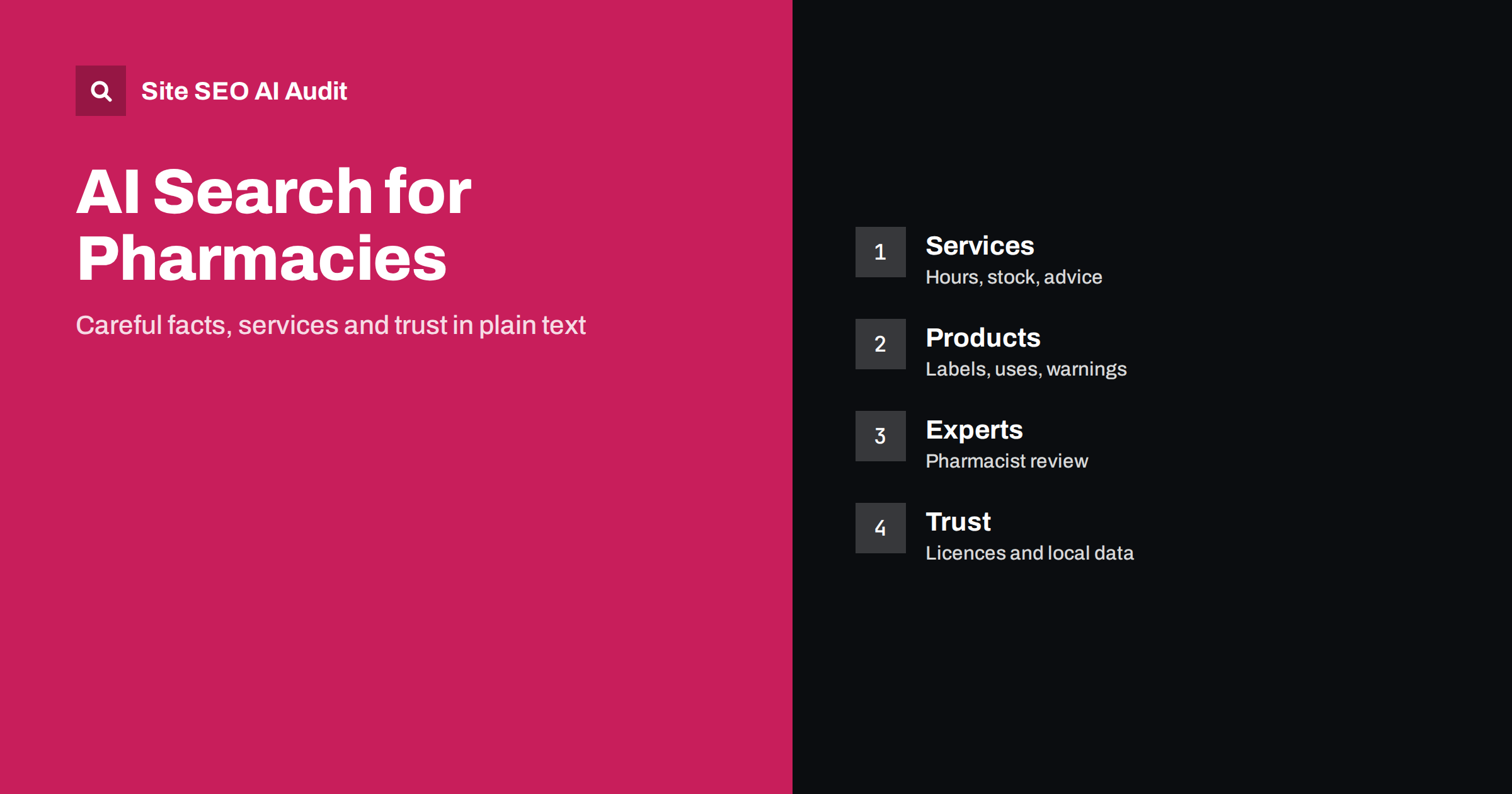
Short answer: Pharmacies and health product retailers are cited by AI assistants when their pages give accurate, careful and clearly sourced information: opening hours, services, delivery, product details with uses, ingredients, warnings and age limits, and guidance written or reviewed by qualified staff. Keep claims within what the law and the product label allow, show who the pharmacist or expert is, publish licence and contact details, use consistent local data and mark up the business and products truthfully. Health claims that cannot be supported should not be published at all.
Health questions are among the most sensitive that people ask assistants. Some are practical: which pharmacy nearby is open on Sunday, whether a pharmacy offers vaccinations or blood pressure checks, how prescription collection works. Others concern products: what a supplement contains, whether a cream suits sensitive skin, how a thermometer works. Assistants are careful here and prefer sources that show expertise and avoid exaggeration. For a pharmacy or retailer this is an opportunity, because careful, clear and correct pages stand out in a field full of exaggerated claims. It is also a field with strict rules, so every page should be written with care. This guide explains how to do that. For the standards applied to such content, read YMYL topics and AI search.
Know what customers ask
Collect questions from the counter, the phone, email, chat and reviews. They tend to fall into practical, product and health groups. Practical questions concern opening hours, location, parking, delivery, prescription handling, stock, payment and services. Product questions concern what an item is for, how to use it, who should not use it and how it compares with another. Health questions ask what to do about a symptom, and these call for a careful answer that directs people to professionals. Write pages for the first two groups in detail, and for the third offer only general, reviewed information that sends people to qualified help when needed. Review the list each season, since demand shifts with the weather and the calendar, as in seasonal pages and SEO.
Think about how a person in a hurry reads your pages. They want to know in two lines whether you can help today. Place the answer first: open now, closed until nine, prescription collection available, delivery within a stated area. Then provide the detail. Pages that make visitors scroll through a long story before they find the opening hours lose both people and assistants, which look for a direct statement they can quote.
Publish service and location details
Many searches are local and urgent. Create a page for each location with the address, phone number, opening hours including holidays and emergency or late service, how to reach it, parking and accessibility. List services such as prescription collection, repeat prescriptions, vaccinations, health checks, consultations, medicine reviews, delivery and click-and-collect, each with what it includes, who may use it, whether booking is needed and the price if there is one. State clearly what your pharmacy cannot do. Keep the details identical on the website, the map profile and in directories, because inconsistent hours are a common cause of lost trust. Further local guidance is in AI search for local businesses.
Describe products accurately and within the rules
Each product page should state the name, brand, form and strength, pack size, ingredients, intended use as written on the label or the approved information, directions, age limits, warnings and storage, who should seek advice before use and the manufacturer. Copy the label wording carefully and update it when the label changes. Do not add claims that go beyond it, and avoid words like cure, guaranteed or miracle. Rules for advertising medicines and supplements differ by country, so check them for your market and have a qualified person approve the text. Add clear images of the label and box with alt text. For general product page advice, see the product page guide.
Use qualified authors and review dates
Health content should be written or reviewed by someone with the right qualifications, such as a pharmacist, and the page should show it: name, role, registration where appropriate and the date of the last review. Create a short profile for each expert and link to it from their articles. Cite sources for factual statements, such as official health bodies, and name them in the text. Update pages when guidance changes and show the update date. This approach supports the signals discussed in E-E-A-T and AI search, and it protects readers. Do not publish diagnoses or personal treatment advice, and add a clear note about when to speak to a professional.
Be especially careful with comparisons and rankings. A statement that one product is the best, safest or most effective cannot be checked and may break advertising rules. Compare by facts instead: ingredients, strength, pack size, form, age range and price per unit. Where evidence exists, cite the source and state its limits, such as who was studied. Readers and assistants both respond better to restraint than to superlatives, and regulators are less likely to object.
Write helpful guides for common needs
Useful guides draw people to a trustworthy local source. Examples include how to use a medicine safely, how to store it, what to keep in a family first aid kit, how to prepare for travel, how to read an ingredient list and when to see a doctor. Start each with a short answer, then give steps, cautions and links to relevant products and services. Keep language plain, and avoid scaring people or promising results. Add a short FAQ with the real questions customers ask. Mark up the FAQ only if the questions and answers are visible. For structure, see FAQ sections for AI answers.
Accessibility is part of care. Many pharmacy customers are older people or have disabilities, so make sure that text is large enough, contrast is good, forms can be completed with a keyboard, images have meaningful alt text and phone numbers can be tapped on a mobile device. Describe the physical access to each branch, such as step-free entrance, a private consultation room and available languages. These details help people decide where to go and show that you have thought about their needs; see web accessibility and SEO.
Show licences, policies and privacy practices
Trust depends on transparency. Display your pharmacy licence or registration details where the rules require, the name of the responsible pharmacist, company details and a contact route for complaints. Explain how prescriptions are handled online and offline, how you protect personal data, how returns work (some health products cannot be returned), delivery conditions such as temperature control and identity checks, and payment methods. Publish a privacy notice in plain language and do not collect more health information than needed. Keep policies on separate pages with dates. If you sell online across borders, state the countries you serve and the rules that apply, and do not offer what the law does not permit.
Add structured data and consistent local data
Mark up the business with local business data, including name, address, phone, hours and links to official profiles, using the local business schema guide. Mark up products with name, description, brand, price and availability only when the page shows the same values. Add review markup only for real reviews that are visible. Test after each change and watch for differences between the page, the map profile and directories. Ensure that your robots rules and firewall do not block the crawlers you want, and review them with the AI crawlers and robots.txt guide. If an assistant shows wrong hours or services, correct the source and use the guide to wrong information.
Measure, review and stay compliant
Each month, ask the questions your customers ask, such as which pharmacy nearby is open, which provides a particular service and what a product is used for, and record which sources appear and whether the details are correct. Review product pages against current labels, check hours before holidays and remove products that are no longer sold, following the out-of-stock product guide. Keep a log of changes and approvals, so that you can show who reviewed each health statement and when. In this field, accuracy and restraint are the best optimisation, and they are also what customers expect from their pharmacy.
Site SEO AI Audit crawls your site like a search engine, checks titles, structured data, status codes, orphan pages, images and speed on each page, and lists the fixes ranked by the points they add. The first audit of up to 200 pages is free; larger sites can see the pricing page.
Related reading
- AI Search for Healthcare Clinics
- AI Search for Beauty, Fitness and Wellness
- AI Search for Local Businesses
- Author Pages and Bylines
The bottom line
Pharmacies and health retailers are cited when their pages are accurate, restrained and clearly reviewed by qualified people. Publish services, hours, product facts within label limits, expert profiles, policies and consistent local data, and review them regularly.
DUK
Can I describe what a supplement does?
Only within what the label and the rules of your market allow. Avoid claims about curing or preventing disease, and have a qualified person approve the text.
Do I need a pharmacist to review health articles?
It is strongly advisable. Show the reviewer’s name, role and the review date, and cite official sources for factual statements.
Should I list opening hours for each location?
Yes. Include holidays and late services, and keep the hours identical on the website, map profile and directories.
Can I use customer testimonials about health results?
Be very careful. Many markets restrict testimonials for health products. Check the rules and focus reviews on service, delivery and experience.
What if an assistant gives wrong health information about my product?
Correct your own pages first, make the label details easy to find and report serious errors through the assistant’s feedback channels.