ENEnglish
 LTLietuviškai
 DEDeutsch
 FRFrançais
 RUРусский
 ESEspañol
 PLPolski
 ITItaliano
 UKУкраїнська
 CSČeština
 PTPortuguês
 JA日本語
JA日本語 LVLatviešu valoda
 ETEesti
 HUMagyar
 IDBahasa Indonesia
 TRTürkçe
 HIहिन्दी
 ELΕλληνικά
 ARالعربية
 THไทย
THไทย VITiếng Việt
 RORomână
 MSBahasa Melayu
 BNবাংলা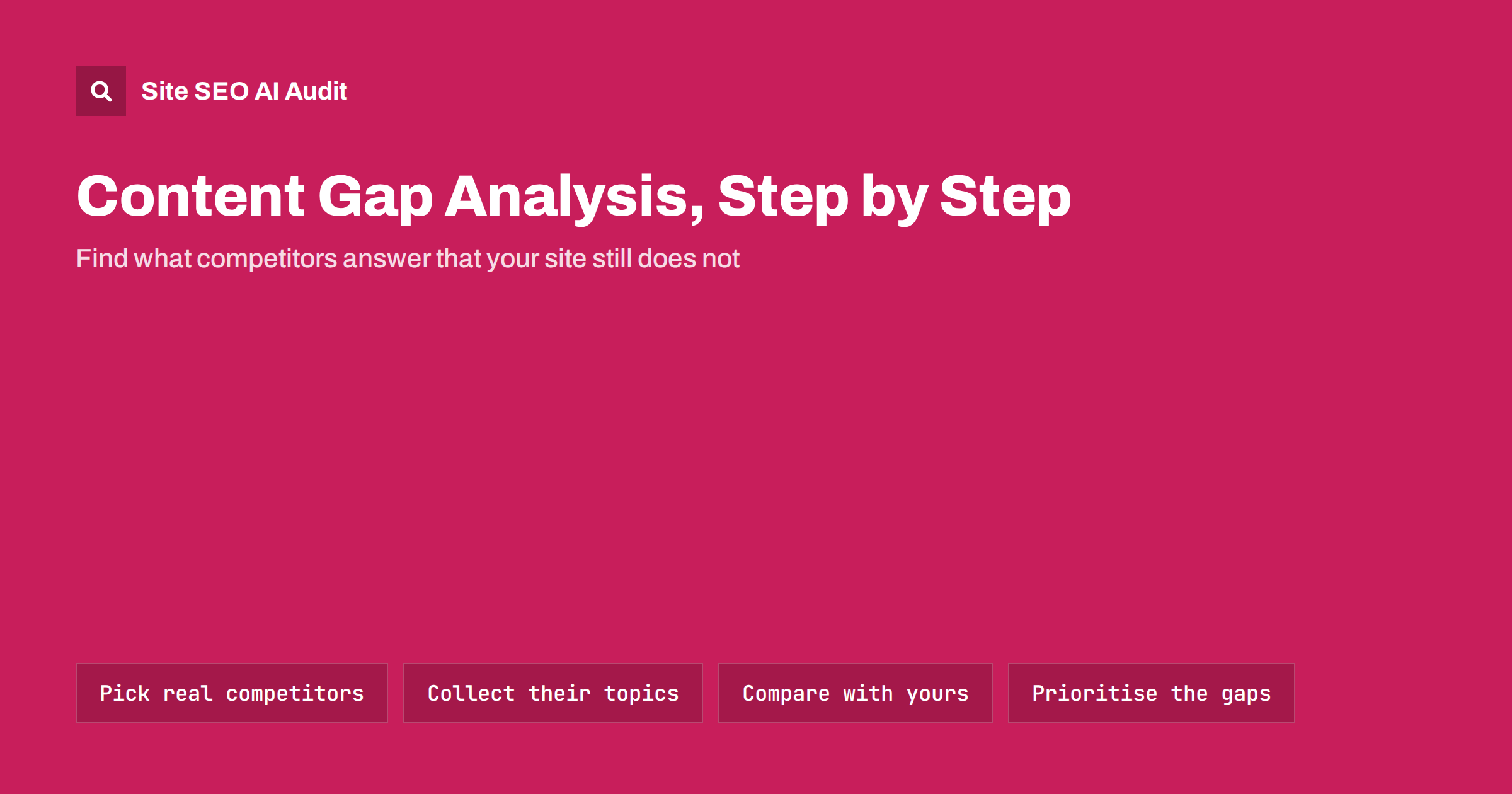
Short answer: A content gap analysis compares the topics and questions your competitors’ pages cover with those your site covers, so you can see what is missing or weak. Pick the sites that actually rank for your topics, list their pages and the questions they answer, mark each topic as missing, weak or covered on your site, and prioritise gaps by search intent, business value and effort. The output is a short, ordered list of pages to create or improve.
Most sites do not lose search visibility because their pages are badly optimised. They lose it because they never answered the questions their customers ask, while a competitor did. A content gap analysis makes those missing answers visible. It does not require expensive tools; a spreadsheet, a few searches and an honest look at your own pages go a long way.
What counts as a content gap
A gap is any question or need in your topic area that searchers have and your site does not serve well. In practice there are four types:
- Missing topics: subjects your competitors cover with dedicated pages and you do not mention at all.
- Thin coverage: topics you mention in a sentence or two, while competitors answer them in depth.
- Wrong format: you have a blog post where searchers clearly want a comparison table, a calculator, a checklist or a product category page.
- Outdated content: you covered the topic years ago, and the information, screenshots or prices are no longer right.
Keeping these four apart matters, because each needs a different fix: a new page, an expanded section, a new format or a refresh.
Step 1: Choose the right competitors
Your business competitors and your search competitors are often different. A local accounting firm competes with other firms for clients, but in search it may compete with government sites, software vendors and publishers explaining tax rules.
- Write down 10 to 20 searches that matter to your business: product or service names, common problems and typical questions.
- Search each one in a private browser window and note which domains appear on the first page again and again.
- Pick three to five domains that rank repeatedly and are similar to you in size or audience. A national news site or a huge marketplace is a poor model for a small business.
If you serve several countries or languages, repeat this per market. Competitors in Germany can be completely different from those in the UK.
Step 2: Collect the competitors’ topics
You want a list of what each competitor covers, not every word on their site. Good sources are:
- Sitemaps and blog archives. Many sites publish an XML sitemap or an HTML sitemap that lists every page. Category and tag pages also show how they group topics.
- Navigation and hub pages. Main menus, resource centres and pillar pages reveal the topics a competitor considers important.
- Headings of top pages. For pages that rank for your key searches, note the H2 and H3 headings. They show which sub-questions are answered.
- Search features. “People also ask” boxes and related searches show the questions searchers have around a topic, regardless of who answers them.
- SEO tools, if you have them. Keyword gap reports can list searches where competitors rank and you do not. Treat the numbers as estimates.
Put everything into one sheet with columns for topic, example search, competitor URL and the format used, such as guide, comparison, checklist or tool.
Step 3: Map the topics against your own pages
Now check each topic against your site. Search your own site, look at your sitemap, and use the Performance report in Search Console to see which of your pages already receive impressions for related queries.
| Status | What it means | Typical action |
|---|---|---|
| Covered | You have a page that answers it at least as well as competitors | Leave it, or refresh when needed |
| Weak | Mentioned, but shallow, outdated or in the wrong format | Expand or rework the existing page |
| Missing | No page or section addresses it | Create a new page or add a section |
| Not for us | Relevant to competitors, not to your offer or audience | Skip it deliberately |
The “not for us” column is as important as the others. A gap analysis that tells you to write about everything is not an analysis. This step also connects naturally with keyword mapping: each topic you keep should belong to exactly one page on your site.
Step 4: Check the search intent of each gap
Before you plan a page, search the main query for the gap and look at what ranks. The results tell you what Google believes the searcher wants:
- mostly guides and explanations: informational intent, write an answer-first article;
- mostly product or category pages: commercial or transactional intent, a blog post will struggle;
- mostly comparisons and “best” lists: the searcher is choosing, so a comparison page fits;
- mostly tools or calculators: a plain article may not be enough.
Matching the format is often the difference between a page that ranks and one that does not. Our search intent guide goes deeper into reading results pages.
Step 5: Prioritise the gaps
You will usually find more gaps than you can fill. Score each one quickly on three questions, from 1 to 3:
- Business value: would a person searching this be a likely customer, or help someone become one?
- Search demand: do people actually search for it? Tool estimates, Search Console impressions and “People also ask” frequency all help here.
- Effort and authority: can you create something genuinely better or more specific than what ranks today, with the knowledge you have?
Start with gaps that score high on value and on your ability to do them well. Weak pages that already get impressions are often the fastest wins, because expanding an existing page is usually quicker than earning visibility for a new one. Our guide to refreshing old posts covers that process.
Turning gaps into pages without creating new problems
Filling gaps carelessly can hurt as much as it helps. Watch for these issues:
- Cannibalisation. Do not create a new page for a topic an existing page already targets. Expand the existing one instead. See keyword cannibalisation fixes if two pages already compete.
- Thin pages. A separate page for every small question leads to many weak URLs. Group closely related questions into one solid page.
- Copying structure. Use competitors to learn which questions matter, not to clone their outline. Add your own experience, examples and opinions.
- Orphan pages. Link every new page from related existing pages and from the relevant hub, so both readers and crawlers can find it.
Before publishing, check the basics on every new page: one clear H1, a descriptive title and meta description, logical headings and internal links. Site SEO AI Audit checks these on-page signals, such as titles, descriptions, H1, thin and duplicate content and image alt texts, across your whole site and ranks issues by how many points each fix adds. The first audit of a website is free, and paid plans add re-audits so you can compare before and after.
How often to repeat the analysis
Search results and competitor sites change, so a gap analysis is not a one-off project. For most small and medium sites:
- do a full analysis once or twice a year, or when you enter a new market or launch a new product;
- do a light check every quarter on your ten most important topics;
- check right away when a competitor suddenly overtakes you for a key search, because the reason is often new content on their side.
Keep the spreadsheet. Each round becomes faster when you only need to add what changed. Add a column for the date each gap was filled and the URL that filled it, so that on the next round you can see which new or expanded pages started to gain impressions and which topics still need work. Over time this turns the sheet into a simple record of what kind of content works for your audience.
Related reading
- Semantic SEO: How to Cover a Topic, Not Just a Keyword
- Keyword mapping guide
- Long-tail keywords guide
- Content pruning guide
The bottom line
A content gap analysis shows the questions your audience asks that competitors answer and you do not. Choose search competitors rather than business rivals, list their topics, mark each as covered, weak, missing or not for you, check the intent, and fill the most valuable gaps first, mostly by improving pages you already have. Done once or twice a year, it keeps your content plan tied to what people actually search for.
BUJ
Do I need paid SEO tools for a content gap analysis?
No. Competitor sitemaps, their headings, “People also ask” boxes and your own Search Console data are enough for a useful analysis. Paid tools add estimated search volumes and keyword lists, which speed things up for larger sites.
How many competitors should I analyse?
Three to five search competitors are usually enough. More than that adds work without many new insights, especially for a small business with a focused offer.
What is the difference between a content gap and a keyword gap?
A keyword gap lists searches where competitors rank and you do not. A content gap looks at the topics and questions behind those searches, so several keywords often point to one content gap and one page.
Should I always create new pages for gaps?
No. Many gaps are best filled by expanding or reworking an existing page. Create a new page only when the topic has its own search intent and does not overlap with a page you already have.
How long until filled gaps show results?
It varies. Improvements to pages that already have impressions can show changes within weeks, while new pages on new topics often take a few months to gain steady visibility.