ENEnglish
 LTLietuviškai
 DEDeutsch
 FRFrançais
 RUРусский
 ESEspañol
 PLPolski
 ITItaliano
 UKУкраїнська
 CSČeština
 PTPortuguês
 JA日本語
JA日本語 LVLatviešu valoda
 ETEesti
 HUMagyar
 IDBahasa Indonesia
 TRTürkçe
 HIहिन्दी
 ELΕλληνικά
 ARالعربية
 THไทย
THไทย VITiếng Việt
 RORomână
 MSBahasa Melayu
 BNবাংলা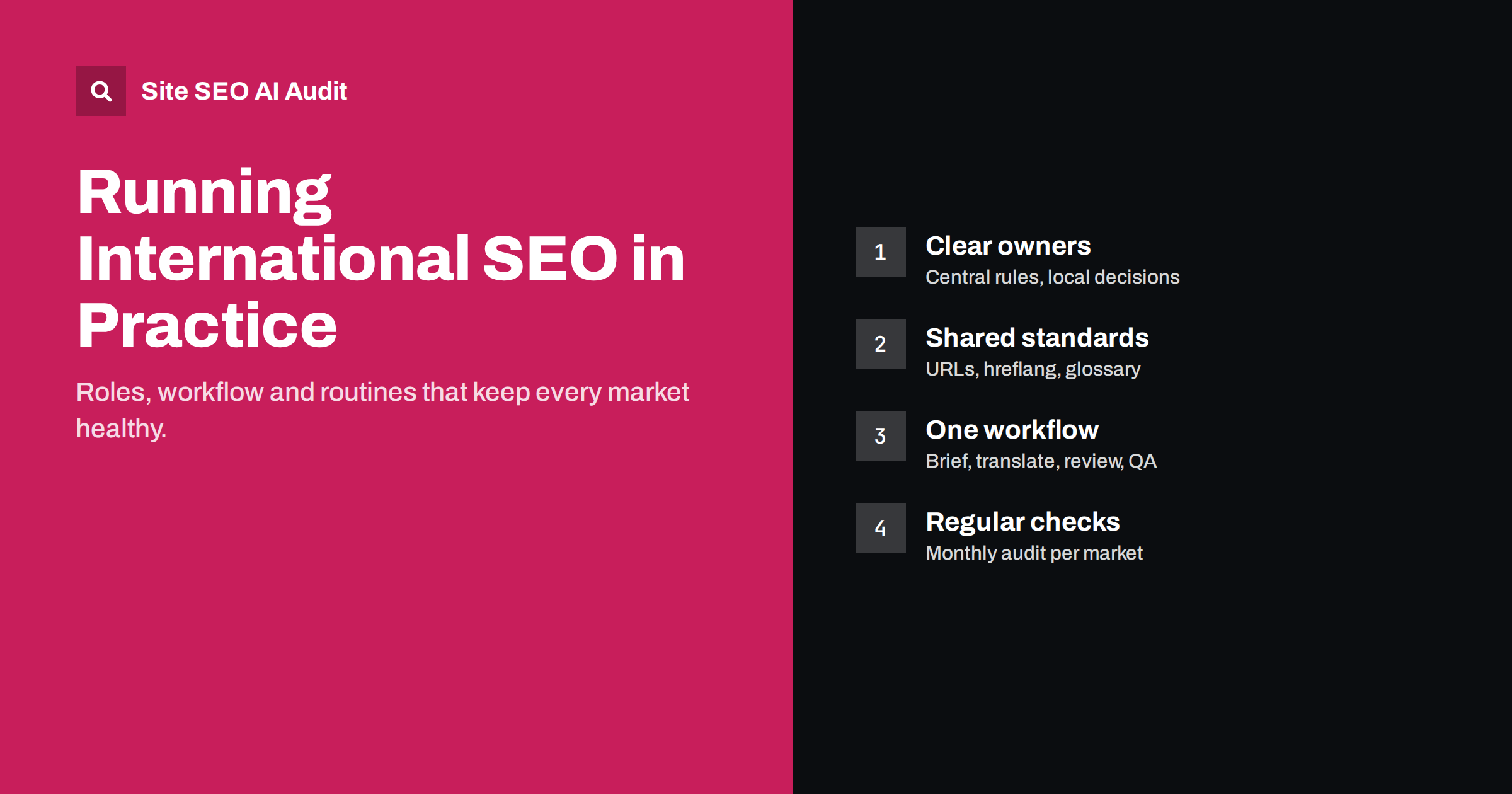
Short answer: International SEO works best with a hybrid model: a central owner sets the technical rules, templates and standards for every market, while local owners decide on keywords, content and priorities for their language or country. Connect them with one documented workflow from source content to localised, reviewed and technically checked pages, keep shared standards for URLs, hreflang and terminology, and run a regular audit per market. Most multilingual SEO problems come from unclear ownership, not from lack of knowledge.
Why international SEO needs an operating model
On a single-language site, one person or small team usually sees everything. Once a site runs in several languages or countries, work spreads across translators, local marketers, developers, agencies and sometimes separate companies. Each group sees only its part.
The typical symptoms are familiar from audits:
- hreflang annotations break after a template change, and nobody notices for months.
- Local teams publish pages that exist only in their language, without connecting them to other versions.
- Translations lag behind the source, so markets show outdated prices or features.
- Two markets target the same country with different pages.
- Titles and meta descriptions are translated literally and never checked for local search terms.
None of these requires advanced knowledge to fix. They require someone who is responsible, and a routine that catches problems early. The cost of unclear ownership also grows with every market: a mistake in a shared template is copied into every language at once, while a missing update process leaves more versions behind each month.
Three ways to organise the work
| Model | Cum funcționează | Strengths | Weaknesses |
|---|---|---|---|
| Centralised | One team plans, localises and publishes for all markets | Consistent technical quality, clear ownership | Weak local insight, slow for local needs |
| Decentralised | Each market runs its own site section independently | Strong local relevance, fast local decisions | Inconsistent setup, broken hreflang, duplicated effort |
| Hybrid | Central team owns standards and technology; local owners own content and priorities | Consistency plus local relevance | Needs clear rules and communication |
Small businesses entering one or two markets often start centralised, with a freelance translator or local reviewer. As markets grow, a hybrid model usually becomes necessary. Fully decentralised setups tend to drift apart technically unless a central function audits them.
Whichever model you choose, write down where the boundary lies. For example: the central team decides URL structure and templates, market owners decide which pages exist in their language and how they are worded, and neither changes the other’s area without a short review.
The roles you need
In a small company, one person may hold several of these roles. What matters is that each responsibility has a name next to it.
- International SEO owner. Owns the technical standards: URL structure, hreflang, canonicals, sitemaps, language switcher, templates. Reviews every change that affects all markets.
- Market owner. One person per language or country who decides which content that market needs, approves local keywords and checks that pages make sense to local customers.
- Translators and localisers. Adapt content, including titles, descriptions, alt text and structured data, following a brief and a glossary. The difference between translating and adapting is covered in translation vs localization.
- Developers. Implement templates and technical changes, and run checks before releases that touch multilingual elements.
- Content editors. Publish pages and connect language versions in the CMS.
- Legal or compliance reviewer, where local rules apply to product claims, prices or policies.
Shared standards everyone works from
A short written standard prevents most recurring errors. It does not need to be long; a few pages are enough if they are kept current.
- URL conventions: language and country folder codes, whether slugs are translated, trailing slashes.
- hreflang rules: which codes are used, how x-default is set, where the annotations live. For big sites, see hreflang at scale.
- Untranslated content: what happens to pages that exist in only some languages, as discussed in untranslated pages.
- Glossary: brand names, product names and key terms per language, including terms that must not be translated.
- Metadata rules: title and description patterns per template, with room for local wording. The guide on translating title tags and descriptions has examples.
- Keyword lists per market, based on local keyword research, not on translated keywords.
A workflow from source page to local page
New and updated content should follow the same path every time. A typical sequence:
- Source content is created in the main language and marked for localisation, with a note on which markets need it.
- Localisation brief: target keywords per market, audience notes, required local details such as prices or legal text.
- Translation and adaptation by the translator, using the glossary and brief.
- Local review by the market owner or a native speaker who knows the product.
- Publishing with language versions connected in the CMS, correct slugs and metadata.
- Technical check: hreflang, canonical, lang attribute and internal links on the published page.
- Update loop: when the source page changes materially, all language versions get a task to update, with a deadline.
The update loop is the step most often missing. Without it, language versions quietly fall behind. A simple field in the CMS or a spreadsheet that records the source version each translation is based on is often enough to track it.
Handling technical changes safely
Changes that affect all markets carry the highest risk: new templates, CMS upgrades, plugin changes, URL restructures or a new language. Treat them as releases with an international checklist:
- Test hreflang and canonicals on a staging version for each language before release.
- Check that the language switcher links to equivalent pages, not to home pages.
- Crawl a sample of every language version immediately after release.
- Keep a changelog, so a sudden drop in one market can be traced to a change date.
Adding a new language follows the same logic on a larger scale; launching a new language version walks through it.
Routines and reporting per market
A fixed rhythm keeps the whole system healthy:
- Monthly: a crawl of all language versions with an international checklist, reviewed by the central owner. The international SEO audit checklist lists what to include.
- Monthly: performance per market in Search Console, filtered by country or folder, as described in Search Console for international sites.
- Quarterly: a review with market owners of content priorities, translation backlog and keyword changes.
- After every major release: a targeted technical check across all languages.
Report issues per market with a named owner and a due date. A single list of “international SEO problems” without owners tends to stay open.
Working with agencies and freelancers
Many companies use external translators or local agencies. That works well if the standards and workflow are shared with them from the start. Give every external partner the glossary, the metadata rules and the brief template, and define who publishes and who checks. Agencies that audit several markets for a client often use a similar structure, described in how agencies audit multilingual sites.
A few agreements prevent most friction with external partners:
- Access: decide whether partners publish directly in the CMS or deliver files that your team publishes. Direct access is faster but needs clear rules about what they may change.
- Quality criteria: agree in advance how titles, descriptions and headings are checked, not only the body text.
- Turnaround times: set expectations for new pages and for updates, so the update loop does not stall.
- Handover: make sure glossaries, translation memories and keyword lists stay with your company if the partner changes.
How Site SEO AI Audit helps
A monthly or weekly crawl is the backbone of the routine. Site SEO AI Audit crawls every language version and checks hreflang return links, broken language versions, x-default and lang attributes, along with titles, descriptions, links and speed. Its fix list ranks issues by how many points each fix adds, which makes it easier to assign the biggest problems first. Pro plans include weekly audits with e-mail alerts and comparisons over time, and the Agency plan adds white-label reports. See the plans for details.
Related reading
- International SEO for Beginners: How to Take a Site Global
- hreflang Errors: The Complete List and How to Fix Each One
- Which Blog Posts to Translate First: A Data-Led Approach
The bottom line
International SEO is as much an organisational task as a technical one. Choose an operating model, name an owner for technical standards and one per market, write short shared standards, run every page through one workflow including an update loop, and audit all language versions on a fixed schedule. Clear ownership turns scattered multilingual work into a system that stays healthy.
FAQ
Who should own international SEO in a company?
Ideally one central owner for technical standards and templates, plus one owner per market for local content and priorities. In small companies these can be the same person, but the responsibilities should still be written down.
Should local teams manage their own SEO?
They should manage local content, keywords and priorities, because they know the market. Technical elements shared by all markets, such as hreflang and templates, are better owned centrally.
How do I keep translations up to date?
Record which version of the source page each translation is based on, and create an update task for every language when the source changes materially. Review the backlog regularly with market owners.
How often should a multilingual site be audited?
A monthly crawl of all language versions suits most sites, plus a targeted check after every release that touches templates, URLs or the CMS. Large or fast-changing sites benefit from weekly checks.
What should a localisation brief contain?
Target keywords for the market, the audience, required local details such as prices or legal text, terms from the glossary and any parts of the source that should be adapted rather than translated.