ENEnglish
 LTLietuviškai
 DEDeutsch
 FRFrançais
 RUРусский
 ESEspañol
 PLPolski
 ITItaliano
 UKУкраїнська
 CSČeština
 PTPortuguês
 JA日本語
JA日本語 LVLatviešu valoda
 ETEesti
 HUMagyar
 IDBahasa Indonesia
 TRTürkçe
 HIहिन्दी
 ELΕλληνικά
 ARالعربية
 THไทย
THไทย VITiếng Việt
 RORomână
 MSBahasa Melayu
 BNবাংলা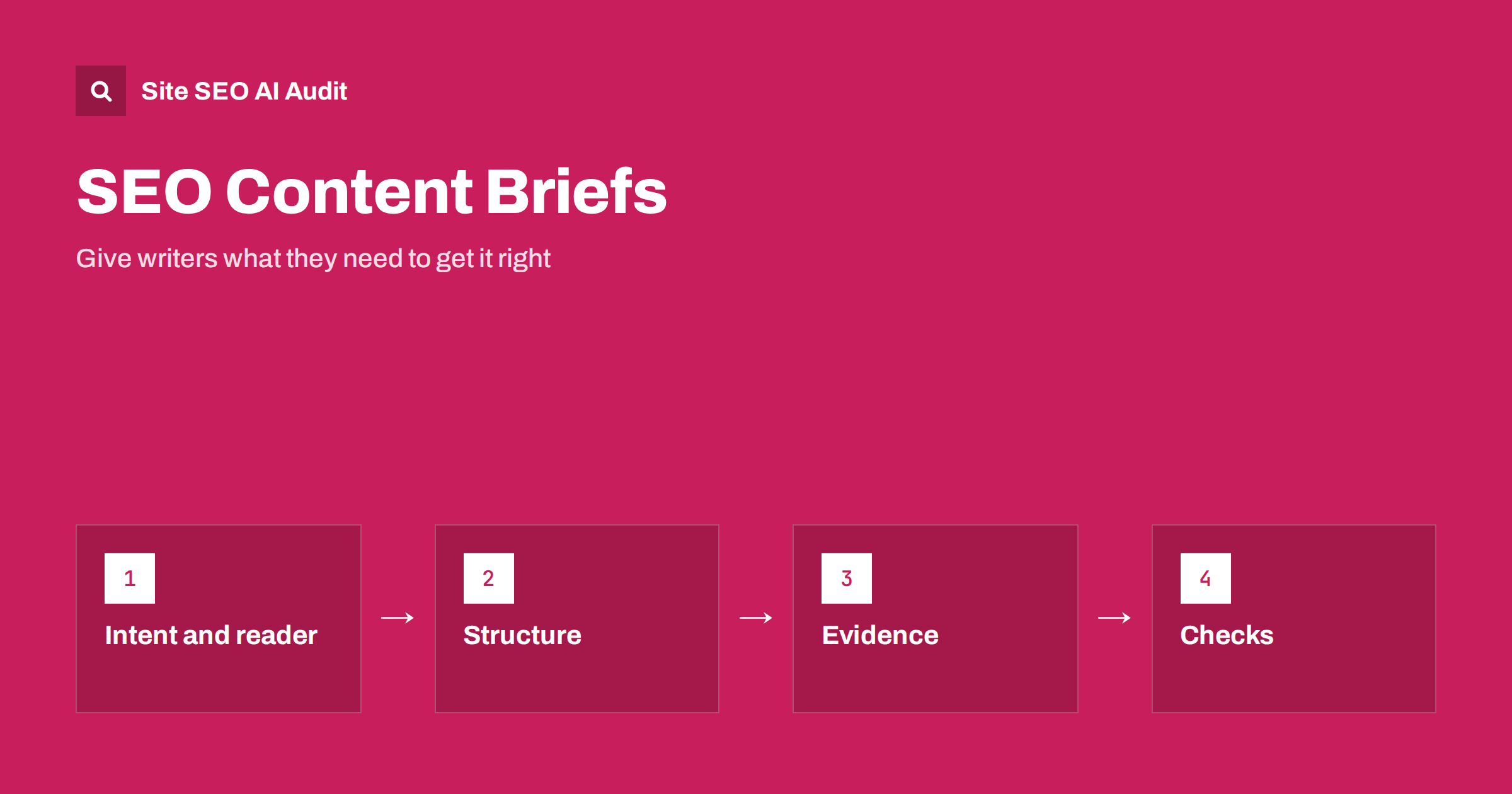
Short answer: An SEO content brief is a one-page set of instructions that tells a writer who the page is for, what the searcher wants, what the page must cover, how to structure it, which sources and examples to use, where to link and how it will be reviewed. Good briefs do not dictate keyword counts. They give enough context for a writer to produce a useful, accurate page the first time, with fewer rounds of revision.
Many content projects fail before the first word is written. The writer receives a keyword and a deadline, guesses what the page should do and delivers something generic. The editor then adds missing points, the SEO specialist asks for changes to headings, and the page takes three rounds to publish. A clear brief shortens the whole process. It also makes the results measurable, because everyone knows what the page was meant to achieve. This guide lists the parts of a useful brief and ends with a template.
Start with purpose and reader
Begin the brief with the reason the page exists. Answer these questions in a few lines:
- Goal: what should the page achieve for the business: attract readers, answer support questions, support a product, earn links?
- Audience: who will read it, what do they already know, what words do they use?
- Next step: what should a reader do after reading: sign up, compare plans, read another guide, contact sales?
- Funnel stage: is the reader learning, comparing or ready to act?
Writers produce better work when they can picture a person. Add a one-sentence description such as “a small business owner who runs a WordPress site and has never looked at technical SEO.” Avoid vague audiences like “everyone interested in marketing.”
Describe the search intent
Intent is the most important section. State what the searcher wants to achieve with the query, and which page types currently satisfy it. Look at the results yourself and note:
- The main format: guide, list, comparison, tool, product page, video.
- The common subtopics that top pages cover.
- Questions shown in the related questions area and in autocomplete suggestions.
- Features on the results page, such as featured snippets or AI-generated summaries.
- Gaps: points that the current pages explain badly or leave out.
This work separates a brief from a topic request. See search intent: matching your page to what searchers want and content gap analysis. Make clear in the brief what the page will not cover, which keeps it focused and avoids overlaps with other pages.
Keywords: targets, not quotas
Give the writer a primary topic and a short list of related terms and questions, but do not ask for a specific density or a number of repetitions. Modern search systems read meaning, and forced repetition makes the text worse. Include:
- The main phrase and two or three natural variants.
- Related entities and concepts a complete page would mention.
- Questions to answer, taken from real searches.
- Words to avoid, such as competitor names, banned claims or internal jargon.
Also say which page the topic belongs to, so two pages do not compete for the same query. See keyword mapping and keyword cannibalization. For placement advice you can pass on, see keyword placement on the page.
Structure: headings and the opening
Provide a draft outline, and let the writer improve it. A useful outline includes:
- A working title and the expected H1.
- A short answer at the top that resolves the main question in two or three sentences. See answer-first introductions.
- Six to eight H2 headings in a logical order, each with a note about what it must cover.
- Places for a list, table, image, example or step-by-step part.
- An FAQ with four or five real questions.
- A closing section with the main takeaway and the next step.
Remind the writer to use headings in a clean hierarchy. See heading structure for SEO. Mention the target length as a range tied to the topic, not as a goal in itself. See does word count matter for SEO?
Evidence, experience and sources
Pages that stand out contain something a generic article lacks. In the brief, ask for specific proof:
- First-hand experience, case notes or screenshots from your own work, which the writer can request from named colleagues.
- Original data or examples from your product or customers, with permission.
- Trusted external sources for facts, listed in the brief, and instructions to link to the primary source.
- Quotes from subject experts, with names and roles.
State clearly which claims need a source and which topics need expert review, such as legal, medical or financial matters. See original data and first-hand experience and E-E-A-T and AI search. If AI tools assist the writer, state the rules: what is allowed, who checks the facts and how it is disclosed. See AI-assisted content and SEO.
Links, media and calls to action
List the internal links the writer should include, with suggested anchor text, and the pages that should link back to the new page once it is live. A good brief names three to six existing pages. See internal linking strategy and anchor text best practices. Add rules for external links: how many, to which kinds of sources, and whether they open in a new tab.
For media, specify the images or diagrams needed, who creates them, the required alt text approach and the cover image style. See image alt text. Describe the call to action in one sentence, and say where it belongs. It should fit the reader’s stage and not interrupt the explanation.
Metadata and technical details
Include the fields that the publisher will need so they are not invented at the last minute:
- Proposed title tag and meta description, written to earn the click. See how to write title tags and how to write meta descriptions.
- URL slug, short and descriptive. See SEO-friendly URLs.
- Category, tags and author.
- Structured data type if relevant, such as FAQ markup.
- Publication date or window, and the review date for the next update. See how to refresh old content.
Common mistakes in briefs
Most weak briefs fail in the same few ways, and each one is easy to correct:
- A keyword list without context. Writers need to know the reader and the goal, not only a list of phrases.
- Copying competitor outlines. The result is a page no better than the ones that already exist. Aim to cover the same essentials and add something extra.
- Too many rules. Twenty style requirements hide the three that matter. Link to the style guide instead of repeating it.
- No access to experts. If the page needs product knowledge, name the person who can answer the writer’s questions and by when.
- Silence about updates. Say who owns the page after publication, and when it will be reviewed.
Keep a shared folder of finished briefs and the pages they produced, so new team members can see what good looks like. Short examples teach faster than long instructions, and they make it easier to keep the same standard when several writers work on one site. Ask writers for feedback after each project. They often notice missing information first, and their comments improve the next brief.
Review checklist and a copyable template
Finish the brief with the checks that the editor will use, so the writer can test the draft before delivery:
- Does the opening answer the main question?
- Does the page match the intent and cover the listed subtopics?
- Are all facts accurate, with sources for the important ones?
- Is there at least one element that readers cannot get from other pages?
- Are headings clear, links relevant and the metadata complete?
- Is the tone consistent with the brand and the audience?
A compact template can look like this: Page goal; Reader; Search intent; Primary topic and related terms; Questions to answer; Outline; Evidence and sources; Internal links; Media; Call to action; Metadata; Length range; Deadline; Reviewer. One page is usually enough. If a brief grows beyond two pages, writers stop reading it.
After publication, measure whether the page did what the brief promised, and improve the brief for next time. Site SEO AI Audit crawls the finished pages and checks titles, descriptions, headings, links, structured data, speed and AI visibility signals, so you can confirm that each brief translated into a clean page. The first audit of up to 200 pages is free.
Related reading
The bottom line
A strong brief gives the writer purpose, a clear reader, the search intent, a flexible outline, proof to use, links, metadata and review criteria. It takes an hour to prepare and saves many hours of revision. Keep it short, update it with what you learn, and judge each page by whether it truly helps the person who searched.
FAQ
How long should an SEO content brief be?
One page is ideal, two at most. It should contain only what the writer needs to produce the first draft with confidence.
Should the brief include a keyword density target?
No. Give a primary topic, related terms and questions, and let the writer use them naturally. Forced repetition lowers quality.
Who should write the brief?
An SEO specialist or editor who has reviewed the search results, ideally with input from a subject expert and from customer-facing colleagues.
Do briefs help with AI-assisted writing?
Yes. The same brief guides a tool or a person, but a human must verify facts, add experience and approve the final text.
How do I know if a brief worked?
Check whether the page needed fewer revisions, matched the intent and met its goal, such as visits, links or conversions, after a few months.