ENEnglish
 LTLietuviškai
 DEDeutsch
 FRFrançais
 RUРусский
 ESEspañol
 PLPolski
 ITItaliano
 UKУкраїнська
 CSČeština
 PTPortuguês
 JA日本語
 LVLatviešu valoda
 ETEesti
 HUMagyar
 IDBahasa Indonesia
 TRTürkçe
 HIहिन्दी
 ELΕλληνικά
 ARالعربية
 THไทย
 VITiếng Việt
 RORomână
 MSBahasa Melayu
 BNবাংলা
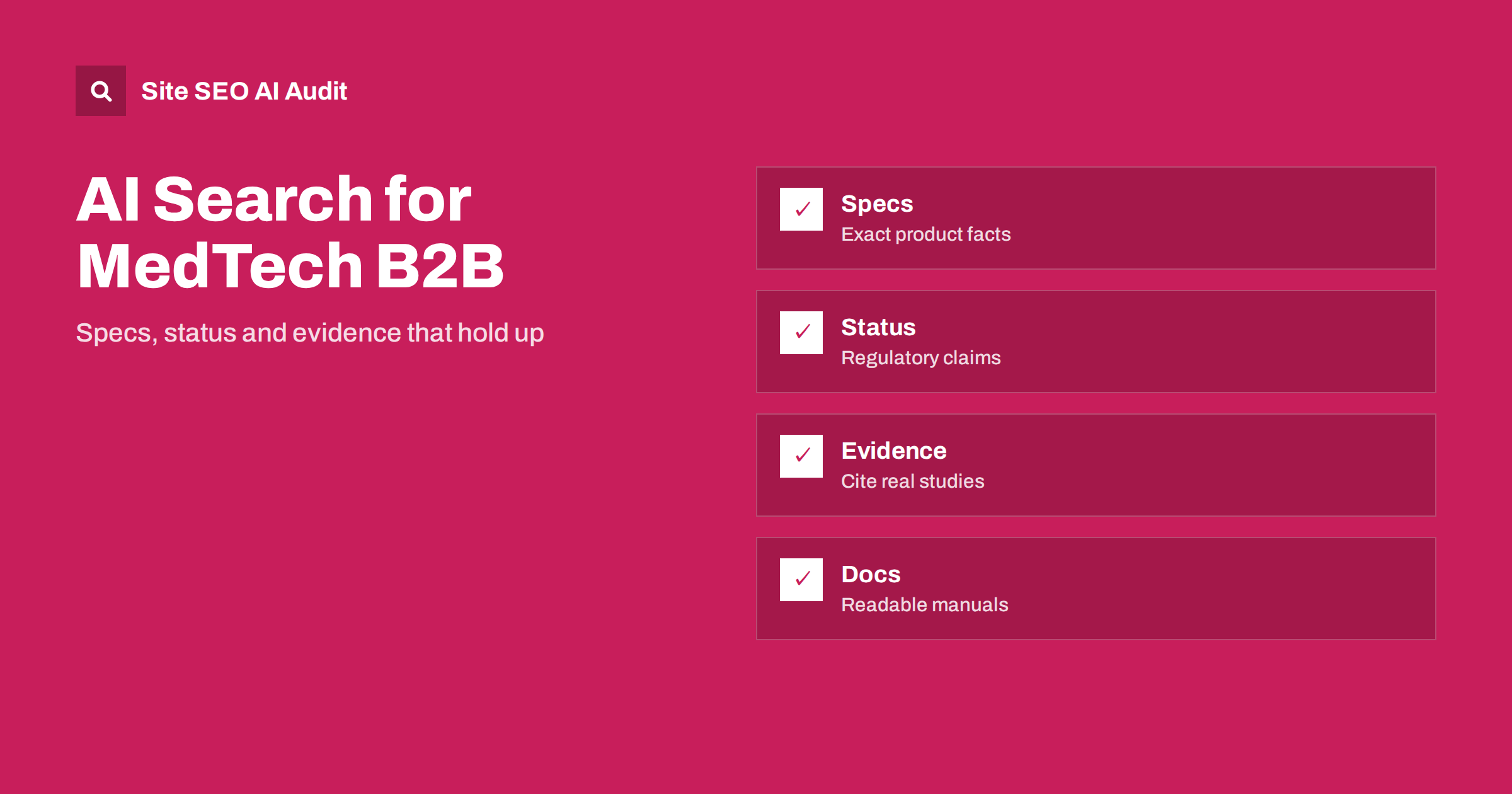
Short answer: Buyers in hospitals, clinics and distribution ask AI assistants detailed questions about devices and suppliers, and assistants are cautious in healthcare. A medical device or healthcare B2B company is more likely to be cited when its pages give exact product specifications, state regulatory status precisely and only where true, cite real clinical or technical evidence, separate audiences for professionals and patients, publish readable manuals and documents, and show clear contact and support details. Accuracy and restraint matter more than persuasion.
Medical technology is among the most carefully regulated fields, and its buyers are professionals who check details. A purchasing manager may ask which devices meet a certain standard, a clinician may ask how a technique compares with another, and a distributor may ask who the manufacturer is and where support is available. Assistants answer such questions from manufacturer pages, regulatory databases, publications and trade sources. A company that publishes precise, verifiable information is easier to cite and harder to misrepresent. This guide covers the content and technical care that apply, without making any claim about a product or its use. For the wider sensitive-topic context, see the guide to YMYL topics and AI search.
Know your audiences and separate them
A medical device site often serves several groups: clinicians who use the product, purchasing and procurement teams, distributors, technical staff who maintain it, investors and sometimes patients. Each group needs different pages. A clinician wants indications, technique and evidence. A purchasing manager wants specifications, certificates, delivery terms and support. A patient wants plain information on what the device does and whom to ask, and in many places rules restrict how a manufacturer may speak to patients about a device.
Make the audience of each section clear in the menu and in the first lines of each page. Where rules require that certain information is shown only to healthcare professionals, follow them, and understand that content behind a gate is usually not available to assistants, a trade-off discussed in the guide to gated content and AI search. Keep public the facts that are allowed to be public, and keep the gate for what must be restricted.
Publish exact product facts
Each product needs a page with the model name and number, the intended purpose as stated in the approved documentation, the main specifications with units, dimensions, materials, compatible accessories, sterilisation or cleaning requirements, storage conditions, service life and available variants. Use the same terms as in your technical files and standards. Put key figures in clear lists or one simple table. Avoid marketing words that can be read as a claim of performance, and avoid comparisons that you cannot support.
Give every product a stable address and keep old versions available with a note when a model is replaced. A buyer may look for a discontinued model to find spare parts or service. The structure follows the guide to product page SEO, adapted to a professional audience.
State regulatory status carefully
This is the point where errors do the most harm. Regulatory terms such as certified, cleared, approved, registered or compliant have specific meanings, and they differ by region and device class. State only what is true, name the region, the classification and the standard or procedure, and give the certificate or registration number where it can be shared. If a product is available in some markets but not others, say so by market. If approval is pending, say that it is pending, not that it is available.
Do not use a symbol or a claim from a different regime. Review every status statement with your regulatory team, date the page and update it when a certificate changes or expires. Link to official databases where they exist, and avoid copying their content. An assistant that repeats an incorrect status from your page can cause real problems for you and for your customer, a risk covered in the guide to wrong information from AI about a business.
Cite real evidence
Clinical and technical evidence is the main currency in this field. If you have published studies, list them with full references, the type of study, the population, the main findings and the limits. Link to the original publications and say who funded the work. Describe results as they are, without exaggeration, and avoid turning a small study into a broad claim. If a claim depends on a setting or a user group, say so. Where evidence is limited, say that it is limited.
The writing of references and sources is discussed in the guide to citing sources. Add the names and credentials of the experts who wrote or reviewed the pages, as in the guide to author pages and bylines. The principles of experience and trust are in the guide to E-E-A-T and AI search.
Make manuals and documents readable
Instructions for use, datasheets, safety notices and certificates are often published as PDF files. They are valuable, since buyers and technicians search for them. Make sure the PDFs have text that can be read, not scanned images, with a clear title, a version number and a date. Link to each document from the product page with descriptive link text and, if you can, provide key content as a web page too, so that crawlers and assistants can read it without opening a file. The practical points are in the guide to PDFs, images and video in AI search.
Keep a clear page for safety notices and field actions, and update it promptly. If a document is superseded, mark the old version as replaced and point to the current one. Old manuals found in search can mislead technicians, so remove or label them.
Build trust pages for institutional buyers
Hospital and distributor buyers want to know who stands behind a product. Show the legal manufacturer name and address, the quality system certifications you hold, the countries where you operate, the contact for technical support and complaints, and the process for reporting issues. Describe your service network and training offers in concrete terms. Name your leadership and technical experts where appropriate. A clear company page and consistent organisation details across profiles help assistants identify you correctly, supported by the markup in the guide to Organization schema.
Case studies can help when permitted. Describe the setting, the need, the solution and the outcome, with approval from the customer and without any patient data. The structure is covered in the guide to case study pages. Do not use testimonials that imply endorsement of clinical results unless the rules allow it.
Answer the questions buyers actually ask
Gather the questions that sales, service and tender teams receive, and answer the common ones on public pages. Typical examples are which standards a device meets, what accessories are compatible, how often maintenance is needed, how long spare parts are supplied, what training is offered, what the delivery time is, how a warranty works and how to compare two models. Write each answer in a few direct sentences, followed by detail and a link to the relevant document. This format suits assistants that retrieve short passages, as described in the guide to answer-first introductions.
Comparison pages deserve care. A fair comparison of your own models, or of a technique against alternatives, helps buyers choose and shows confidence. A comparison with a competitor must be accurate, dated and supportable, so involve your legal and regulatory teams. The structure is explained in the guide to comparison pages and AI search. If you cannot publish a claim, leave it out; a missing claim does less harm than a wrong one.
Review your tender and procurement documents as well. Public tenders often list required properties, and a page that maps your product to common requirements, without overstating, can help a buyer who works through a checklist. Use the exact terminology of the checklist, and keep the page updated whenever specifications or certificates change.
Handle distributors and multiple markets
If you sell through distributors, publish a clear list of authorised partners by country, with contact details, and keep it current. Provide a way for buyers to verify that a seller is authorised. Different markets may have different product names, configurations and approvals, so use separate pages or clear sections for each market with the correct language and status, and connect them with hreflang where the pages are alternates, as explained in the guide to hreflang tags.
Check that distributors do not publish outdated or inaccurate descriptions of your products. Provide them with approved text and images, and review how third parties describe your devices from time to time.
Keep information fresh and consistent
Medical information ages. Add dates to key pages, review them on a schedule and record changes. Remove claims that are no longer valid. Keep names, addresses and product lists the same across your website, trade directories, tender platforms and social pages. The importance of dates is explained in the guide to content dates and freshness.
Site SEO AI Audit crawls your website and checks status codes, titles, descriptions, headings, broken links, structured data, page speed and AI visibility settings such as AI crawlers in robots.txt, which helps you keep product and document pages readable and consistent. It does not review regulatory claims or medical content. The first audit of up to 200 pages is free, and larger sites can see the pricing page.
Related reading
The bottom line
Say exactly what is true, show the evidence and keep every claim reviewed and dated.
FAQ
Can I put regulatory certificates on my website?
Yes, where you may share them. State the region, classification and number precisely, and update them when they change.
Should product information be public or behind a login?
Publish what the rules allow. Gated content is usually unavailable to assistants, so keep the gate only for information that must be restricted.
How do I write about clinical results?
Report them as published, with references, the study type and its limits, and avoid claims broader than the evidence.
Are PDF manuals important for AI search?
Yes, if the text can be read. Use clear titles and versions, link them from product pages and remove outdated copies.
Do distributors affect how my products are described?
Yes. Give them approved text and check third-party descriptions regularly for errors.