ENEnglish
 LTLietuviškai
 DEDeutsch
 FRFrançais
 RUРусский
 ESEspañol
 PLPolski
 ITItaliano
 UKУкраїнська
 CSČeština
 PTPortuguês
 JA日本語
 LVLatviešu valoda
 ETEesti
 HUMagyar
 IDBahasa Indonesia
 TRTürkçe
 HIहिन्दी
 ELΕλληνικά
 ARالعربية
 THไทย
 VITiếng Việt
 RORomână
 MSBahasa Melayu
 BNবাংলা
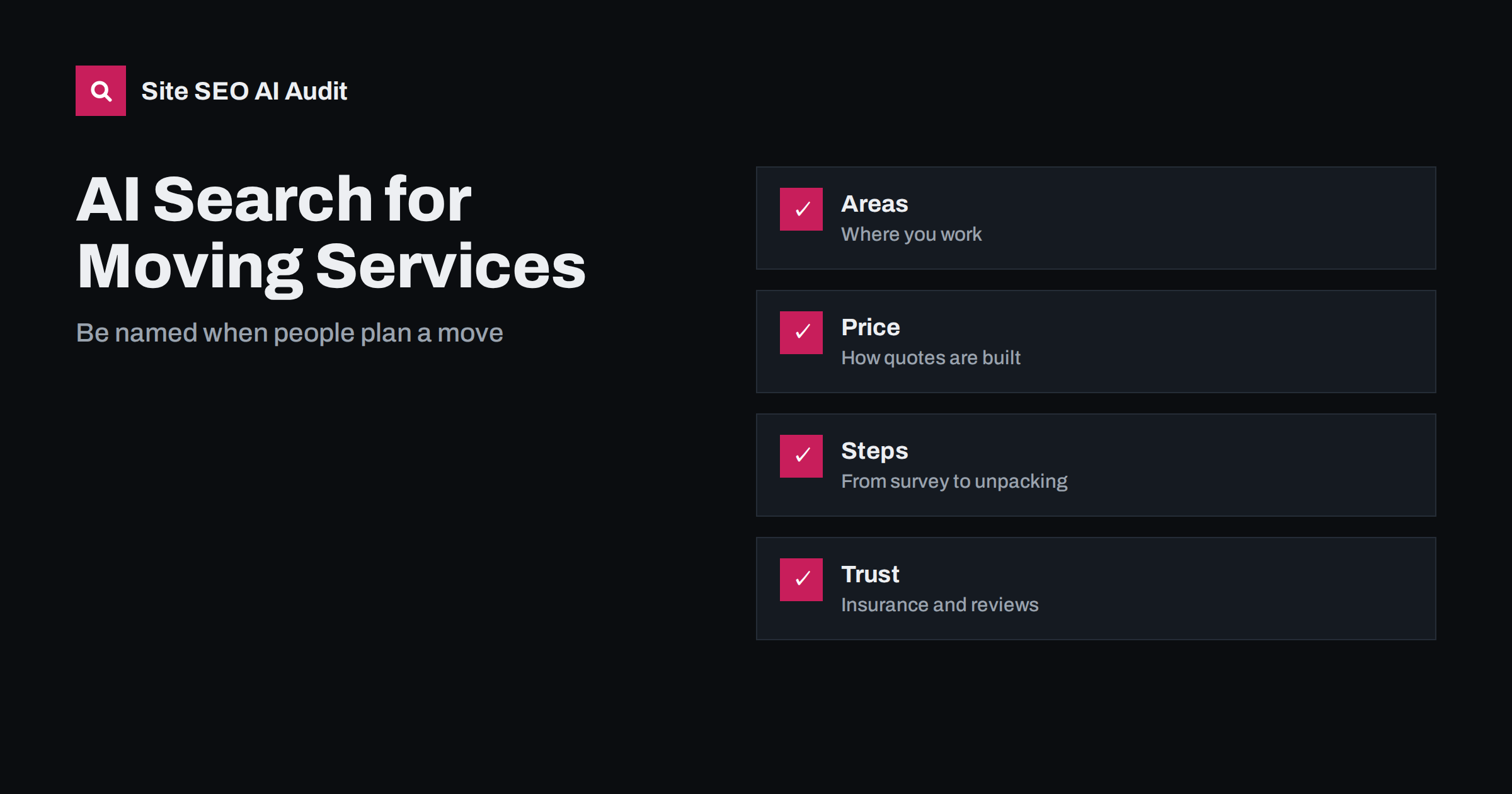
Short answer: People planning a move ask assistants how much it costs to move a two-bedroom flat, which firm handles international relocation or how to store furniture for a few months. Moving and storage companies are named when their pages state service areas, what is included, how quotes are calculated, how insurance works, what the process looks like and what real customers say. Concrete, honest detail wins over claims of low prices and stress-free service.
A move is stressful, expensive and risky, so buyers look for reassurance and clear information. They compare several firms, and assistants increasingly produce the first shortlist. The firm that explains its process and pricing in plain text is easier to include than one that shows only a phone number and a slogan. This guide explains what to publish and how to structure it for removal companies, self-storage operators, relocation consultants and specialist movers. It builds on the local business guide and the generative engine optimization guide.
How people ask
Questions combine size, distance, date and constraints. How much does it cost to move a one-bedroom apartment across town? Who can move a piano up three floors? What is the cheapest way to store furniture for two months? How far ahead should I book movers for the end of the month? What does packing service include? Each question names a need that your pages should answer directly, with figures or ranges if you can give them honestly.
Many moving sites bury everything behind a quote form. A form is useful, but a page with no explanation gives an assistant nothing to quote and a visitor no reason to trust the firm before sharing contact details.
Spell out services and areas
List each service on its own page: home moves, office moves, international moves, packing and unpacking, furniture assembly, piano and special item handling, short-term and long-term storage, disposal and clearance. For each, state what is included, what is extra and what the customer must prepare. Add the types of vehicle and crew sizes where relevant, and the access conditions you can handle, such as stairs, narrow streets or lifts.
Service areas deserve their own treatment. List the cities, regions and countries you serve and how you handle long-distance and international moves, including whether you use your own staff or partners. A page for each major route, such as a move from one city to another, can be valuable if it has real information: typical time, any local rules, parking permits and common issues. Do not clone the same text for many towns, since near-identical pages add nothing, as explained in the guide to location pages.
Explain pricing honestly
Price is the top concern. Even if each job is different, explain the factors that determine the quote: volume or number of rooms, distance, floors and access, packing needs, date and season, special items, insurance level and storage time. Offer typical ranges for common jobs, labelled as examples and not as promises. Say whether prices are by the hour, by volume or fixed, and what extras may apply, such as parking fees or waiting time.
Explain how to get an accurate quote: a video survey, an on-site visit or a detailed inventory form. Transparent pricing builds trust and reduces enquiries from people who are not a fit. If you publish prices, keep them current, and make sure they are the same on every page and language version. Wrong numbers quoted by an assistant harm both parties, a risk discussed in the guide to wrong information about a business.
Describe the process step by step
A clear process reassures customers. Walk through the stages: enquiry, survey, quote, booking and deposit, packing, loading, transport, delivery, unpacking, and the handling of damage claims. For each, say who does what, how long it takes and what the customer should do. Add checklists for the weeks before a move, which are content that people actively search for and that assistants quote: when to book, how to label boxes, what not to pack, how to prepare appliances and how to protect floors.
These guides bring in readers at the planning stage, before they choose a firm. Keep them practical and accurate, and avoid claims that cannot be checked. Use headings that match questions, with short answers first, as covered in the guide to answer-first introductions.
Insurance, licences and safety
Trust signals matter greatly when strangers handle a person’s belongings. State what insurance applies, what it covers, any limits, how to make a claim and how long it takes. Name licences or registrations required in your country for moving or transport businesses, and show membership of professional associations if you truly hold it. Describe how staff are trained and checked, how fragile items are packed and what happens if the delivery is delayed. Do not claim certification you lack.
For storage, explain security measures, access hours, climate control if offered, fire protection, insurance requirements, contract terms and how to end a contract. People ask these questions directly, and clear answers help a storage business appear in recommendations. The trust factors involved are discussed in the guide to E-E-A-T and AI search.
Reviews and reputation
Reviews are crucial in this sector, because assistants lean on them and buyers fear bad experiences. Ask customers for honest reviews after the job, on the main review and map platforms, and respond to every review calmly, especially the critical ones, explaining what you did to put things right. Never publish fake reviews. Showcase real before and after stories with permission, with details of the route, the size of the job and what went well. Consistent business details across the website and listings also help, as discussed in the guide to aligning a business profile with a website.
Mentions in local news, partnerships with estate agents and links from relocation guides help your reputation. Keep a page listing partners and recognition, with links.
International and corporate moves
Customers who relocate for work or study have different questions: customs rules, shipping times, what documents are needed, how to move pets, whether household goods can be stored in transit and what a relocation package from an employer usually covers. If you handle such moves, create dedicated pages written for them, ideally available in the languages of your clients’ origins. Explain the roles of partners abroad and the point at which responsibility changes hands. Technical setup for such pages is covered in the hreflang guide.
Corporate customers need different information: capacity, planning, out-of-hours work, IT equipment handling, inventory tracking and insurance for business assets. A separate section for business moves with case descriptions, without naming clients without permission, helps you appear in answers on office relocation.
Structure and technical points
Use clear headings that match questions, a short answer at the top of each section and lists for steps. Add structured data for the business, its services and FAQs where it matches visible text. Keep pages fast on phones, since many people search while standing in the middle of a pile of boxes, and make the phone number and quote form easy to use. Check that the pages are reachable by AI crawlers and are not hidden behind forms or scripts, as covered in the guide to AI crawlers and robots.txt.
Seasonality matters. Moving peaks at month ends and in summer, and quiet periods may offer lower prices. If you offer such patterns, publish them. Update pages before the busy season with booking advice and lead times.
Think also about the questions that come after the move: how to change address, how to dispose of boxes, how to settle in a new city. Short guides answer these needs and keep your brand present. Do not promise services beyond what you offer, but link to trusted sources where useful. A rounded set of pages shows that the firm understands the whole experience and not just the van.
Here is a short example. A regional moving company had one page with a photo of a truck and a request form. After a rewrite, it published pages for flat moves, office moves, piano moves and storage, an explanation of how quotes are calculated with example ranges for three typical flats, a step-by-step process page, a checklist for the last two weeks before a move and a page on insurance and claims. Customers began to quote the checklist and the price factors in their enquiries, and assistant answers about moving a flat in the region started to include the company, with links to the quote explanation.
A storage operator did something simpler: it published a page that compared the unit sizes in plain language, such as what fits into each, with a photo and a rough list of items, along with the security and access details. The page answered the most common question, which size do I need, and quickly became the one that assistants and customers used.
Site SEO AI Audit crawls your website and checks status codes, titles, descriptions, duplicate and thin content, broken links, structured data, page speed and AI visibility settings, which helps you find weak or duplicated location and service pages. It does not set prices or manage bookings. The first audit of up to 200 pages is free, and the pricing page lists plans for larger sites.
Related reading
The bottom line
Moving and storage firms are recommended when pages state service areas, price factors, process steps, insurance and real reviews clearly, with checklists that help planners.
FAQ
Should I publish prices for moves?
Publish the factors and typical ranges labelled as examples, and explain how to get an exact quote.
Do I need a page for each town?
Only where you have real, distinct information. Near-identical town pages add little value.
What do customers want to know about insurance?
What it covers, the limits, how to claim and how long claims take.
Are planning checklists worth writing?
Yes. People search for them early, and assistants quote them, which puts your brand in front of planners.
How do reviews affect recommendations?
Strongly. Collect honest reviews on major platforms and answer every one politely.