ENEnglish
 LTLietuviškai
 DEDeutsch
 FRFrançais
 RUРусский
 ESEspañol
 PLPolski
 ITItaliano
 UKУкраїнська
 CSČeština
 PTPortuguês
 JA日本語
 LVLatviešu valoda
 ETEesti
 HUMagyar
 IDBahasa Indonesia
 TRTürkçe
 HIहिन्दी
 ELΕλληνικά
 ARالعربية
 THไทย
 VITiếng Việt
 RORomână
 MSBahasa Melayu
 BNবাংলা
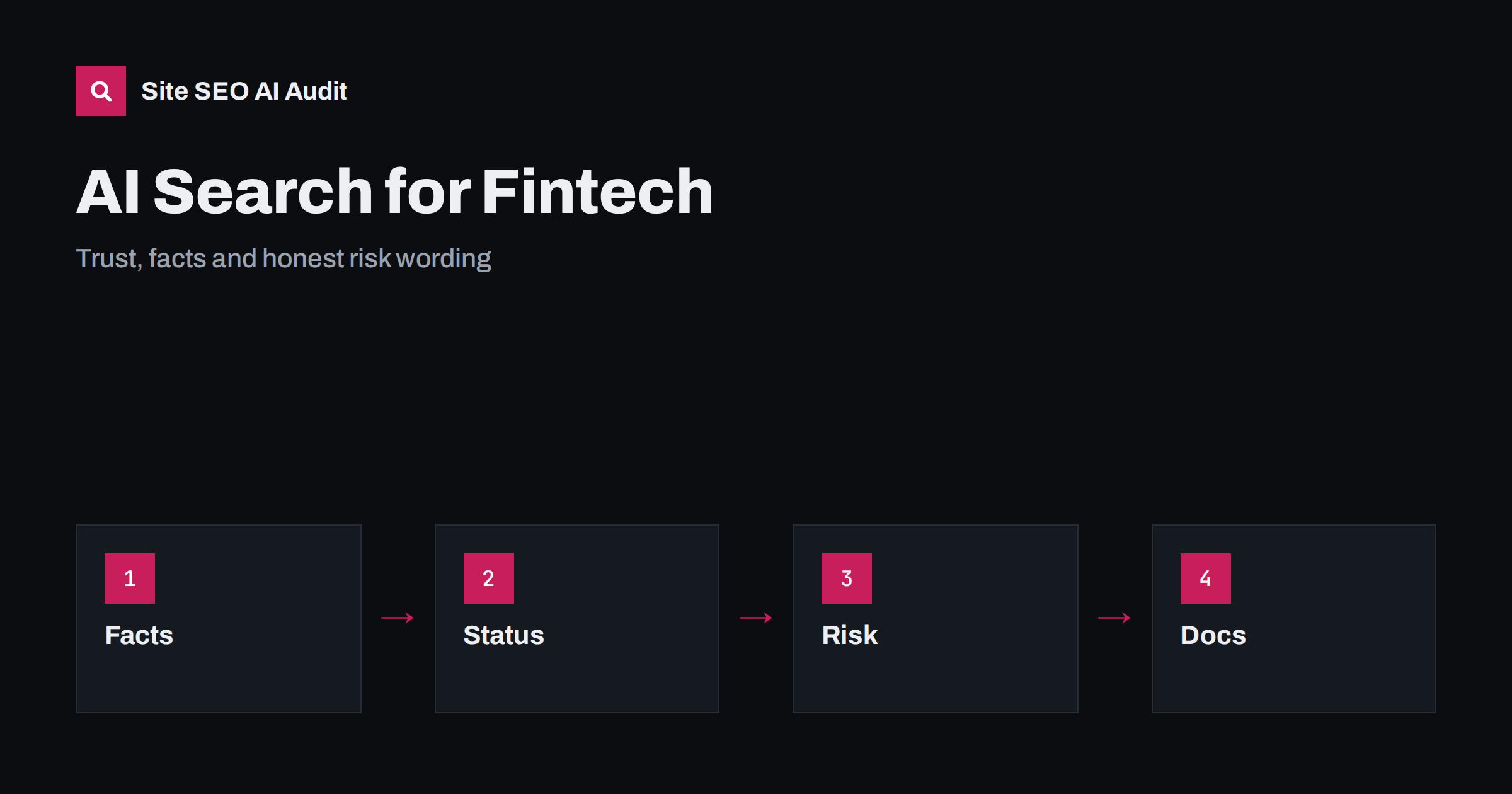
Short answer: Money is a sensitive subject, so AI assistants are careful about which financial companies they name. A fintech, payment or crypto business is more likely to be cited when its pages state exactly what the product does, who may use it, which fees and limits apply, which regulator or licence covers it, what the risks are and who is behind the company. Clear facts, cautious wording, dated information, accurate documentation and consistent details across the web matter far more than clever phrasing or bold promises.
Financial topics belong to the category that search engines call your money or your life: errors can cause real harm, so quality standards are high. Assistants tend to prefer established sources and to avoid recommending products they cannot verify. For a young company this is a challenge, but it is also a chance. A business that publishes plain, complete and honest information can stand out among sites that rely on slogans. This guide covers the pages and details that help, without suggesting any claim you cannot support. For the general approach to sensitive subjects, see the guide to YMYL topics and AI search.
Explain what the product is and is not
Start with a precise description. Is it a payment processor, a wallet, a lending service, a trading platform, an invoicing tool, an exchange or a software layer for banks? Who is the customer: consumers, small businesses or enterprises? Which countries are supported and which currencies? What can the customer do on day one and what requires verification? Avoid vague words such as revolutionary or seamless, and state the function in the first paragraph of the home page and of each product page.
Be careful with terms that have legal meaning, such as bank, deposit, insured, guaranteed, regulated or custody. Use them only when they are accurate and, where needed, explain the exact meaning. If your company works with a licensed partner, name the partner role honestly and avoid implying that your own company holds the licence. An assistant that repeats a misleading phrase from your site can create a legal and reputational problem for you, which is part of the risk covered in the guide to wrong information from AI about a business.
Publish fees, limits and conditions clearly
Questions about cost are among the most common: what does it charge per transaction, are there monthly fees, how long do transfers take, what are the limits, what happens in a dispute. Put the answers on a visible pricing or fees page with dates, and avoid hiding conditions in a file that cannot be read. If fees depend on a country, volume or payment method, show the structure in a table, and add an example calculation. A page like this is also useful for users, and it follows the principles in the guide to pricing page SEO.
Keep the date of the last review near the fee information and update it whenever the terms change. Outdated numbers are risky in this field. If an assistant quotes an old fee from your site, the visitor will be disappointed or misled. The general rule for dates is described in the guide to content dates and freshness.
Show your regulatory status and who is behind the company
Trust grows when a visitor can see who operates the service. Provide the legal name of the company, its registration number, its address, the names of key people where appropriate, and the licence or registration status with the name of the supervising authority and a reference that can be checked. Place this in the footer or on an about page, and link to the official register if one exists. Do not claim approval that you do not have, and do not use phrases that blur the difference between registration and authorisation.
For a new company, honesty is better than decoration. If you are waiting for a licence, say so. If you work under a partner, say how. People and assistants alike can detect a missing explanation. Add author names and credentials to educational articles, as discussed in the guide to author pages and bylines, and reflect the entity consistently using the guide to Organization schema.
Write risk warnings that are real
Financial and crypto products carry risk, and good pages say so plainly. Explain that values can fall, that past results do not predict the future, that funds may not be protected by a deposit scheme, that some assets are volatile and that transactions on some networks cannot be reversed, where these statements are true for your product. Place the warning near the claim, not only in a footer. Do not offer personal advice unless you are authorised to do so, and separate education from promotion.
Avoid headline promises about returns, guaranteed profit or risk-free gains. Such wording harms trust, may break advertising rules in many places and gives assistants a reason to avoid you. Cite sources for market facts and regulatory statements, using the practices in the guide to citing sources. Compare your approach with the broader sector guidance in the guide to AI search for finance and insurance.
Make documentation and help content precise
Many fintech buyers read documentation before they sign up: API references, integration guides, security notes, compliance pages and status information. These pages are often cited when assistants answer technical questions. Keep them in plain HTML that crawlers can read, with stable URLs, version numbers and dates, and clear examples. A help center that answers account questions, such as how to verify an identity or why a payment is pending, reduces support load and gives assistants exact wording. See the guide to help center content for AI answers for the structure.
Do not hide the key product pages behind a login or a script that renders nothing without a browser. If the documentation lives in a separate app, check that it is crawlable and that the canonical URLs point where you expect, as explained in the guide to JavaScript content and AI crawlers.
Handle security and trust pages
Buyers ask how data and funds are protected. A security page should describe real controls in simple language: how data is encrypted, how access is managed, how often systems are tested, how incidents are reported and what certifications or audits exist, if any. Do not exaggerate. Use specific, verifiable statements and date them. Avoid listing logos that you are not entitled to display. If you have a public status page or a vulnerability reporting policy, link to it.
Answer the comparison and how-to questions
People rarely ask only whether a company exists. They ask how it compares with a bank transfer, whether a payment service suits a small online shop, what documents are needed to open an account, how to move funds between wallets safely, or how to reconcile payments in accounting software. Build pages that answer such questions honestly. A comparison page should name the criteria, describe where your product fits and where it does not, and avoid disparaging competitors. Explain the steps of onboarding, including identity checks, and why they exist.
Use real examples with simple numbers: a small business receiving payments from three countries, a freelancer paid in several currencies, a platform that splits payments between sellers. Examples make the abstract product concrete and give assistants text that fits natural questions. Mark clearly where an example is illustrative and not an offer.
Avoid thin pages for every currency, coin or country
Financial sites often generate hundreds of near-identical pages for each currency pair, token or country. If each page has only a changing price and a template sentence, the pages are thin and repetitive. Create such pages only when you can add real, useful content: current rules, specific limits, local payment methods, supported features and honest notes. Otherwise combine them into stronger pages. The risk of weak templates is explained in the guide to programmatic SEO templates. For live price data, say clearly where the data comes from and when it was updated.
Keep reviews, press and third-party facts consistent
Assistants gather impressions from many places: review sites, news articles, forums, regulator registers and social media. If those places contradict your site, the answer may be hedged or negative. Check the company description, the founding year, the headquarters, the product list and the supported countries on every profile you control. Respond calmly to complaints, since an unanswered complaint is visible. The wider topic is covered in the guide to reviews and reputation. Avoid fake or purchased reviews entirely, because they create a serious risk for a financial brand.
Terms, privacy notices, risk disclosures and complaint procedures should be easy to find and readable. They are required in many places and also signal seriousness. Decide whether each legal page should be indexed, as explained in the guide to legal pages and indexing, and keep the versions dated. If you operate in several countries, show the right terms for each, with clear links between versions and a note on which entity serves which region.
Site SEO AI Audit crawls your website and checks status codes, titles, descriptions, headings, broken links, structured data, page speed and AI visibility settings such as AI crawlers in robots.txt, which helps you keep product, pricing and documentation pages crawlable and consistent. It does not review regulatory claims or advise on compliance. The first audit of up to 200 pages is free, and larger sites can see the pricing page.
Related reading
The bottom line
State the facts, the fees, the status and the risks plainly, and keep them current.
FAQ
Why are financial sites treated more strictly?
Mistakes in this field can cause real loss, so assistants and search engines look for strong signs of accuracy, expertise and accountability.
Should I publish my licence number?
Yes, if you hold a licence or registration. Name the authority and link to the official register so that it can be checked.
Can I use words like safe or guaranteed?
Only when they are accurate and allowed in your market. Prefer specific facts about how funds and data are protected.
Is documentation important for AI search?
Yes. Technical buyers ask detailed questions, and well-structured, dated documentation gives assistants exact answers to cite.
Do I need separate pages for each country?
If terms, fees or regulation differ, yes. Show the correct version clearly and link the versions to each other.