ENEnglish
 LTLietuviškai
 DEDeutsch
 FRFrançais
 RUРусский
 ESEspañol
 PLPolski
 ITItaliano
 UKУкраїнська
 CSČeština
 PTPortuguês
 JA日本語
JA日本語 LVLatviešu valoda
 ETEesti
 HUMagyar
 IDBahasa Indonesia
 TRTürkçe
 HIहिन्दी
 ELΕλληνικά
 ARالعربية
 THไทย
THไทย VITiếng Việt
 RORomână
 MSBahasa Melayu
 BNবাংলা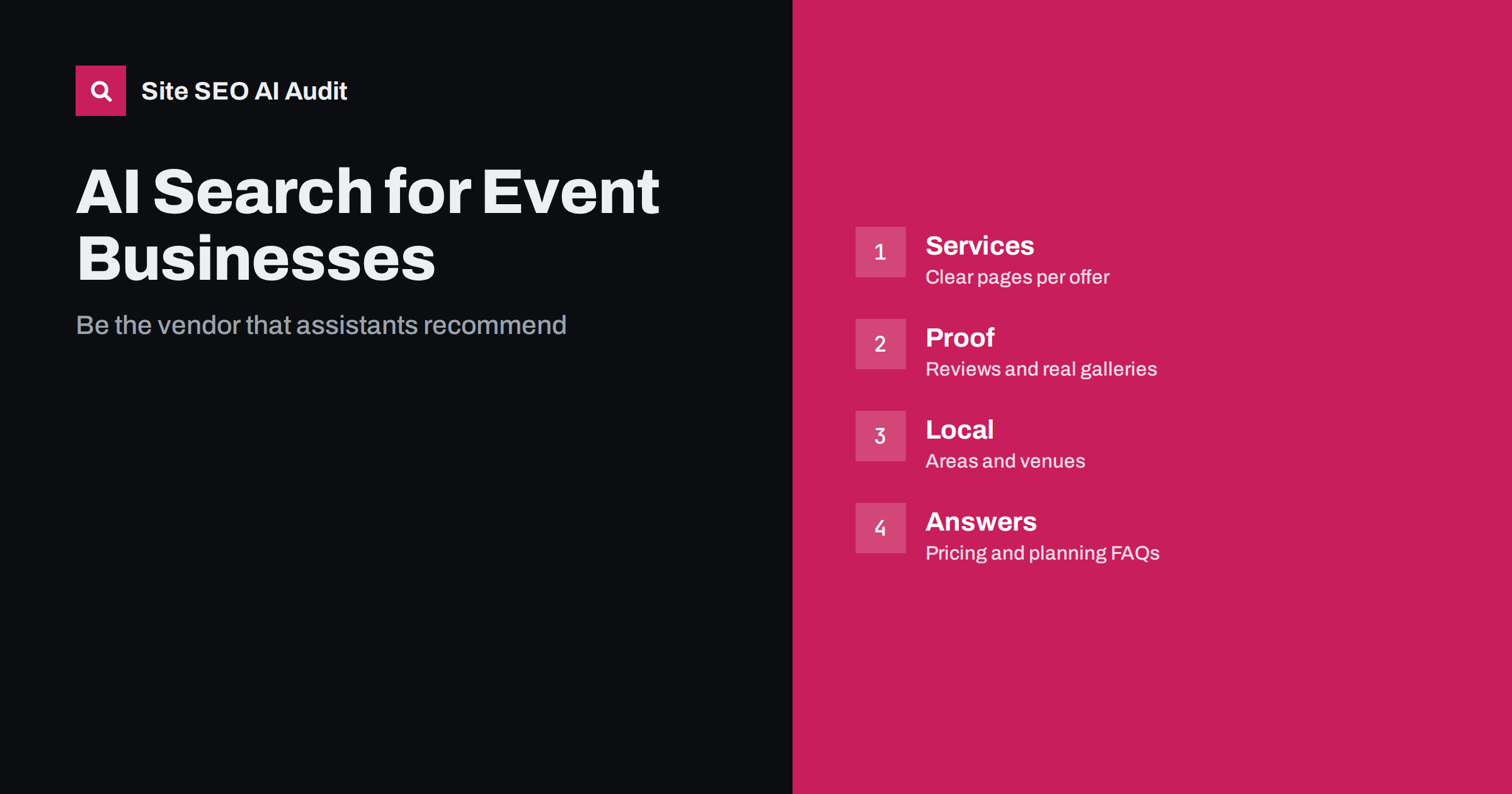
Short answer: Event planners, photographers, florists, caterers, venues and other wedding vendors are recommended by AI assistants when their pages clearly say what they offer, where they work, what it costs or how pricing works, and who vouches for them. Publish one page per service and area, add real galleries with captions, keep your business profiles consistent, answer planning questions in plain text, and check regularly how assistants describe you.
People now ask assistants questions such as “who can photograph a small wedding in a forest venue” or “what should a corporate event planner include in a quote”. The reply often names a few businesses. Event work is personal, visual and local, which makes it hard to explain in a few words, so assistants lean on the pages and profiles that are easiest to read. Many creative businesses have beautiful portfolios built from images and sliders and almost no text. To a crawler, that site says very little. This guide shows what to publish so the facts behind your work are readable by both people and machines.
Understand how assistants choose vendors
AI search systems combine search results, directories, reviews and the pages of businesses to build an answer. They look for matches with the request: service type, event size, style, place, date constraints and budget. They prefer businesses where these details appear in clear sentences on more than one trusted source. A gallery of images with a name and a contact form leaves them guessing. See how AI search engines work for the basics, and local business AI search for the place-based part.
Build a clear page for each service
Give every main service its own page rather than listing everything on the homepage. A planner might have pages for full wedding planning, day-of coordination, corporate events and private parties. A photographer might separate weddings, portraits, family sessions and commercial work. Each page should answer:
- What exactly is included, and what is not?
- Who is it for, such as the size of the event, style or type of client?
- How does the process work from first message to delivery?
- How long does it take, and when should clients book?
- How is pricing structured? A starting price or a range helps, and so does an explanation of what changes the price.
Start the page with a short answer in the first lines. See answer-first introductions. Keep names consistent, for example always “wedding photography” rather than switching between several terms, and keep the style of service pages similar. For structure tips, read service page SEO.
Show proof with real work and real words
Trust is the deciding factor in this field. Assistants and clients both look for evidence that you have done the work well. Useful proof includes:
- Full event stories rather than single photos: venue, number of guests, season, challenge and result.
- Captions and alt text that describe the scene in plain words. See image alt text and file names and captions.
- Reviews on trusted platforms and, with permission, quotes on your site that name the type of event.
- Credits to the venues and partners you worked with, with links where they are happy to be linked.
- Publications, awards or memberships, with dates and the source.
Only publish what is true and can be checked. A page full of unsourced superlatives does not help and can damage trust. Reviews are covered in reviews and reputation in AI recommendations, and the portfolio format in portfolio and gallery pages.
Be precise about places and venues
Event businesses are often searched by city, venue or region. List the areas you serve and say how travel is handled. Create pages for the venues you work at often, for example a guide to photographing a wedding at a named venue, written from experience. Include practical details like light conditions, timing, permits and recommended spots. These pages attract both searches and assistant answers because few sources have first-hand notes. Keep your business name, address or service area and phone number identical across your site and profiles. If you serve several cities, read multi-location local SEO and location pages SEO and avoid copying the same text with a different city name.
Answer planning questions in plain text
Clients ask the same things before booking, and assistants repeat the answers. Write short pages or sections for:
- How far ahead should I book for each season?
- What does a typical package cost, and what affects the price?
- What is the payment schedule and the cancellation policy?
- What happens if the weather is bad or the event is postponed?
- How many guests or hours does each package suit?
- When will the photos or final plan be delivered?
Use headings that match the question and give the answer first. A visible FAQ block is useful, and matching markup can follow; see FAQ sections for AI answers. Do not publish promises that you cannot keep, and make sure the policies on the page match the contract you send.
Make the site readable to crawlers
Sliders, background images and text inside images are invisible or unclear to crawlers. Put the important words in the HTML, keep galleries crawlable, and avoid hiding services behind scripts. Make sure AI crawlers are allowed in your robots file if you want them to read your pages. See AI crawlers and robots.txt and semantic HTML for AI search. Large galleries can slow a page, so use modern formats and lazy loading wisely; see lazy loading and SEO. Add structured data for your business and, where it fits, for events you host; see structured data for AI search.
Keep your profiles and mentions consistent
Assistants cross-check your site with directories, maps, social profiles, vendor lists and venue pages. Mismatched names, old addresses or outdated services cause confusion. Update each profile when something changes, and ask partners such as venues and planners to link to your correct page. Mentions without links also count as signals; see unlinked brand mentions and AI. If the assistant repeats a wrong fact about you, work through what to do when AI gives wrong information about your business.
Check how assistants describe you
Once a month, ask several assistants the questions your clients ask, with your city and service type. Record whether you are named, how you are described, which pages are cited and which competitors appear. Fix missing facts on your site first. Then use a site audit to confirm that the technical basics are in place. Site SEO AI Audit has a dedicated AI visibility area that looks at AI crawler rules, the llms.txt file, content that needs JavaScript, and structure and dates that answers quote. The first audit of up to 200 pages is free, enough for most small business sites. A checklist is in the AI search visibility checklist.
Build a small monthly routine so the work does not stop after launch. In the first week, add one new real event story with photos, captions and a short summary of the brief, the venue and the outcome. In the second week, answer one planning question in depth, such as how to build a timeline for a ceremony held at two locations. In the third week, ask a recent client for a review on the platform they prefer and thank those who already left one. In the fourth week, check your profiles, opening hours, service areas and links, then run your set of test questions on assistants. Over a year this adds a dozen strong pages and a steady flow of fresh proof, which is more convincing than a single large redesign.
Seasonality deserves its own plan. Many event businesses have a busy season and a quiet one, and searches for planning start months before the date. Publish guides ahead of the season, such as what to book first for a summer wedding or how to prepare for a winter corporate party, and update availability notes so that assistants do not repeat outdated information. Keep your off-season pages live, since people research long before they book. Finally, write for the client who has never hired a vendor before: explain terms, avoid jargon and show the steps. Clear, friendly explanations are exactly what assistants prefer to quote.
Related reading
- AI search for local businesses
- An AI search plan for small businesses
- Service page SEO
- Portfolio and gallery pages for SEO
The bottom line
Assistants recommend event and wedding vendors they can describe with confidence. Give each service a clear page, show real work with captions and reviews, state your areas and pricing logic, answer booking questions plainly and keep every profile consistent. Then check the answers regularly and fix what is wrong at the source.
GYIK
Do I need a blog to appear in AI answers as a wedding vendor?
Not necessarily, but helpful guides based on real experience, such as venue notes and planning timelines, give assistants more to quote than a portfolio alone.
Should I publish prices?
Publishing a starting price or a range, with an explanation of what changes it, helps both clients and assistants. If you cannot show prices, explain how quotes are built.
Are image galleries bad for AI search?
No, but images need captions, alt text and nearby text. A gallery without words tells crawlers very little about what you do.
How important are reviews?
They are important trust signals. Collect them on well-known platforms, respond to them and keep the content on your site consistent with what reviewers say.
How can I tell if assistants mention my business?
Ask the questions your clients ask, in your city, on several assistants once a month, and keep notes. Compare the answers with your pages and fix gaps.