ENEnglish
 LTLietuviškai
 DEDeutsch
 FRFrançais
 RUРусский
 ESEspañol
 PLPolski
 ITItaliano
 UKУкраїнська
 CSČeština
 PTPortuguês
 JA日本語
 LVLatviešu valoda
 ETEesti
 HUMagyar
 IDBahasa Indonesia
 TRTürkçe
 HIहिन्दी
 ELΕλληνικά
 ARالعربية
 THไทย
 VITiếng Việt
 RORomână
 MSBahasa Melayu
 BNবাংলা
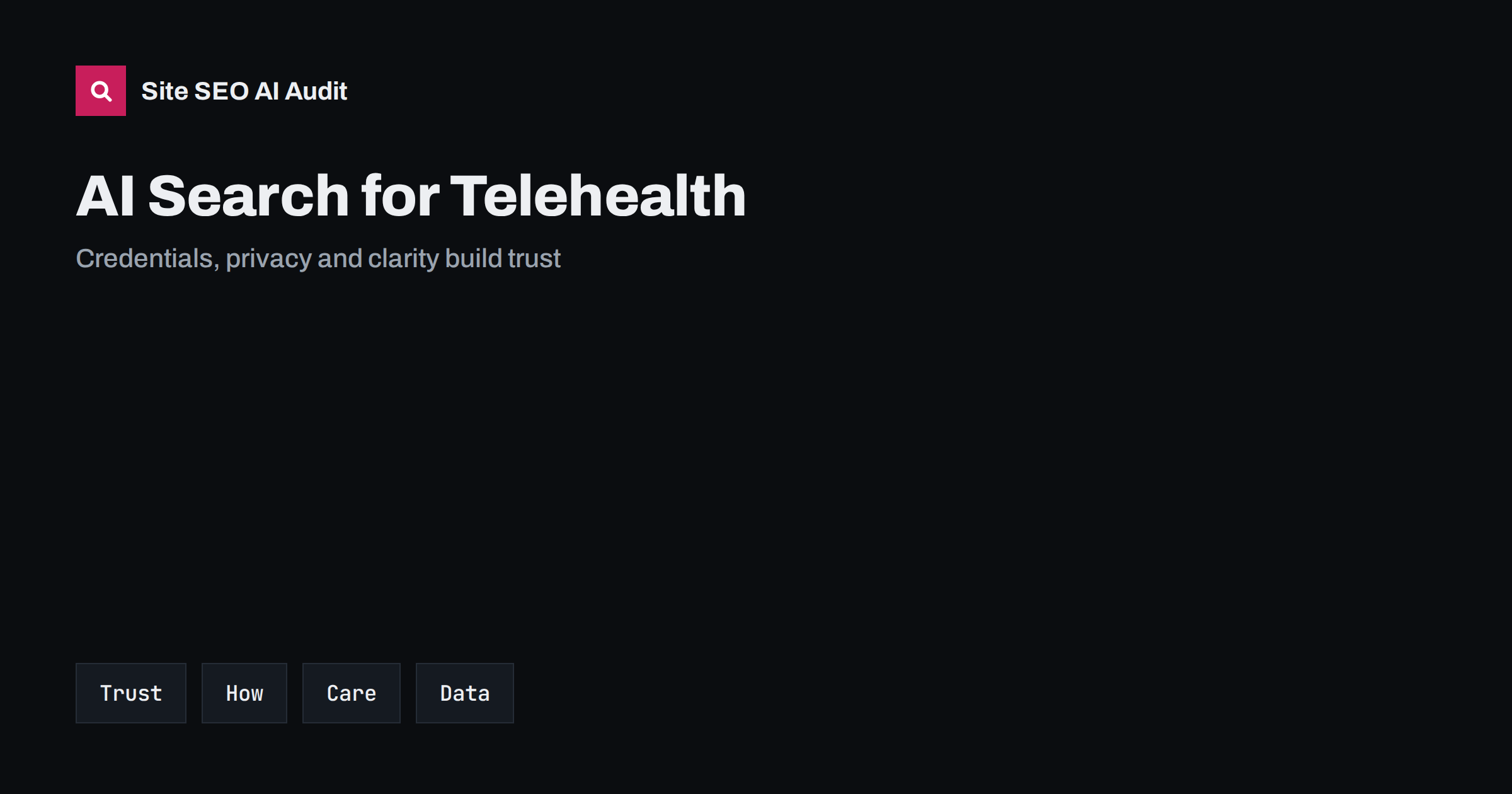
Short answer: People ask AI assistants which online doctors or therapists to use, how remote care works and whether it is safe, private and affordable. Telehealth and online therapy providers are more likely to be named when their site shows who they are and what qualifications they hold, explains clearly how a consultation works, states the conditions they treat and those they do not, covers privacy and emergencies honestly, publishes pricing and the regions they serve, and keeps health content reviewed by qualified people. Trust signals matter more than keywords.
Remote care has become normal for many routine needs: prescriptions renewals, skin checks, mental health support, follow-up visits, sleep and nutrition advice. People who are new to it have many questions, and they increasingly ask an assistant. How does an online appointment work? Is it as good as a visit? Who are the professionals? Is my data safe? What does it cost, and can I use insurance? Health is a sensitive topic where search systems are cautious, so the providers that appear are those that look reliable and give clear, accurate information. This guide covers what to build. For the general rules of sensitive topics, read the guide to sensitive topics in AI search.
What people ask about remote care
Questions follow the stages of a decision. People first ask whether online care is suitable for their problem and when to see someone in person. Then they compare providers: licensed or not, which professionals, which specialities, which languages, how fast an appointment can be found. They ask how a session works, what technology is needed, what happens if the connection fails and how prescriptions or referrals are handled. Finally they ask about price, payment, insurance, privacy and what to do in an emergency.
Write a page for each of these concerns. Use the words that patients use, give the direct answer in the first sentence and add detail below, as in the guide to answer-first introductions. For clinics with physical premises, see also the guide to AI search for healthcare clinics.
Show who is behind the care
The strongest signal is real, checkable identity. Publish pages for the professionals with their names, photos, roles, qualifications, licences or registration numbers where this is customary, the regions where they are licensed to practise and their areas of experience. Link to the professional registers in which they can be checked. Describe the organization too: who owns it, where it is registered, how it is regulated and how to contact it by more than a form.
Do not use vague claims such as the best doctors or leading experts. State facts: years of practice, specialisation, languages and the type of patients. This is the evidence that assistants and readers look for, as explained in the guide to E-E-A-T and AI search. If staff change, update the pages promptly, and remove anyone who has left.
Explain how a consultation works
A page named How it works can answer a large part of the questions. Describe the steps: choosing a service, booking, completing any forms, the technology needed, the format of the appointment, the length, what the professional can and cannot do remotely, how notes and prescriptions are handled and what follow-up is available. Add a short section on what to prepare, such as a quiet place, a list of medicines or photos for a skin issue. Use simple pictures or screenshots of the booking and the video call, and explain the options for people with limited technical skills or accessibility needs.
Be honest about the limits. Say which problems are not suitable for remote care and what the patient should do instead. A visible note on what to do in a medical or mental health emergency, with the right emergency numbers for the countries you serve, is essential, not optional.
Scope, conditions and safe content
Create a page for each service or condition that you really treat, with a plain explanation, who it suits, how the provider approaches it, what the process involves and when to seek urgent or in-person care. Mark the date and who reviewed the page, with their credentials. Cite reliable sources such as public health bodies and guidelines, and link to them. Avoid promising cures or particular results, avoid before-and-after claims and follow the advertising rules for health services in each country. If you cover medication, describe it carefully and say that decisions belong to the treating clinician.
Review all health content on a schedule. Medical guidance changes, and old advice is a risk. A page that shows a recent review date and a named reviewer is easier to trust, in line with the guide to content dates and freshness. For general health writing, see the principles of the guide to AI search for pharmacies and health products.
Privacy, data and security
Patients worry about who sees their information. Explain in plain words what data you collect, why, how long you keep it, who has access and how it is protected, and link to the full privacy policy. Describe how video sessions are secured, whether sessions are recorded and how records can be requested or deleted. Mention the laws that apply to your service, and say what rights patients have. Do not claim a certification or compliance that you do not hold, and do not use words like fully secure, which cannot be proved.
Technical security also supports trust: use HTTPS everywhere, keep the booking and login areas out of the index and keep scripts from third parties to a minimum on pages that handle health data. See the guide to HSTS and security headers. Be careful with tracking tools on pages where visitors describe symptoms, and respect consent rules, as covered in the guide to cookie banners and consent.
Pricing, insurance and regions
Cost is among the first questions. Publish the price of each type of appointment, what is included, how payment works, cancellation terms and whether insurance or public health systems cover the service. If prices differ by country or clinician, say so, and show them clearly. Avoid hidden fees and unclear subscriptions. If you offer plans, describe what they include and how to stop them, following the structure in the guide to pricing page SEO.
State exactly where you can provide care. Licensing rules differ by region, and a provider can usually treat patients only in places where its professionals are allowed to practise. Create pages for each country or region you serve, with the right rules, languages and emergency information, and avoid duplicates that only change the place name. See the guide to multi-country local SEO.
Reviews, outcomes and honesty
Patient reviews influence choices, but health reviews need care. Do not publish testimonials that make medical claims, and follow the rules on health advertising and privacy. Invite honest feedback through independent platforms and respond politely without revealing any private information. Never offer incentives that bias reviews. If you publish outcome data, show how it is measured and what it means, with the limits.
Consistency matters. Make sure that the names, addresses, licences, services and prices on your site match your profiles on maps, directories, app stores and professional registers. The method is in the guide to business profile and website alignment. See also the guide to reviews and reputation.
Technical and structured data
Use clear page types: a services page, a professional page, a condition page, an article page and a contact page. Add organization and local business markup with the correct details, and mark up the professionals in a way that matches the visible page. Take care with medical markup: use it only when it describes your content accurately, and test it, as in the guide to fixing structured data errors. Make sure that the pages load fast on phones, and that important content is available without scripts, which is also important for AI crawlers; see the guide to JavaScript content and AI crawlers.
Here is a short example. An online therapy service had a site with a booking form and a few general statements. Assistants rarely named it. The service added pages for each therapist with registration details, a clear How it works page, a page on emergencies and limits, a reviewed article for each main concern and a transparent price table. It also fixed inconsistent details on its profiles. Over the next months, it began to appear in answers to questions on how online therapy works and who offers it in its regions.
Site SEO AI Audit crawls your website and checks status codes, titles, descriptions, broken links, structured data, page speed and AI visibility settings such as AI crawlers in robots.txt, which helps you keep information pages fast and error-free. It does not review medical content or check licences. The first audit of up to 200 pages is free, and larger sites can see the pricing page.
Related reading
The bottom line
Show real credentials, explain the care and its limits, and keep every health page reviewed.
DUK
What is the most important trust signal for a telehealth site?
Checkable professional identity: names, qualifications, registration and the regions in which each person may practise.
Should I publish medical articles?
Yes, if a qualified person reviews them, they cite reliable sources and they show a review date. Avoid promises of results.
How do I handle emergencies on the site?
Show a clear note with the right emergency numbers for each country you serve, and say what the service cannot do.
Can I use patient testimonials?
Only within the advertising and privacy rules that apply to you, and without medical claims. Independent review platforms are often safer.
Do I need separate pages for each country?
If rules, prices or languages differ, yes. Write each page for its real situation instead of changing only the place name.