ENEnglish
 LTLietuviškai
 DEDeutsch
 FRFrançais
 RUРусский
 ESEspañol
 PLPolski
 ITItaliano
 UKУкраїнська
 CSČeština
 PTPortuguês
 JA日本語
 LVLatviešu valoda
 ETEesti
 HUMagyar
 IDBahasa Indonesia
 TRTürkçe
 HIहिन्दी
 ELΕλληνικά
 ARالعربية
 THไทย
 VITiếng Việt
 RORomână
 MSBahasa Melayu
 BNবাংলা
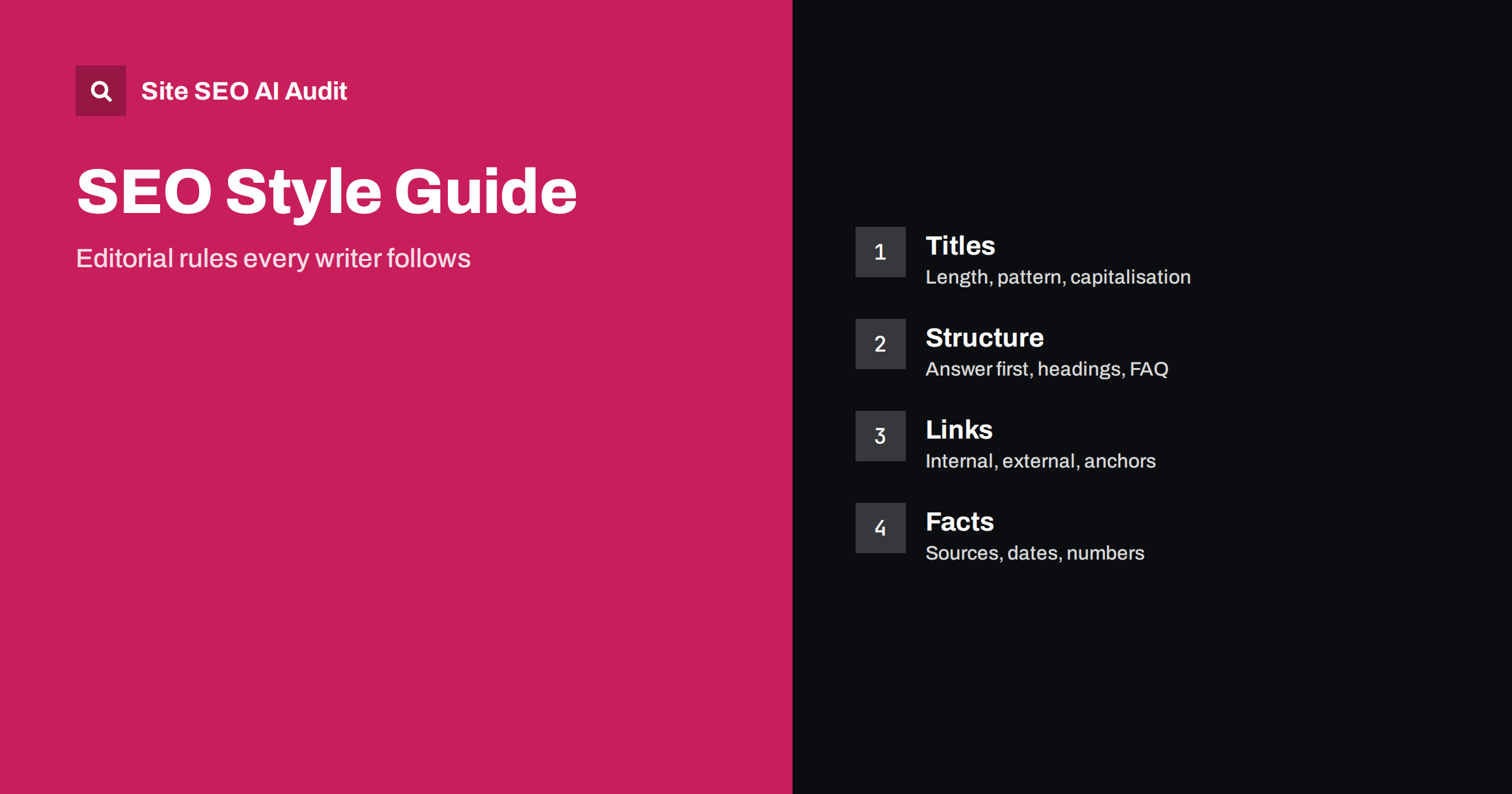
Short answer: An SEO style guide is a short document that tells every writer how a page on your site is built: title and meta description rules, heading structure, how the first paragraph answers the question, how to link internally and externally, how to format lists and tables, how to cite sources and dates, and what the house tone is. It exists so that a blog written by five people reads like one site, so that technical requirements are met without a checklist for each article, and so that quality does not depend on who happened to write the piece. Keep it to a few pages, give examples, and enforce it with a template and a review step.
Most content problems that show up in an audit are not creative failures; they are consistency failures. One writer puts the keyword in the title, another writes a clever headline that says nothing. One article has a FAQ, the next has none. Internal links point to the same three pages because nobody knows what else exists. Dates are missing, numbers have no source, and headings jump from H2 to H4. A style guide fixes these issues at the source. This guide explains what to include, how to make the rules usable rather than bureaucratic, and how the rules connect to rankings and to citations in AI answers. It complements the per-article brief described in SEO content briefs for writers.
What a style guide is for
A brief tells a writer what one article should cover. A style guide tells every writer how every article is built. The two should not be confused, and the style guide should not try to repeat the brief. Its job is to remove decisions that do not need to be made each time: how long a title is, whether to use sentence case, whether to write “e-commerce” or “ecommerce”, how to format a date, where the call to action goes. Removing those decisions speeds up writing, makes editing faster and makes the site look deliberate to readers and to search engines, which reward consistent structure with better understanding of each page.
A practical outline that fits most sites has eight parts: purpose and audience of the blog; titles, descriptions and URLs; page structure; links; facts, sources and dates; tone and vocabulary; images and formatting; and the publishing checklist. Each part is a page or less. Write it once with examples drawn from your own best articles, so that writers see the rules applied to real pages rather than abstract instructions. Store it where the writers work, next to the template, and link to it from every brief. A guide kept in a shared drive nobody opens has the same effect as no guide at all.
Titles, descriptions and URLs
This is the section writers consult most, so make it concrete. State the title length range, the pattern you use, such as “topic: specific promise”, the capitalisation style, whether numbers and years are allowed, and whether the brand name is appended automatically. Give three examples of good titles and one of a bad one. Do the same for meta descriptions: length, that they describe what the page delivers, that they include the main term naturally and that they are not a copy of the first sentence. For URLs, specify lowercase, hyphens, a maximum number of words, no stop words unless meaning requires them and no dates. The reasoning behind each rule is in the title tag writing guide, the meta description guide and SEO-friendly URL slugs; the style guide only needs the rules and examples.
Structure of a page
Define the skeleton every article follows. A typical one: a short answer or summary in the first paragraph, an introduction that explains who the page is for, six to nine H2 sections with descriptive headings, H3 only inside an H2 and never skipping levels, a conclusion, a FAQ with four to six questions that people really ask, and a related reading list. State the expected length range and that length follows the subject, not a quota. Give rules for lists versus paragraphs, when to use a table, and the maximum number of tables. Explain that headings should say what the section contains, not tease it. The reasons for an answer-first opening and for heading discipline are explained in answer-first introductions and heading structure for SEO.
Links and anchors
Internal links are where consistency pays off most. Specify a minimum number of in-body internal links, that anchors describe the target page, that each article links to at least one product or service page, and that related reading lists use the full title of the target. Keep a current list of hub pages that writers should link to for each topic, and update it as the site grows. For external links, set a maximum per article, require reputable sources, and state when nofollow or sponsored attributes apply. Forbid links to competitors’ commercial pages unless the brief asks for a comparison. The underlying principles are in internal linking strategy and anchor text best practices.
Facts, sources, dates and numbers
Accuracy rules protect the site’s reputation and its chances of being cited. Require that every statistic has a named source and, where possible, a year; that claims about your own product match the live product pages; that prices and limits are checked on the day of writing; and that the article shows a publication date and a visible updated date when content changes. State how numbers are written, how currencies and units are formatted, which spelling variant is used and how product names are capitalised. Prohibit invented quotes and vague attributions such as “studies show”. These rules matter more now that AI assistants extract facts and attribute them; a clear, dated, sourced statement is what gets quoted, as explained in writing content that AI answers quote.
Tone, vocabulary and inclusivity
Describe the voice in a few lines with examples: direct or formal, first person plural or neutral, how much humour is acceptable, how to address the reader. List house terms and banned terms, including filler phrases and hype words that make text sound generated. Define how to refer to the company and its products, how to treat competitors, and what to do with jargon: explain it on first use or avoid it. Add a short note on inclusive language and on writing for readers whose first language is not English, which keeps sentences shorter and clearer. Readability rules, such as sentence length and paragraph length, belong here too; see readability and SEO writing.
Images, media and formatting
Specify the cover image size, that covers are unique and not stock-looking, how in-body images are named and captioned, that every image has alt text describing what is visible, and the preferred formats and maximum file sizes. Give rules for embedding videos and for tables, including a header row and a caption. State how code samples, quotes and call-out boxes are formatted, and where the call to action appears. The image rules follow the alt text guide.
Enforcing the guide without slowing writers
A style guide works when it is short, has examples and is built into the workflow. Turn it into a template in the CMS with placeholders for each section. Add a short pre-publish checklist of ten items at most. Assign one editor to check structure, links and facts rather than rewriting prose. Review the guide every quarter against what the audit finds: if duplicate titles or missing FAQs keep appearing, the guide or the enforcement needs to change. When a rule is broken repeatedly, ask whether it is clear and whether the template makes it easy to follow; most violations come from unclear rules, not careless writers. Keep a short changelog at the top of the guide so that returning freelancers see what changed since their last piece. Run a site audit after each batch of articles to catch the problems that slipped through. Site SEO AI Audit crawls the site, scores seven areas and ranks the fixes by impact; the first audit of up to 200 pages is free, and the pricing page covers regular re-audits for larger blogs.
Related reading
- SEO Content Briefs: What to Give Your Writers
- SEO Content Calendar: How to Plan a Quarter of Content
- Blog Post SEO Optimization
- On-Page SEO Checklist
The bottom line
A few pages of clear rules on titles, structure, links, facts, tone and media turn a group of writers into one consistent site. Keep the guide short, show examples, build it into a template and a brief checklist, and revise it based on what audits reveal. Consistency is cheap to achieve and is one of the most reliable ways to improve both rankings and the chance of being cited.
FAQ
How long should an SEO style guide be?
Three to six pages. Longer guides are not read. Put details and reasoning in linked articles and keep the guide to rules and examples.
What is the difference between a style guide and a content brief?
The style guide applies to every article and rarely changes. The brief is written for one article and states its topic, audience, questions and target pages.
Should the style guide include keyword rules?
Only general ones: where the main term appears and that it is used naturally. Specific keywords belong in the brief.
How do I get freelancers to follow it?
Send the guide with the first brief, provide a template, and return the first article with specific notes. Most writers adapt within two pieces.
How often should the guide be updated?
Review it quarterly against audit results and reader feedback, and update it whenever the site adds a new content type or template.