ENEnglish
 LTLietuviškai
 DEDeutsch
 FRFrançais
 RUРусский
 ESEspañol
 PLPolski
 ITItaliano
 UKУкраїнська
 CSČeština
 PTPortuguês
 JA日本語
 LVLatviešu valoda
 ETEesti
 HUMagyar
 IDBahasa Indonesia
 TRTürkçe
 HIहिन्दी
 ELΕλληνικά
 ARالعربية
 THไทย
 VITiếng Việt
 RORomână
 MSBahasa Melayu
 BNবাংলা
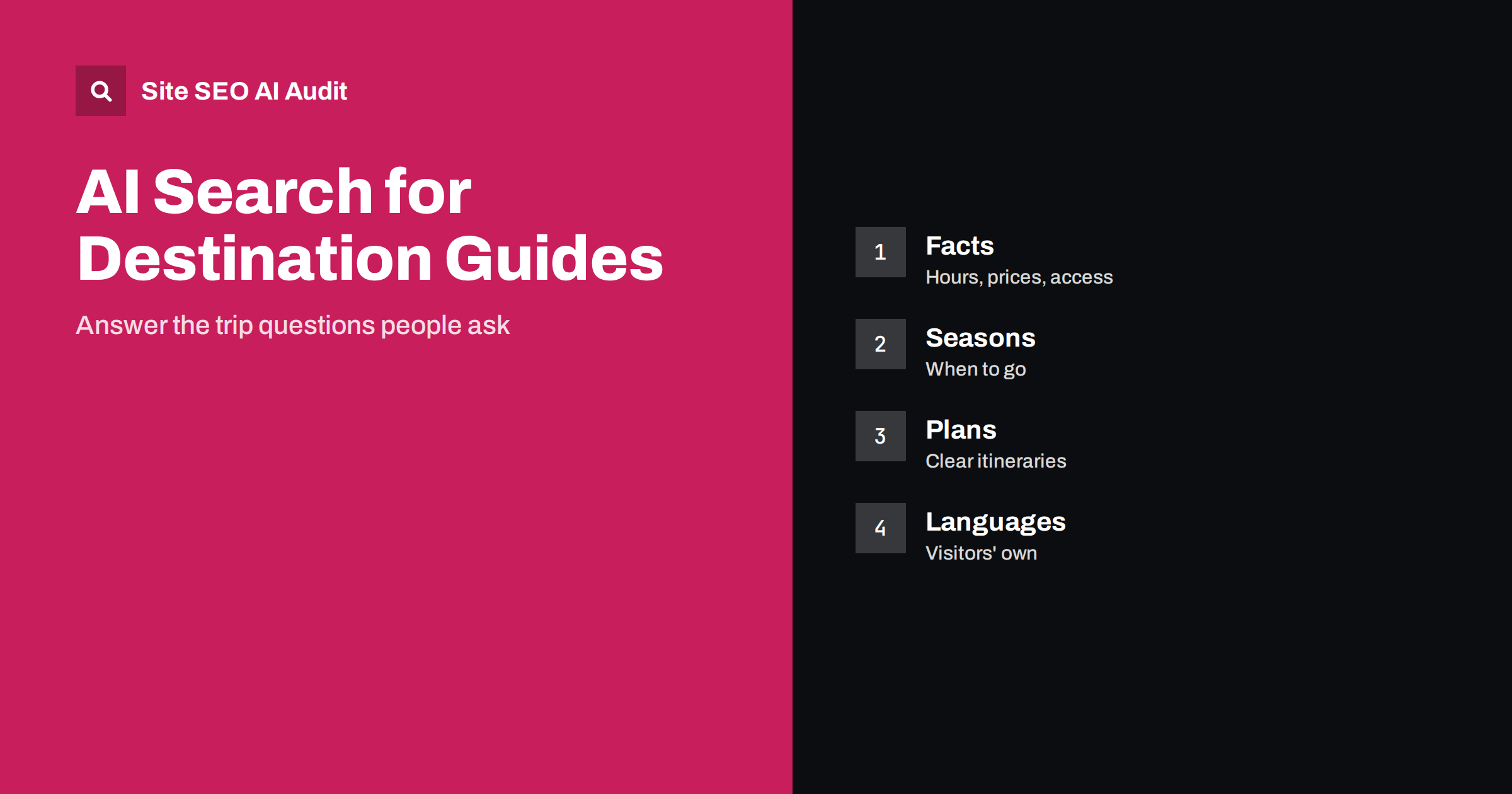
Short answer: Travellers ask AI assistants where to go, what to see, how many days to stay and how to get around. Tourism boards and destination guides can be cited if they publish current practical facts, seasonal advice, clear itineraries, accurate listings of attractions and events, and content in the languages of their visitors. Keep pages dated, maintain each fact in one place and make sure listings match what operators publish themselves.
A destination website has an advantage that commercial travel sites lack: it is the official or closest source for a place. But being official is not enough. Assistants mix information from tour operators, review sites, social posts, news and old blog posts, and they may repeat outdated opening hours or closed attractions. Tourism boards, regional associations and independent destination guides can improve their position by making their own pages the clearest and most current answer. For the general method, see the guide to generative engine optimization.
How travellers ask
Typical questions are planning questions: what to do in three days, where to stay for a family or a couple, the best time to visit, how to travel without a car and what is open in winter. There are also practical questions on the road, such as parking, accessibility, weather alternatives and local customs. Others concern events, from festivals to markets. Each type needs a page that gives a direct answer first and the detail after it, as described in the guide to answer-first introductions.
The answers that assistants give are usually short lists with a few named places. To be among them, your pages must make clear what is special about each place, where it is and what a visitor needs to know.
Publish accurate practical facts
For every attraction, route, beach, museum or trail, give the facts in plain text: address and a map, how to get there, opening days and hours by season, ticket prices where they are set, accessibility, parking, dog and child policies, and the booking method. Show the date of the last check. If the information comes from operators, ask them to send updates regularly and keep a record of who confirms what.
Keep each fact in one place. If prices appear on ten pages, ten pages will be wrong when they change. Use one master page or database and link to it. The same principle for local businesses is described in the guide to business profile and website alignment, and the consequences of wrong facts are in the guide to wrong information about your business.
Cover seasons and timing
Most travel questions involve timing. Create clear pages about each season and month: weather, crowd levels, what is open, which events happen and what to pack. Be honest about quiet periods and closures, because travellers appreciate truthful advice and assistants will quote it. Also provide pages for short breaks, such as a weekend, and for rainy days.
Update these pages every year and keep the address stable. Seasonal pages should not be replaced by new addresses every year, as explained in the guide to seasonal pages. Show the year or the date of review where it matters, in line with the guide to content dates and freshness.
Itineraries and decision help
Itineraries are among the most useful and most quoted content for destinations. Write them as clear sequences: day one, morning, afternoon and evening, with distances and time estimates, transport options and alternatives for bad weather. State who the plan is for, such as families with small children, cyclists or people with limited mobility. Add a map with the stops and, where helpful, a downloadable version.
Comparison and choice content also works: which of two areas suits a first visit, which island to choose for quiet beaches, how to decide between a city break and a countryside stay. Keep the tone helpful and balanced, and describe the downsides. Visitors who find the truth are more likely to trust and return.
Events, culture and local life
Maintain a clear events calendar with dates, places, prices and links to official organisers. Keep past events accessible in an archive or remove them cleanly, and make sure that recurring events have stable pages. See the guide to event pages. Write about local food, traditions and etiquette, since visitors often ask what to try and how to behave. For cultural venues, the advice in the guide to AI search for museums and culture is relevant too.
Include information about local businesses in a fair way. If your site lists restaurants, hotels and guides, give clear criteria for inclusion and keep the details correct. The parallel advice for single businesses is in the guide to AI search for restaurants and the guide to travel and hotel AI search.
Languages for your visitors
Tourism is international by nature, so languages matter. Identify the top markets from your analytics and tourism statistics, and offer the main pages in those languages. Quality is crucial: a poorly translated page with wrong place names or dates harms the image of the destination. Use the names that visitors use, such as common English spellings of local places, and explain the local names too. Link the versions with hreflang and a clear language switcher.
AI assistants answer in the language of the question and may use sources in other languages, so having the same facts in several languages reduces errors. See the guide to AI search in other languages and the guide to multilingual countries.
Technical foundations
Make sure the key pages load fast on mobile networks, since travellers often search on the road. Use markup where suitable, such as organisation, event, place and breadcrumb data, and keep it equal to visible content. Give every attraction its own page with a stable address, and avoid putting essential facts only inside images, PDFs or interactive maps without a text version. Do not block search and AI crawlers by mistake, as described in the guide to AI crawlers and robots.txt.
Provide downloadable material, such as brochures and maps, in a form that is also available as text on the page. Keep a clear contact page for visitor information centres and an accurate profile in business and map listings.
Working with partners
A destination site depends on others: hotels, tour operators, museums, transport companies and local associations. Agree on a shared way to name places and attractions, a regular process to update facts and a clear rule for what you can promise. Ask partners to link to the official pages and to use consistent descriptions. Check from time to time what assistants say about your destination and send corrections to the sources that are wrong.
It is also useful to track which questions your visitor centres receive. They show what people want to know, and each frequent question deserves a clear page.
Measure and review
Choose a few measures that show whether the content works. Look at visits to the key planning pages, searches in different languages, clicks on partner links and booking pages, and the questions that reach visitor centres. Add a short question to an on-site survey about how visitors found the destination, including whether an assistant or a chat tool was involved, and read the free-text answers. They often reveal missing information that no report would show.
Review the main pages before each season. Check the opening times, closed attractions, new routes, price changes and event dates, then update the date shown on the page. Ask a few real or test questions in several languages, such as what to do in two days or where to go in the rain, and note which pages are named. When a good page is missing from the answers, look at how it is linked, how clear its first paragraph is and whether another site gives a clearer version. This routine takes little time and keeps the destination from being described by old information.
Finally, be careful with promises. Do not state that a place is always quiet, always open or the best in the region unless that is true and can be supported. Specific, checkable statements build trust with both visitors and the systems that read your pages.
Here is a short example. A regional tourism association had several pages with different opening hours for the same castle, because each partner entered its own. Assistants gave visitors old hours and some arrived at a closed gate. The association created one master page with seasonal hours, linked all other pages to it and asked the operator to confirm the hours twice a year. Complaints fell and the answers became consistent.
A second example is a small island guide that published a day-by-day itinerary for visitors without a car, with bus times and walking distances. It was quoted often, because few other sources answered that question clearly.
Site SEO AI Audit crawls your website and checks status codes, titles, descriptions, broken links, structured data, hreflang, page speed and AI visibility settings, which helps you find outdated, duplicated or hard-to-crawl destination pages. It does not verify opening hours or manage listings. The first audit of up to 200 pages is free, and larger sites can see the pricing page.
Related reading
- Location Pages and SEO
- Local SEO Across Several Countries
- AI Search for Government and Public Sector Sites
The bottom line
Be the clearest, most current and most honest source for your place, in the languages your visitors use.
FAQ
Why would AI search use a tourism board website?
Because it is a close-to-official source, if its pages are current, specific and easy to read.
What should every attraction page contain?
Address, map, how to get there, opening times by season, prices where set, accessibility, parking, booking details and the date of the last check.
Do I need several languages?
If you have international visitors, yes for the main pages, with careful translation and correct place names.
How can I keep information from partners accurate?
Keep each fact on one master page, ask partners to confirm details regularly and show the date of the last review.
Are itineraries worth the effort?
Yes. They answer the most common planning questions and are easy for assistants to quote.